
Sign In Start Free Trial
Account

Add to playlist

Create a Playlist

Modal Close icon
You need to login to use this feature.
  • Book Overview & Buying Selenium WebDriver Quick Start Guide
  • Table Of Contents Toc
Selenium WebDriver Quick Start Guide

Selenium WebDriver Quick Start Guide

By : Chaubal
4 (3)
close
close
Selenium WebDriver Quick Start Guide

Selenium WebDriver Quick Start Guide

4 (3)
By: Chaubal

Overview of this book

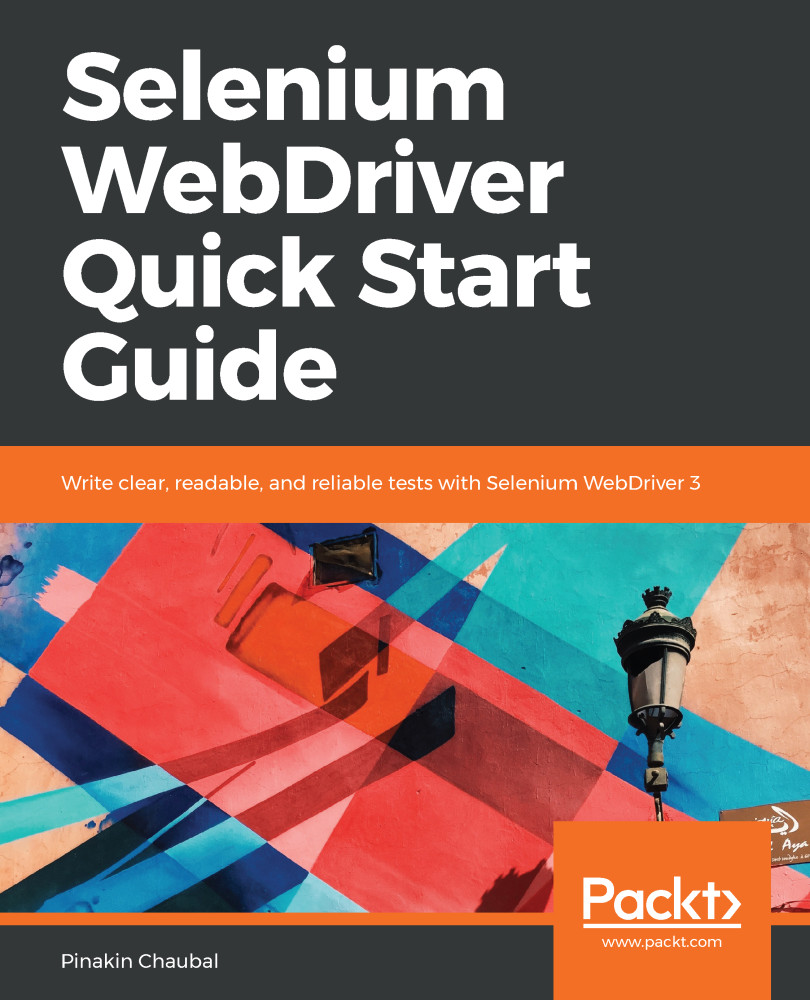
Selenium WebDriver is a platform-independent API for automating the testing of both browser and mobile applications. It is also a core technology in many other browser automation tools, APIs, and frameworks. This book will guide you through the WebDriver APIs that are used in automation tests. Chapter by chapter, we will construct the building blocks of a page object model framework as you learn about the required Java and Selenium methods and terminology. The book starts with an introduction to the same-origin policy, cross-site scripting dangers, and the Document Object Model (DOM). Moving ahead, we'll learn about XPath, which allows us to select items on a page, and how to design a customized XPath. After that, we will be creating singleton patterns and drivers. Then you will learn about synchronization and handling pop-up windows. You will see how to create a factory for browsers and understand command design patterns applicable to this area. At the end of the book, we tie all this together by creating a framework and implementing multi-browser testing with Selenium Grid.
Table of Contents (10 chapters)
close
close

Why is test automation required?

Let's get started by understanding why test automation is needed. Today's agile world needs quick feedback on the code's quality. The developers check-in application code in a source code repository like GitHub. It is imperative that these changes be tested, and the best way to do so is through automation. A test-automation suite can eliminate the mundane work of manual regression testing and can be helpful in finding bugs earlier, thus reducing manual testing time. It can be configured to run at a particular time in the day.

A cut-off time should be provided to the developers, such as 6 P.M. in the evening, by which time they should check in code, get the application build done, and the application deployed to a server like Apache Tomcat. The automation suite may be scheduled to run at 7 P.M. daily. Jenkins is a tool that's used for continuous integration, and so can be used for this purpose.

Advantages of test automation

Advantages of test automation include reducing the burden on the testers doing the manual execution so that they can focus on the functional aspects of the application. Generally, a smoke, sanity, regression test suite is created for this purpose. The advantage of having automatic triggering through Jenkins is that it facilitates test execution in an unattended mode.

CONTINUE READING
83
Tech Concepts
36
Programming languages
73
Tech Tools
Icon Unlimited access to the largest independent learning library in tech of over 8,000 expert-authored tech books and videos.
Icon Innovative learning tools, including AI book assistants, code context explainers, and text-to-speech.
Icon 50+ new titles added per month and exclusive early access to books as they are being written.
Selenium WebDriver Quick Start Guide
notes
bookmark Notes and Bookmarks search Search in title playlist Add to playlist download Download options font-size Font size

Change the font size

margin-width Margin width

Change margin width

day-mode Day/Sepia/Night Modes

Change background colour

Close icon Search
Country selected

Close icon Your notes and bookmarks

Confirmation

Modal Close icon
claim successful

Buy this book with your credits?

Modal Close icon
Are you sure you want to buy this book with one of your credits?
Close
YES, BUY

Submit Your Feedback

Modal Close icon
Modal Close icon
Modal Close icon