


-
Book Overview & Buying
-
Table Of Contents

Mastering Python 2E - Second Edition
By :


Mastering Python 2E
By:
Overview of this book
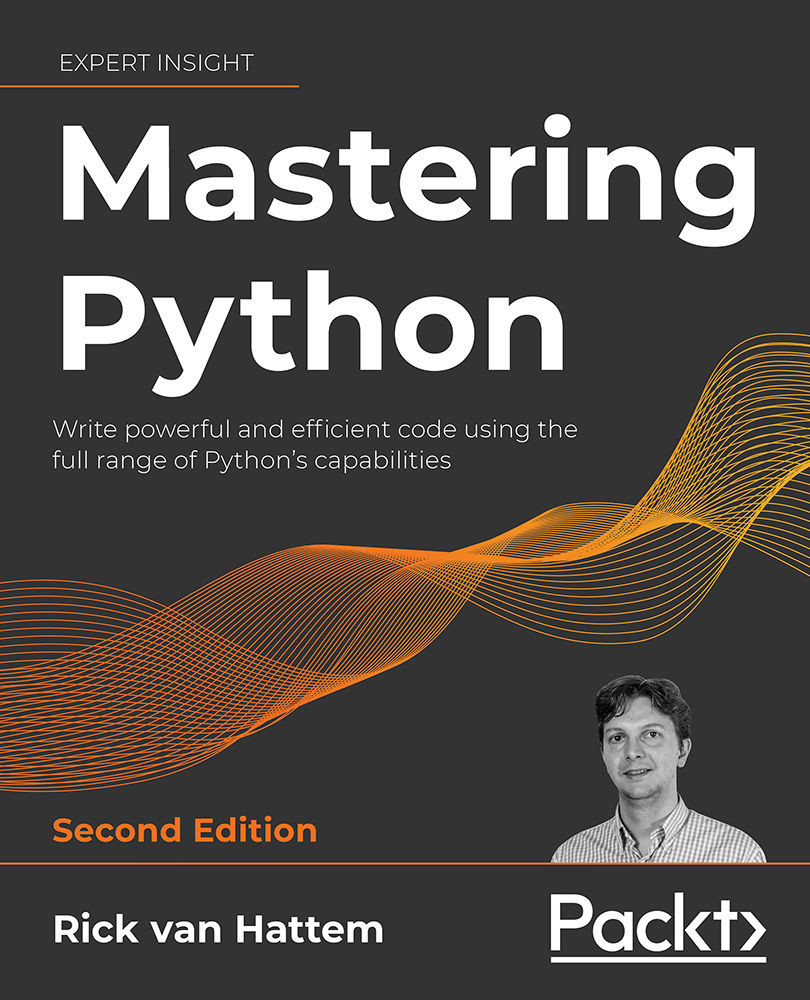
Even if you find writing Python code easy, writing code that is efficient, maintainable, and reusable is not so straightforward. Many of Python’s capabilities are underutilized even by more experienced programmers. Mastering Python, Second Edition, is an authoritative guide to understanding advanced Python programming so you can write the highest quality code. This new edition has been extensively revised and updated with exercises, four new chapters and updates up to Python 3.10.
Revisit important basics, including Pythonic style and syntax and functional programming. Avoid common mistakes made by programmers of all experience levels. Make smart decisions about the best testing and debugging tools to use, optimize your code’s performance across multiple machines and Python versions, and deploy often-forgotten Python features to your advantage. Get fully up to speed with asyncio and stretch the language even further by accessing C functions with simple Python calls. Finally, turn your new-and-improved code into packages and share them with the wider Python community.
If you are a Python programmer wanting to improve your code quality and readability, this Python book will make you confident in writing high-quality scripts and taking on bigger challenges
Table of Contents (21 chapters)
Preface


 Free Chapter
Getting Started – One Environment per Project
Interactive Python Interpreters
Pythonic Syntax and Common Pitfalls

Pythonic Design Patterns
Functional Programming – Readability Versus Brevity
Decorators – Enabling Code Reuse by Decorating
Generators and Coroutines – Infinity, One Step at a Time
Metaclasses – Making Classes (Not Instances) Smarter
Documentation – How to Use Sphinx and reStructuredText
Testing and Logging – Preparing for Bugs
Debugging – Solving the Bugs
Performance – Tracking and Reducing Your Memory and CPU Usage
asyncio – Multithreading without Threads
Multiprocessing – When a Single CPU Core Is Not Enough
Scientific Python and Plotting
Artificial Intelligence
Extensions in C/C++, System Calls, and C/C++ Libraries
Packaging – Creating Your Own Libraries or Applications
Other Books You May Enjoy
Index


