Sign In Start Free Trial
Account

Add to playlist

Create a Playlist

Modal Close icon
You need to login to use this feature.
  • Book Overview & Buying Expert Python Programming – Fourth Edition
  • Table Of Contents Toc
  • Feedback & Rating feedback
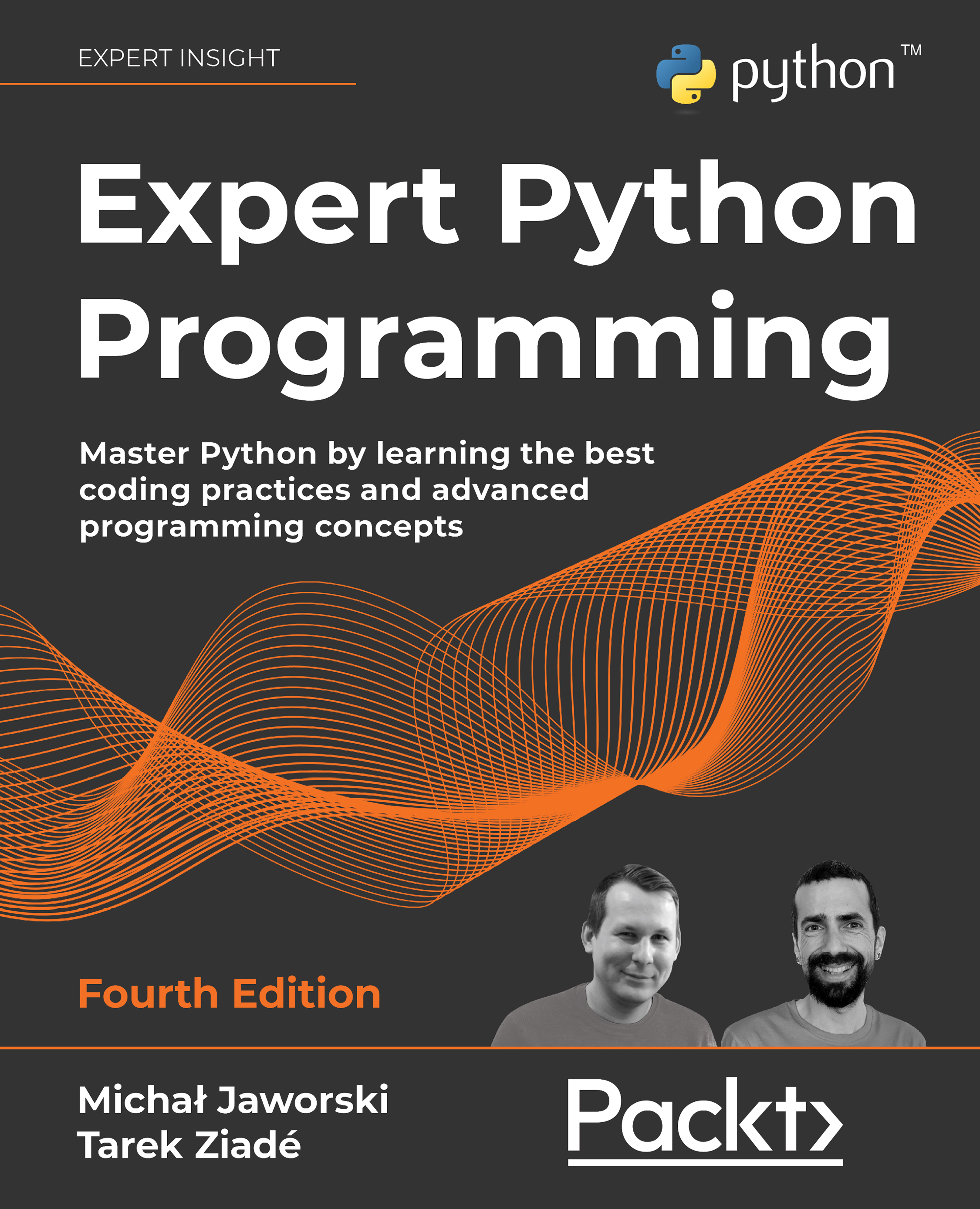
Expert Python Programming – Fourth Edition

Expert Python Programming – Fourth Edition - Fourth Edition

By : Michał Jaworski, Tarek Ziade, Ziadé
4.4 (24)
close
close
Expert Python Programming – Fourth Edition

Expert Python Programming – Fourth Edition

4.4 (24)
By: Michał Jaworski, Tarek Ziade, Ziadé

Overview of this book

This new edition of Expert Python Programming provides you with a thorough understanding of the process of building and maintaining Python apps. Complete with best practices, useful tools, and standards implemented by professional Python developers, this fourth edition has been extensively updated. Throughout this book, you’ll get acquainted with the latest Python improvements, syntax elements, and interesting tools to boost your development efficiency. The initial few chapters will allow experienced programmers coming from different languages to transition to the Python ecosystem. You will explore common software design patterns and various programming methodologies, such as event-driven programming, concurrency, and metaprogramming. You will also go through complex code examples and try to solve meaningful problems by bridging Python with C and C++, writing extensions that benefit from the strengths of multiple languages. Finally, you will understand the complete lifetime of any application after it goes live, including packaging and testing automation. By the end of this book, you will have gained actionable Python programming insights that will help you effectively solve challenging problems.
Table of Contents (16 chapters)
close
close
14
Other Books You May Enjoy
15
Index

Interfaces, Patterns, and Modularity

In this chapter, we will dive deep into the realm of design patterns through the lens of interfaces, patterns, and modularity. We've already neared this realm when introducing the concept of programming idioms. Idioms can be understood as small and well-recognized programming patterns for solving small problems. The key characteristic of a programming idiom is that it is specific to a single programming language. While idioms can often be ported to a different language, it is not guaranteed that the resulting code will feel natural to "native" users of that programming language.

Idioms generally are concerned with small programming constructs—usually a few lines of code. Design patterns, on the other hand, deal with much larger code structures—functions and classes. They are also definitely more ubiquitous. Design patterns are reusable solutions to many common design problems appearing in software engineering. They are often language-agnostic and thus can be expressed using many programming languages.

In this chapter, we will look at a quite unusual take on the topic of design patterns. Many programming books start by going back to the unofficial origin of software design patterns—the Design Patterns: Elements of Reusable Object-Oriented Software book by Gamma, Vlissides, Helm, and Johnson. What usually follows is a lengthy catalog of classic design patterns with more or less idiomatic examples of their Python implementation. Singletons, factories, adapters, flyweights, bridges, visitors, strategies, and so on and so forth.

There are also countless web articles and blogs doing exactly the same, so if you are interested in learning the classic design patterns, you shouldn't have any problems finding resources online.

If you are interested in learning about the implementation of "classic" design patterns in Python, you can visit the https://python-patterns.guide site. It provides a comprehensive catalog of design patterns together with Python code examples.

Instead, we will focus on two key "design pattern enablers":

  • Interfaces
  • Inversion of control and dependency injectors

These two concepts are "enablers" because without them we wouldn't even have proper language terms to talk about design patterns. By discussing the topic of interfaces and inversion of control, we will be able to better understand what the challenges are for building modular applications. And only by deeply understanding those challenges will we be able to figure out why we actually need patterns.

We will of course use numerous classic design patterns on the way, but we won't focus on any specific pattern.

Visually different images
CONTINUE READING
83
Tech Concepts
36
Programming languages
73
Tech Tools
Icon Unlimited access to the largest independent learning library in tech of over 8,000 expert-authored tech books and videos.
Icon Innovative learning tools, including AI book assistants, code context explainers, and text-to-speech.
Icon 50+ new titles added per month and exclusive early access to books as they are being written.
Expert Python Programming – Fourth Edition
notes
bookmark Notes and Bookmarks search Search in title playlist Add to playlist download Download options font-size Font size

Change the font size

margin-width Margin width

Change margin width

day-mode Day/Sepia/Night Modes

Change background colour

Close icon Search
Country selected

Close icon Your notes and bookmarks

Confirmation

Modal Close icon
claim successful

Buy this book with your credits?

Modal Close icon
Are you sure you want to buy this book with one of your credits?
Close
YES, BUY

Submit Your Feedback

Modal Close icon
Modal Close icon
Modal Close icon