Sign In Start Free Trial
Account

Add to playlist

Create a Playlist

Modal Close icon
You need to login to use this feature.
  • Book Overview & Buying Geospatial Data Analytics on AWS
  • Table Of Contents Toc
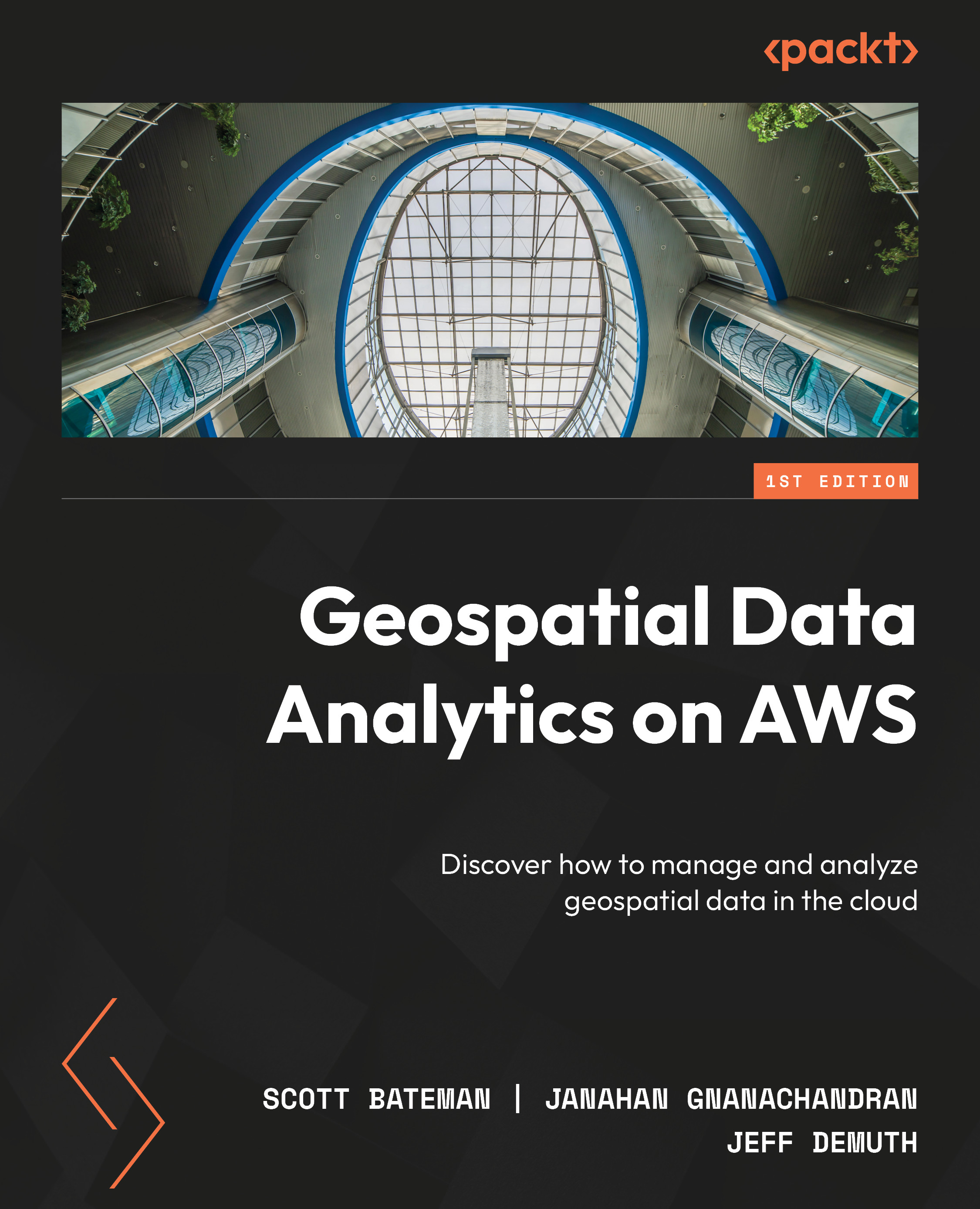
Geospatial Data Analytics on AWS

Geospatial Data Analytics on AWS

By : Scott Bateman, Janahan Gnanachandran, Jeff DeMuth
4.9 (11)
close
close
Geospatial Data Analytics on AWS

Geospatial Data Analytics on AWS

4.9 (11)
By: Scott Bateman, Janahan Gnanachandran, Jeff DeMuth

Overview of this book

Managing geospatial data and building location-based applications in the cloud can be a daunting task. This comprehensive guide helps you overcome this challenge by presenting the concept of working with geospatial data in the cloud in an easy-to-understand way, along with teaching you how to design and build data lake architecture in AWS for geospatial data. You’ll begin by exploring the use of AWS databases like Redshift and Aurora PostgreSQL for storing and analyzing geospatial data. Next, you’ll leverage services such as DynamoDB and Athena, which offer powerful built-in geospatial functions for indexing and querying geospatial data. The book is filled with practical examples to illustrate the benefits of managing geospatial data in the cloud. As you advance, you’ll discover how to analyze and visualize data using Python and R, and utilize QuickSight to share derived insights. The concluding chapters explore the integration of commonly used platforms like Open Data on AWS, OpenStreetMap, and ArcGIS with AWS to enable you to optimize efficiency and provide a supportive community for continuous learning. By the end of this book, you’ll have the necessary tools and expertise to build and manage your own geospatial data lake on AWS, along with the knowledge needed to tackle geospatial data management challenges and make the most of AWS services.
Table of Contents (23 chapters)
close
close
1
Part 1: Introduction to the Geospatial Data Ecosystem
4
Part 2: Geospatial Data Lakes using Modern Data Architecture
10
Part 3: Analyzing and Visualizing Geospatial Data in AWS
16
Part 4: Accessing Open Source and Commercial Platforms and Services

Preface

This book will provide a comprehensive overview of geospatial data and analytics in the cloud. You will learn how to optimize your geospatial data asset by using the Amazon Web Services (AWS) cloud. You will be shown examples and exercises depicting how to ingest and manage geospatial data from a variety of sources using AWS services like Amazon S3, Amazon DynamoDB, Amazon RDS, Amazon Redshift, and Amazon Athena. The concepts and patterns outlined in this book can help to build a new Geographic Information System (GIS) for you and your organization. It will also be helpful to identify areas of an existing GIS that are candidates for migration to or modernization in the AWS cloud.

Each chapter will give you a basic understanding about what you can do in the cloud for a specific technical area and point you in the right direction for additional resources. The earlier chapters are general and read somewhat like a narrative. Later chapters have lab exercises and samples with prescriptive steps to walk you through how to do specific tasks. We know that everyone learns differently and sometimes it is just about knowing enough to start asking the right questions. Frank Lloyd Wright said that an expert is someone who has “stopped thinking because he ‘knows.’ If you are a cloud-native geospatial expert much of this book’s content will be a refresher, but I invite you to read it cover to cover and you’ll find some new topics and ideas. Warren Berger realized “As expertise loses its ‘shelf life,’ it also loses some of its value” and the AWS cloud has brought that to GIS. If you knew everything there was about creating highly available web mapping services 10 years ago, most of that expertise is due for a reboot.

We hope you appreciate the years of expertise, experimentation, failures, and successes that went into the creation of this book. The geospatial ecosphere on AWS is continually evolving, and future revisions of this title will include sections to cover new services and features that will make your life easier. Using the AWS cloud for geospatial data management and analysis provides substantial benefits over an on-premises deployment. As you reflect on your GIS environment and identify areas for improvement, we hope this book serves as a trusted guide to inspire you to build and explore. We love all forms of feedback, so please reach out if there are topics or use cases that would be particularly helpful for you and your organization.

CONTINUE READING
83
Tech Concepts
36
Programming languages
73
Tech Tools
Icon Unlimited access to the largest independent learning library in tech of over 8,000 expert-authored tech books and videos.
Icon Innovative learning tools, including AI book assistants, code context explainers, and text-to-speech.
Icon 50+ new titles added per month and exclusive early access to books as they are being written.
Geospatial Data Analytics on AWS
notes
bookmark Notes and Bookmarks search Search in title playlist Add to playlist font-size Font size

Change the font size

margin-width Margin width

Change margin width

day-mode Day/Sepia/Night Modes

Change background colour

Close icon Search
Country selected

Close icon Your notes and bookmarks

Confirmation

Modal Close icon
claim successful

Buy this book with your credits?

Modal Close icon
Are you sure you want to buy this book with one of your credits?
Close
YES, BUY

Submit Your Feedback

Modal Close icon
Modal Close icon
Modal Close icon