Sign In Start Free Trial
Account

Add to playlist

Create a Playlist

Modal Close icon
You need to login to use this feature.
  • Book Overview & Buying Kotlin Design Patterns and Best Practices
  • Table Of Contents Toc
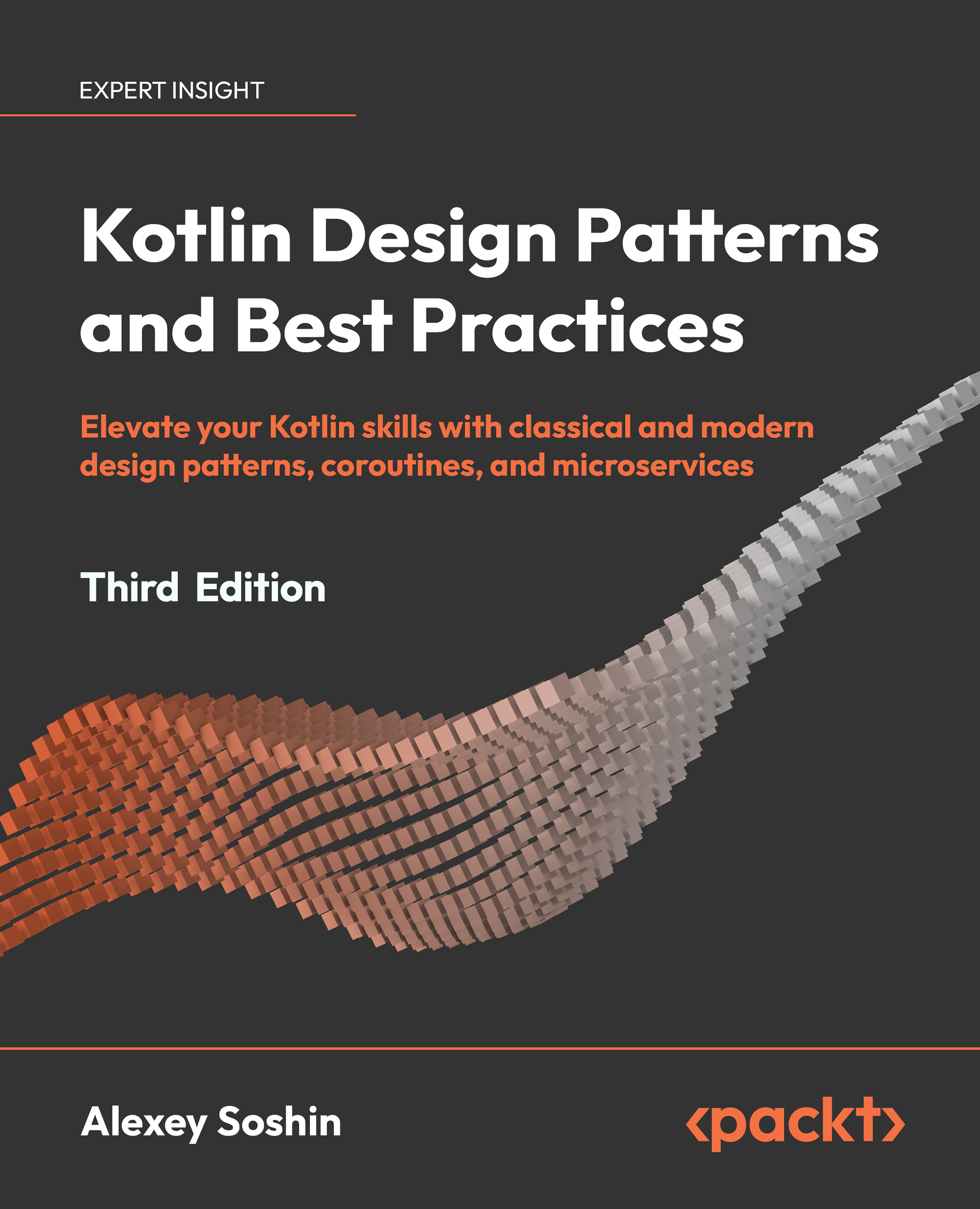
Kotlin Design Patterns and Best Practices

Kotlin Design Patterns and Best Practices - Third Edition

By : Alexey Soshin
4.9 (26)
close
close
Kotlin Design Patterns and Best Practices

Kotlin Design Patterns and Best Practices

4.9 (26)
By: Alexey Soshin

Overview of this book

For developers who are working with design patterns in Kotlin, this practical guide offers an opportunity to put their knowledge into practice. The book covers classical and modern design patterns, and provides a hands-on approach to implementation, along with associated methodologies. The third edition stays current with Kotlin updates, spanning from version 1.6 onwards, and offers in-depth insights into topics like structured concurrency and context receivers. The book starts by introducing essential Kotlin syntax and the significance of design patterns, covering classic Creational, Structural, and Behavioral patterns. It then progresses to explore functional programming, Reactive, and Concurrent patterns, including detailed discussions on coroutines and structured concurrency. As you navigate through these advanced concepts, you'll enhance your Kotlin coding skills. The book also delves into the latest architectural trends, focusing on microservices design patterns and aiding your decision-making process when choosing between architectures. By the end of the book, you will have a solid grasp of these advanced concepts and be able to apply them in your own projects.
Table of Contents (19 chapters)
close
close
Lock Free Chapter
1
Section 1: Classical Patterns
6
Section 2: Reactive and Concurrent Patterns
11
Section 3: Practical Application of Design Patterns
16
Assessments
17
Other Book You May Enjoy
18
Index

Inline functions

It’s considered best practice to divide your code into small functions, and rightfully so. However, every function call introduces a level of indirection and slight performance overhead. While insignificant individually, this overhead may stack up if the function is invoked millions of times. In some cases, such as within the Spring Framework, functions may be hundreds of lines long due to performance requirements, leading to a departure from the single responsibility principle.

Inline functions can enhance performance by reducing the overhead of function calls. When you call a regular function, the Kotlin compiler generates a function invocation, which entails pushing arguments onto the stack, jumping to the function code, executing it, and then returning. Inline functions replace the function call with the actual function body at compile time, eliminating this overhead.

When passing lambda expressions as arguments to higher-order functions in Kotlin...

CONTINUE READING
83
Tech Concepts
36
Programming languages
73
Tech Tools
Icon Unlimited access to the largest independent learning library in tech of over 8,000 expert-authored tech books and videos.
Icon Innovative learning tools, including AI book assistants, code context explainers, and text-to-speech.
Icon 50+ new titles added per month and exclusive early access to books as they are being written.
Kotlin Design Patterns and Best Practices
notes
bookmark Notes and Bookmarks search Search in title playlist Add to playlist download Download options font-size Font size

Change the font size

margin-width Margin width

Change margin width

day-mode Day/Sepia/Night Modes

Change background colour

Close icon Search
Country selected

Close icon Your notes and bookmarks

Confirmation

Modal Close icon
claim successful

Buy this book with your credits?

Modal Close icon
Are you sure you want to buy this book with one of your credits?
Close
YES, BUY

Submit Your Feedback

Modal Close icon
Modal Close icon
Modal Close icon