Sign In Start Free Trial
Account

Add to playlist

Create a Playlist

Modal Close icon
You need to login to use this feature.
  • Book Overview & Buying Kotlin Design Patterns and Best Practices
  • Table Of Contents Toc
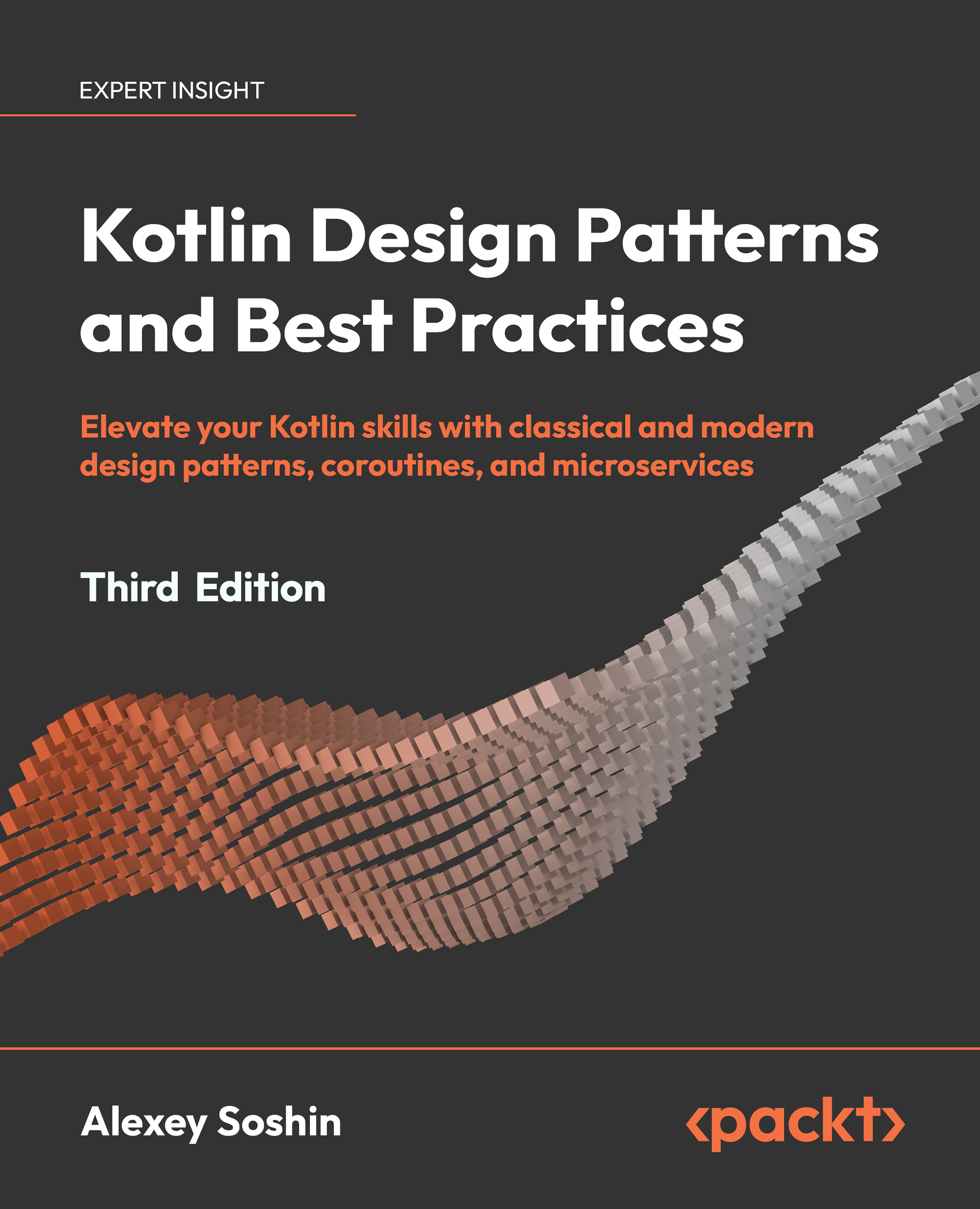
Kotlin Design Patterns and Best Practices

Kotlin Design Patterns and Best Practices - Second Edition

By : Alexey Soshin
4.9 (27)
close
close
Kotlin Design Patterns and Best Practices

Kotlin Design Patterns and Best Practices

4.9 (27)
By: Alexey Soshin

Overview of this book

This book shows you how easy it can be to implement traditional design patterns in the modern multi-paradigm Kotlin programming language, and takes you through the new patterns and paradigms that have emerged. This second edition is updated to cover the changes introduced from Kotlin 1.2 up to 1.5 and focuses more on the idiomatic usage of coroutines, which have become a stable language feature. You'll begin by learning about the practical aspects of smarter coding in Kotlin, as well as understanding basic Kotlin syntax and the impact of design patterns on your code. The book also provides an in-depth explanation of the classical design patterns, such as Creational, Structural, and Behavioral families, before moving on to functional programming. You'll go through reactive and concurrent patterns, and finally, get to grips with coroutines and structured concurrency to write performant, extensible, and maintainable code. By the end of this Kotlin book, you'll have explored the latest trends in architecture and design patterns for microservices. You’ll also understand the tradeoffs when choosing between different architectures and make informed decisions.
Table of Contents (19 chapters)
close
close
1
Section 1: Classical Patterns
6
Section 2: Reactive and Concurrent Patterns
11
Section 3: Practical Application of Design Patterns
16
Assessments
17
Other Book You May Enjoy
18
Index

Achieving concurrency in Ktor

Looking back at the code we've written in this chapter, you may be under the impression that the Ktor code is not concurrent at all. However, this couldn't be further from the truth.

All the Ktor functions we've used in this chapter are based on coroutines and the concept of suspending functions.

For every incoming request, Ktor will start a new coroutine that will handle it, thanks to the CIO server engine, which is based on coroutines at its core. Having a concurrency model that is performant but not obtrusive is a very important principle in Ktor.

In addition, the routing blocks we used to specify all our endpoints have access to CoroutineScope, meaning that we can invoke suspending functions within those blocks.

One of the examples for such a suspending function is call.respond(), which we were using throughout this chapter. Suspending functions provide our application with opportunities to context switch, and to execute...

CONTINUE READING
83
Tech Concepts
36
Programming languages
73
Tech Tools
Icon Unlimited access to the largest independent learning library in tech of over 8,000 expert-authored tech books and videos.
Icon Innovative learning tools, including AI book assistants, code context explainers, and text-to-speech.
Icon 50+ new titles added per month and exclusive early access to books as they are being written.
Kotlin Design Patterns and Best Practices
notes
bookmark Notes and Bookmarks search Search in title playlist Add to playlist download Download options font-size Font size

Change the font size

margin-width Margin width

Change margin width

day-mode Day/Sepia/Night Modes

Change background colour

Close icon Search
Country selected

Close icon Your notes and bookmarks

Confirmation

Modal Close icon
claim successful

Buy this book with your credits?

Modal Close icon
Are you sure you want to buy this book with one of your credits?
Close
YES, BUY

Submit Your Feedback

Modal Close icon
Modal Close icon
Modal Close icon