Sign In Start Free Trial
Account

Add to playlist

Create a Playlist

Modal Close icon
You need to login to use this feature.
  • Book Overview & Buying Learn Python Programming
  • Table Of Contents Toc
  • Feedback & Rating feedback
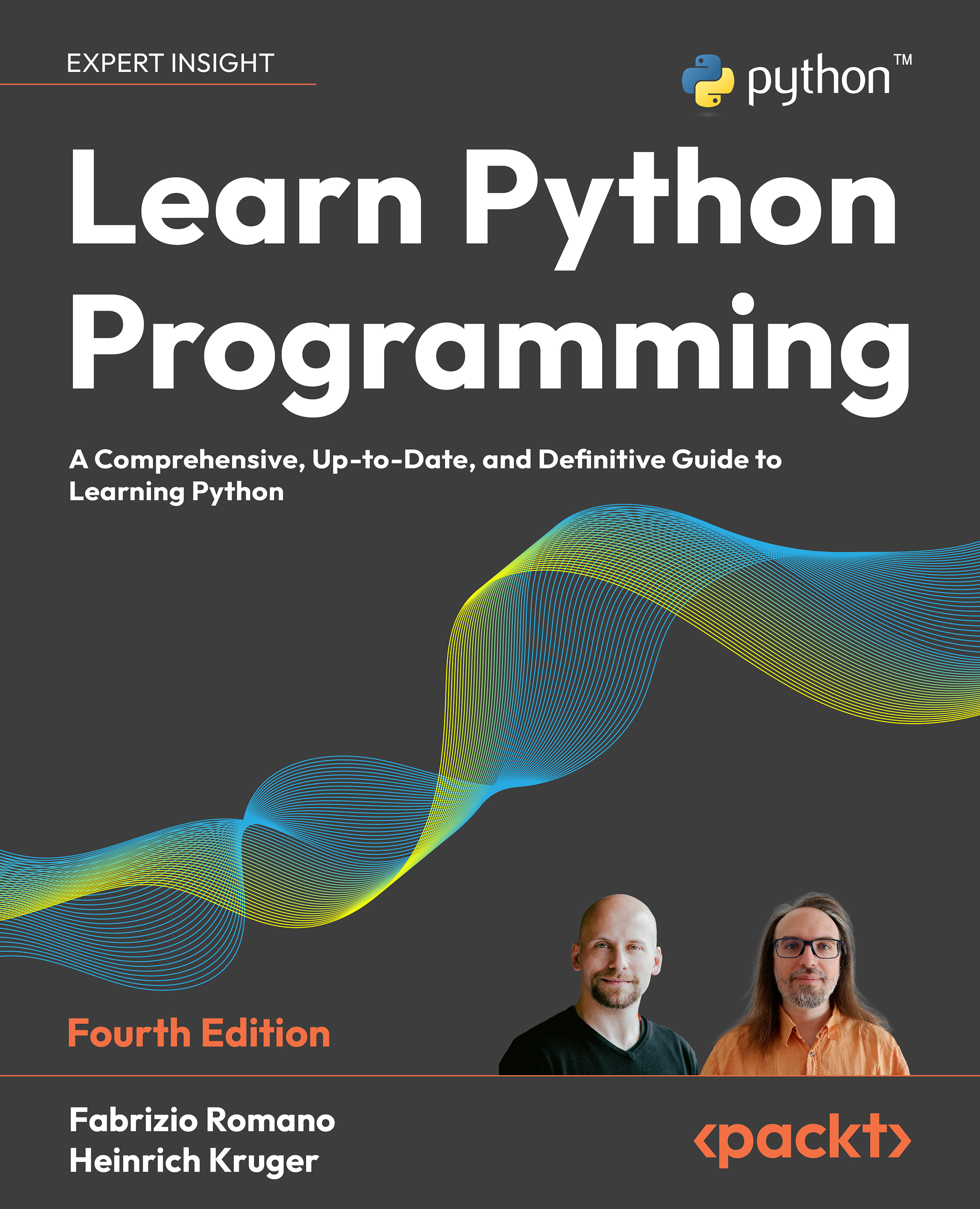
Learn Python Programming

Learn Python Programming - Fourth Edition

By : Fabrizio Romano, Heinrich Kruger
3.5 (2)
close
close
Learn Python Programming

Learn Python Programming

3.5 (2)
By: Fabrizio Romano, Heinrich Kruger

Overview of this book

Learn Python Programming, Fourth Edition, provides a comprehensive, up-to-date introduction to Python programming, covering fundamental concepts and practical applications. This edition has been meticulously updated to include the latest features from Python versions 3.9 to 3.12, new chapters on type hinting and CLI applications, and updated examples reflecting modern Python web development practices. This Python book empowers you to take ownership of writing your software and become independent in fetching the resources you need. By the end of this book, you will have a clear idea of where to go and how to build on what you have learned from the book. Through examples, the book explores a wide range of applications and concludes by building real-world Python projects based on the concepts you have learned. This Python book offers a clear and practical guide to mastering Python and applying it effectively in various domains, such as data science, web development, and automation.
Table of Contents (20 chapters)
close
close
18
Other Books You May Enjoy
19
Index

The railway API

Now that we have a working knowledge of what an API is, let us turn to something more concrete.

Before we show you the code, allow us to stress that this code is not production-ready, as that would have been too long and needlessly complex for a book’s chapter. However, this code is fully functional, and it should provide you with a good starting point to learn more, especially if you experiment with it. We will leave suggestions on how to do so at the end of this chapter.

We have a database with some entities that model a railway application. We want to allow an external system to perform CRUD operations on the database, so we are going to write an API to serve as the interface to it.

CRUD stands for Create, Read, Update, and Delete. These are the four basic database operations. Many HTTP services also model CRUD operations through REST or REST-like APIs.

Let us start by looking at the project files, so you will have an idea of where...

Visually different images
CONTINUE READING
83
Tech Concepts
36
Programming languages
73
Tech Tools
Icon Unlimited access to the largest independent learning library in tech of over 8,000 expert-authored tech books and videos.
Icon Innovative learning tools, including AI book assistants, code context explainers, and text-to-speech.
Icon 50+ new titles added per month and exclusive early access to books as they are being written.
Learn Python Programming
notes
bookmark Notes and Bookmarks search Search in title playlist Add to playlist download Download options font-size Font size

Change the font size

margin-width Margin width

Change margin width

day-mode Day/Sepia/Night Modes

Change background colour

Close icon Search
Country selected

Close icon Your notes and bookmarks

Confirmation

Modal Close icon
claim successful

Buy this book with your credits?

Modal Close icon
Are you sure you want to buy this book with one of your credits?
Close
YES, BUY

Submit Your Feedback

Modal Close icon
Modal Close icon
Modal Close icon