Sign In Start Free Trial
Account

Add to playlist

Create a Playlist

Modal Close icon
You need to login to use this feature.
  • Book Overview & Buying The Ruby Workshop
  • Table Of Contents Toc
  • Feedback & Rating feedback
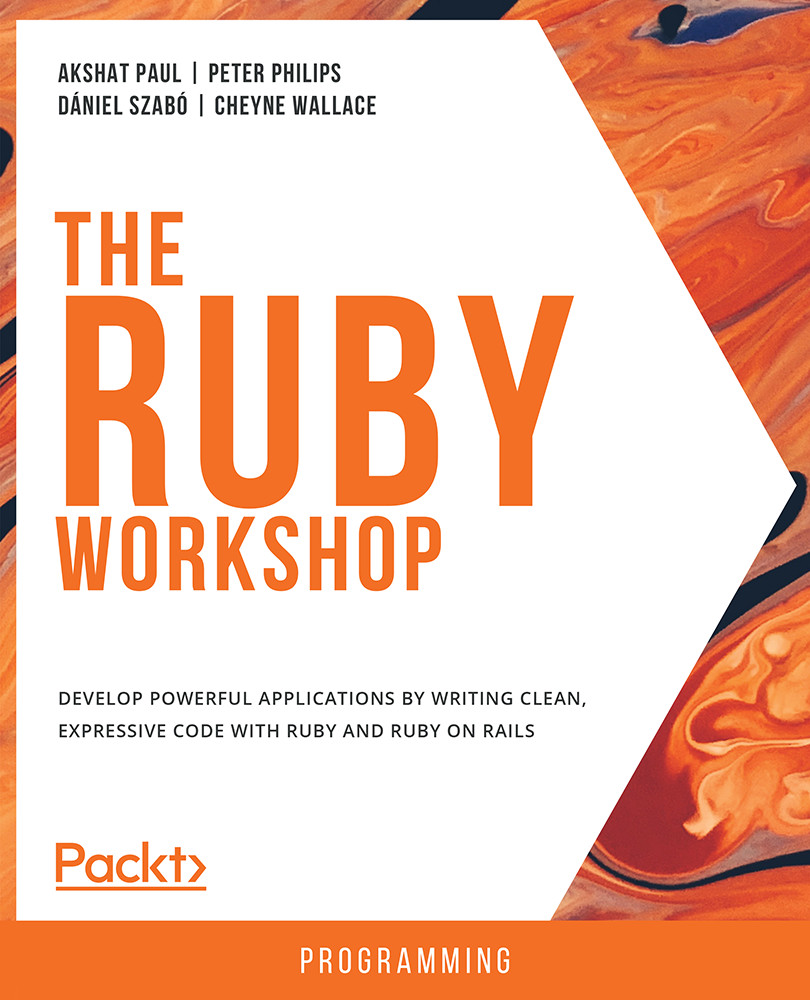
The Ruby Workshop

The Ruby Workshop

By : Akshat Paul, Philips, Dániel Szabó , Wallace
3.3 (3)
close
close
The Ruby Workshop

The Ruby Workshop

3.3 (3)
By: Akshat Paul, Philips, Dániel Szabó , Wallace

Overview of this book

The beauty of Ruby is its readability and expressiveness. Ruby hides away a lot of the complexity of programming, allowing you to work quickly and 'do more' with fewer lines of code. This makes it a great programming language for beginners, but learning any new skill can still be a daunting task. If you want to learn to code using Ruby, but don't know where to start, The Ruby Workshop will help you cut through the noise and make sense of this fun, flexible language. You'll start by writing and running simple code snippets and Ruby source code files. After learning about strings, numbers, and booleans, you'll see how to store collections of objects with arrays and hashes. You'll then learn how to control the flow of a Ruby program using boolean logic. The book then delves into OOP and explains inheritance, encapsulation, and polymorphism. Gradually, you'll build your knowledge of advanced concepts by learning how to interact with external APIs, before finally exploring the most popular Ruby framework ? Ruby on Rails ? and using it for web development. Throughout this book, you'll work on a series of realistic projects, including simple games, a voting application, and an online blog. By the end of this Ruby book, you'll have the knowledge, skills and confidence to creatively tackle your own ambitious projects with Ruby.
Table of Contents (14 chapters)
close
close

Introduction

In the previous chapter, we learned about Boolean variables, conditional expressions, and loops, including the core Ruby concepts of using blocks. We will now zoom out a little in the Ruby world and learn about methods. In fact, we've been using methods in the previous chapters, and we will look at them in more depth now.

Methods are foundational units in Ruby. They allow you to wrap code in chunks that can be called with different parameters to get different outputs. Methods commonly have descriptive names and, as such, make clear what the underlying bundle of code does. For instance, we previously learned about the each method on arrays. This method enumerates over each item in the array, and so is very descriptive. In fact, method naming is an art where you balance simplicity with descriptiveness. It is considered that the difficult things in computer science are caching, naming things, and off-by-one errors. Commonly known as OBOB errors, off-by-one bugs are...

Visually different images
CONTINUE READING
83
Tech Concepts
36
Programming languages
73
Tech Tools
Icon Unlimited access to the largest independent learning library in tech of over 8,000 expert-authored tech books and videos.
Icon Innovative learning tools, including AI book assistants, code context explainers, and text-to-speech.
Icon 50+ new titles added per month and exclusive early access to books as they are being written.
The Ruby Workshop
notes
bookmark Notes and Bookmarks search Search in title playlist Add to playlist font-size Font size

Change the font size

margin-width Margin width

Change margin width

day-mode Day/Sepia/Night Modes

Change background colour

Close icon Search
Country selected

Close icon Your notes and bookmarks

Confirmation

Modal Close icon
claim successful

Buy this book with your credits?

Modal Close icon
Are you sure you want to buy this book with one of your credits?
Close
YES, BUY

Submit Your Feedback

Modal Close icon
Modal Close icon
Modal Close icon