Sign In Start Free Trial
Account

Add to playlist

Create a Playlist

Modal Close icon
You need to login to use this feature.
  • Book Overview & Buying Dancing with Qubits
  • Table Of Contents Toc
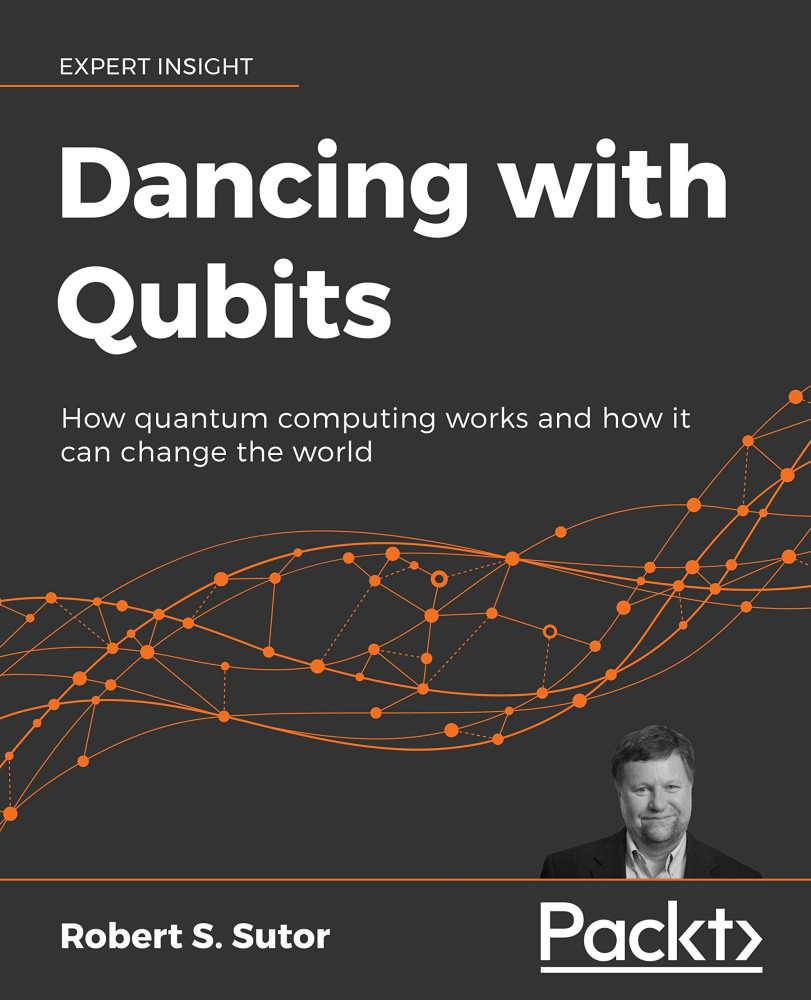
Dancing with Qubits

Dancing with Qubits

By : Robert S. Sutor
4.4 (47)
close
close
Dancing with Qubits

Dancing with Qubits

4.4 (47)
By: Robert S. Sutor

Overview of this book

Quantum computing is making us change the way we think about computers. Quantum bits, a.k.a. qubits, can make it possible to solve problems that would otherwise be intractable with current computing technology. Dancing with Qubits is a quantum computing textbook that starts with an overview of why quantum computing is so different from classical computing and describes several industry use cases where it can have a major impact. From there it moves on to a fuller description of classical computing and the mathematical underpinnings necessary to understand such concepts as superposition, entanglement, and interference. Next up is circuits and algorithms, both basic and more sophisticated. It then nicely moves on to provide a survey of the physics and engineering ideas behind how quantum computing hardware is built. Finally, the book looks to the future and gives you guidance on understanding how further developments will affect you. Really understanding quantum computing requires a lot of math, and this book doesn't shy away from the necessary math concepts you'll need. Each topic is introduced and explained thoroughly, in clear English with helpful examples.
Table of Contents (16 chapters)
close
close
Preface
13
Afterword

3.10 Summary

There’s more to numbers than you might have thought, despite using them daily. Starting with the simplest kind, the natural numbers N, we systematically added operations and properties to gain functionality. The idea of “closure” drove us to understand the value of extending to increasingly larger collections of numbers that could handle the problems we wanted to solve.

We briefly delved into abstract algebra to look at groups, rings, and fields and see their structure. Complex numbers are key to working with quantum computing, and we began to look at their algebraic properties. Though they involve the imaginary i, they are very real in describing the way the universe evidently works.

The following table brings together the number collections we have seen and some of their properties.

Displayed math

The following diagram shows the inclusion relationships among the collections of numbers. The expressions

...
CONTINUE READING
83
Tech Concepts
36
Programming languages
73
Tech Tools
Icon Unlimited access to the largest independent learning library in tech of over 8,000 expert-authored tech books and videos.
Icon Innovative learning tools, including AI book assistants, code context explainers, and text-to-speech.
Icon 50+ new titles added per month and exclusive early access to books as they are being written.
Dancing with Qubits
notes
bookmark Notes and Bookmarks search Search in title playlist Add to playlist download Download options font-size Font size

Change the font size

margin-width Margin width

Change margin width

day-mode Day/Sepia/Night Modes

Change background colour

Close icon Search
Country selected

Close icon Your notes and bookmarks

Confirmation

Modal Close icon
claim successful

Buy this book with your credits?

Modal Close icon
Are you sure you want to buy this book with one of your credits?
Close
YES, BUY

Submit Your Feedback

Modal Close icon
Modal Close icon
Modal Close icon