Sign In Start Free Trial
Account

Add to playlist

Create a Playlist

Modal Close icon
You need to login to use this feature.
  • Book Overview & Buying Dancing with Qubits
  • Table Of Contents Toc
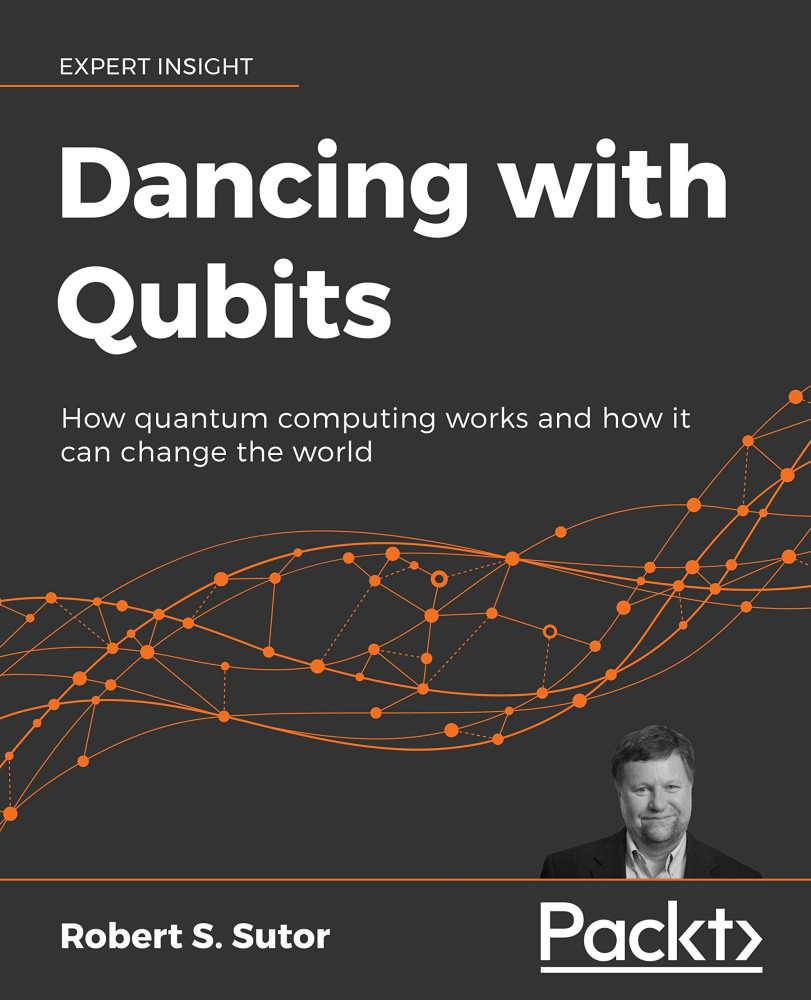
Dancing with Qubits

Dancing with Qubits

By : Robert S. Sutor
4.4 (47)
close
close
Dancing with Qubits

Dancing with Qubits

4.4 (47)
By: Robert S. Sutor

Overview of this book

Quantum computing is making us change the way we think about computers. Quantum bits, a.k.a. qubits, can make it possible to solve problems that would otherwise be intractable with current computing technology. Dancing with Qubits is a quantum computing textbook that starts with an overview of why quantum computing is so different from classical computing and describes several industry use cases where it can have a major impact. From there it moves on to a fuller description of classical computing and the mathematical underpinnings necessary to understand such concepts as superposition, entanglement, and interference. Next up is circuits and algorithms, both basic and more sophisticated. It then nicely moves on to provide a survey of the physics and engineering ideas behind how quantum computing hardware is built. Finally, the book looks to the future and gives you guidance on understanding how further developments will affect you. Really understanding quantum computing requires a lot of math, and this book doesn't shy away from the necessary math concepts you'll need. Each topic is introduced and explained thoroughly, in clear English with helpful examples.
Table of Contents (16 chapters)
close
close
Preface
13
Afterword

6.1 Being discrete

Sometimes, it seems like probability is the study of flipping coins or rolling dice, given the number of books that explain it in those ways. It’s tough to break away from these convenient examples. An advantage shared by both is that they make it easy to explain discrete events and independence. A set of events is discrete if there are only a finite number of them or if we can put them in one-to-one correspondence with Z. sample space$discrete

For the sake of mixing it up, suppose we have a cookie machine. It’s a big box with a button on top. Every time you press the button, a cookie pops out of a slot on the bottom. There are four kinds of cookies: chocolate, sugar, oatmeal, and coconut.

Assume, for the moment, there is no limit to the number of cookies our machine can distribute. You get a million cookies if you hit the button a million times. Also, assume you get a random cookie each time. What does this mean, “random...

CONTINUE READING
83
Tech Concepts
36
Programming languages
73
Tech Tools
Icon Unlimited access to the largest independent learning library in tech of over 8,000 expert-authored tech books and videos.
Icon Innovative learning tools, including AI book assistants, code context explainers, and text-to-speech.
Icon 50+ new titles added per month and exclusive early access to books as they are being written.
Dancing with Qubits
notes
bookmark Notes and Bookmarks search Search in title playlist Add to playlist download Download options font-size Font size

Change the font size

margin-width Margin width

Change margin width

day-mode Day/Sepia/Night Modes

Change background colour

Close icon Search
Country selected

Close icon Your notes and bookmarks

Confirmation

Modal Close icon
claim successful

Buy this book with your credits?

Modal Close icon
Are you sure you want to buy this book with one of your credits?
Close
YES, BUY

Submit Your Feedback

Modal Close icon
Modal Close icon
Modal Close icon