Sign In Start Free Trial
Account

Add to playlist

Create a Playlist

Modal Close icon
You need to login to use this feature.
  • Book Overview & Buying C++ Data Structures and Algorithm Design Principles
  • Table Of Contents Toc
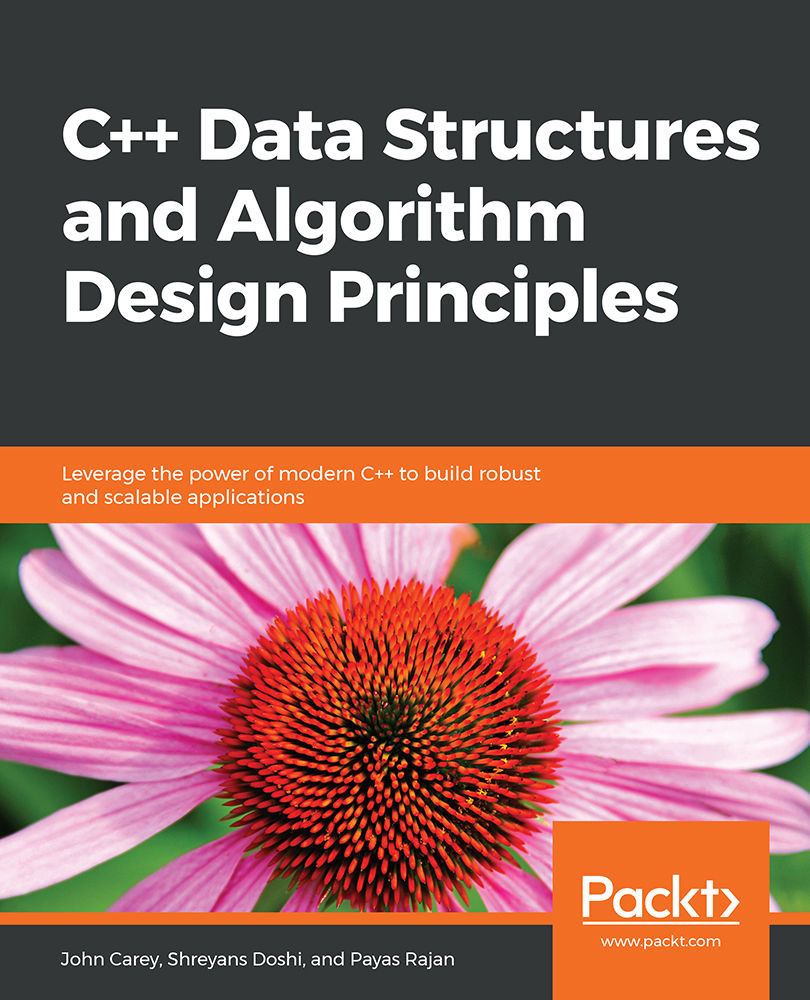
C++ Data Structures and Algorithm Design Principles

C++ Data Structures and Algorithm Design Principles

By : John Carey, Anil Achary, Shreyans Doshi, Payas Rajan
2.3 (4)
close
close
C++ Data Structures and Algorithm Design Principles

C++ Data Structures and Algorithm Design Principles

2.3 (4)
By: John Carey, Anil Achary, Shreyans Doshi, Payas Rajan

Overview of this book

C++ is a mature multi-paradigm programming language that enables you to write high-level code with a high degree of control over the hardware. Today, significant parts of software infrastructure, including databases, browsers, multimedia frameworks, and GUI toolkits, are written in C++. This book starts by introducing C++ data structures and how to store data using linked lists, arrays, stacks, and queues. In later chapters, the book explains the basic algorithm design paradigms, such as the greedy approach and the divide-and-conquer approach, which are used to solve a large variety of computational problems. Finally, you will learn the advanced technique of dynamic programming to develop optimized implementations of several algorithms discussed in the book. By the end of this book, you will have learned how to implement standard data structures and algorithms in efficient and scalable C++ 14 code.
Table of Contents (11 chapters)
close
close

Introduction

Lookup is nothing but checking whether an element is present in a container or finding the corresponding value for a key in the container. In the student database system and the hospital management system examples that we mentioned in the previous chapters, a common operation is to fetch a particular record from the vast amount of data stored in the system. A similar problem also presents itself while getting the meaning of a word from a dictionary, checking whether a person is allowed to enter a certain facility based on a set of records (access control), and many more applications.

For most of these scenarios, just going through all the elements linearly and matching the values would be extremely time-consuming, especially considering the vast amount of records that are stored. Let's take a simple example of looking up a word in a dictionary. There are roughly 170,000 words in the English dictionary. One of the simplest ways to do this is to traverse the dictionary linearly...

CONTINUE READING
83
Tech Concepts
36
Programming languages
73
Tech Tools
Icon Unlimited access to the largest independent learning library in tech of over 8,000 expert-authored tech books and videos.
Icon Innovative learning tools, including AI book assistants, code context explainers, and text-to-speech.
Icon 50+ new titles added per month and exclusive early access to books as they are being written.
C++ Data Structures and Algorithm Design Principles
notes
bookmark Notes and Bookmarks search Search in title playlist Add to playlist font-size Font size

Change the font size

margin-width Margin width

Change margin width

day-mode Day/Sepia/Night Modes

Change background colour

Close icon Search
Country selected

Close icon Your notes and bookmarks

Confirmation

Modal Close icon
claim successful

Buy this book with your credits?

Modal Close icon
Are you sure you want to buy this book with one of your credits?
Close
YES, BUY

Submit Your Feedback

Modal Close icon
Modal Close icon
Modal Close icon