Sign In Start Free Trial
Account

Add to playlist

Create a Playlist

Modal Close icon
You need to login to use this feature.
  • Book Overview & Buying The Python Workshop
  • Table Of Contents Toc
  • Feedback & Rating feedback
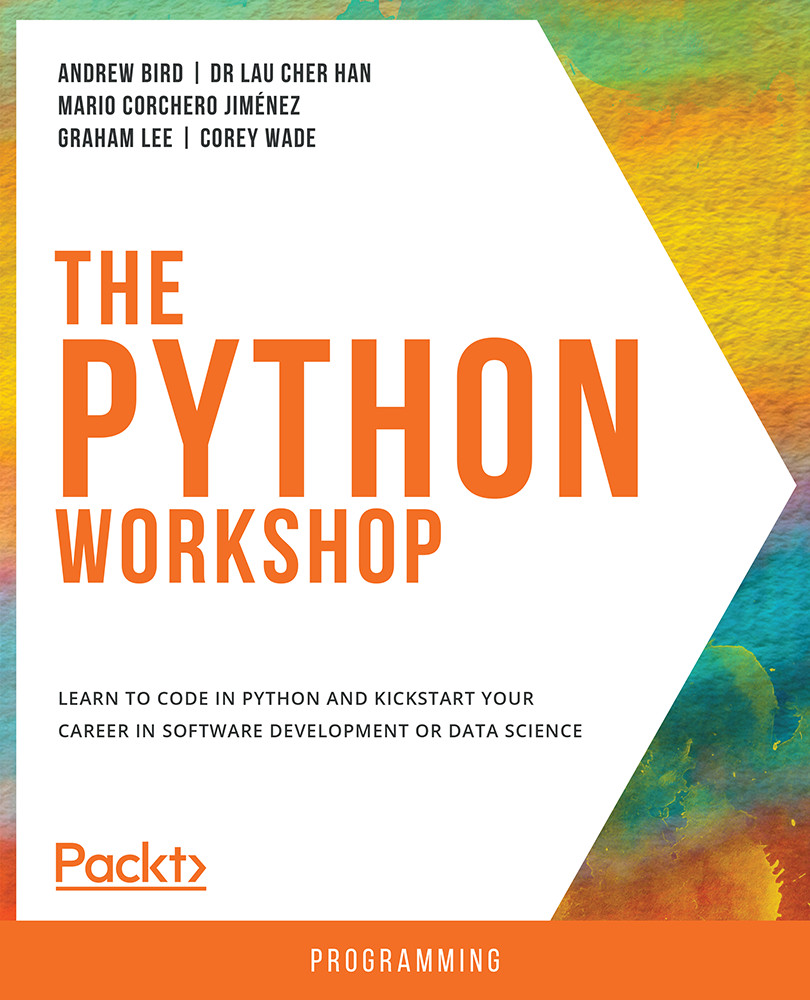
The Python Workshop

The Python Workshop

By : Bird, Dr. Lau Cher Han, Mario Corchero Jiménez , Graham Lee, Wade
4.3 (36)
close
close
The Python Workshop

The Python Workshop

4.3 (36)
By: Bird, Dr. Lau Cher Han, Mario Corchero Jiménez , Graham Lee, Wade

Overview of this book

Have you always wanted to learn Python, but never quite known how to start? More applications than we realize are being developed using Python because it is easy to learn, read, and write. You can now start learning the language quickly and effectively with the help of this interactive tutorial. The Python Workshop starts by showing you how to correctly apply Python syntax to write simple programs, and how to use appropriate Python structures to store and retrieve data. You'll see how to handle files, deal with errors, and use classes and methods to write concise, reusable, and efficient code. As you advance, you'll understand how to use the standard library, debug code to troubleshoot problems, and write unit tests to validate application behavior. You'll gain insights into using the pandas and NumPy libraries for analyzing data, and the graphical libraries of Matplotlib and Seaborn to create impactful data visualizations. By focusing on entry-level data science, you'll build your practical Python skills in a way that mirrors real-world development. Finally, you'll discover the key steps in building and using simple machine learning algorithms. By the end of this Python book, you'll have the knowledge, skills and confidence to creatively tackle your own ambitious projects with Python.
Table of Contents (13 chapters)
close
close

Variable Scope

Variables are only available in the area where they are defined. This area is called the scope of the variable. Depending on how and where a variable is defined, it may or may not be accessible in certain parts of your code. Here, you will discuss what variables in Python represent, the difference in defining them inside or outside a function, and how the global and nonlocal keywords can be used to override these default behaviors.

Variables

A variable is a mapping between a name and an object at a certain location in the computer's memory. For example, if you set x = 5, then x is the variable's name, and the value 5 is stored in memory. Python keeps track of the mapping between the name x and the location of the value using namespaces. Namespaces can be thought of as dictionaries, with the names as the keys of the dictionary, and locations in memory as the values.

Note that when a variable is assigned to the value of another variable, this just means...

Visually different images
CONTINUE READING
83
Tech Concepts
36
Programming languages
73
Tech Tools
Icon Unlimited access to the largest independent learning library in tech of over 8,000 expert-authored tech books and videos.
Icon Innovative learning tools, including AI book assistants, code context explainers, and text-to-speech.
Icon 50+ new titles added per month and exclusive early access to books as they are being written.
The Python Workshop
notes
bookmark Notes and Bookmarks search Search in title playlist Add to playlist font-size Font size

Change the font size

margin-width Margin width

Change margin width

day-mode Day/Sepia/Night Modes

Change background colour

Close icon Search
Country selected

Close icon Your notes and bookmarks

Confirmation

Modal Close icon
claim successful

Buy this book with your credits?

Modal Close icon
Are you sure you want to buy this book with one of your credits?
Close
YES, BUY

Submit Your Feedback

Modal Close icon
Modal Close icon
Modal Close icon