Sign In Start Free Trial
Account

Add to playlist

Create a Playlist

Modal Close icon
You need to login to use this feature.
  • Book Overview & Buying OpenLayers Cookbook
  • Table Of Contents Toc
OpenLayers Cookbook

OpenLayers Cookbook

4.8 (9)
close
close
OpenLayers Cookbook

OpenLayers Cookbook

4.8 (9)

Overview of this book

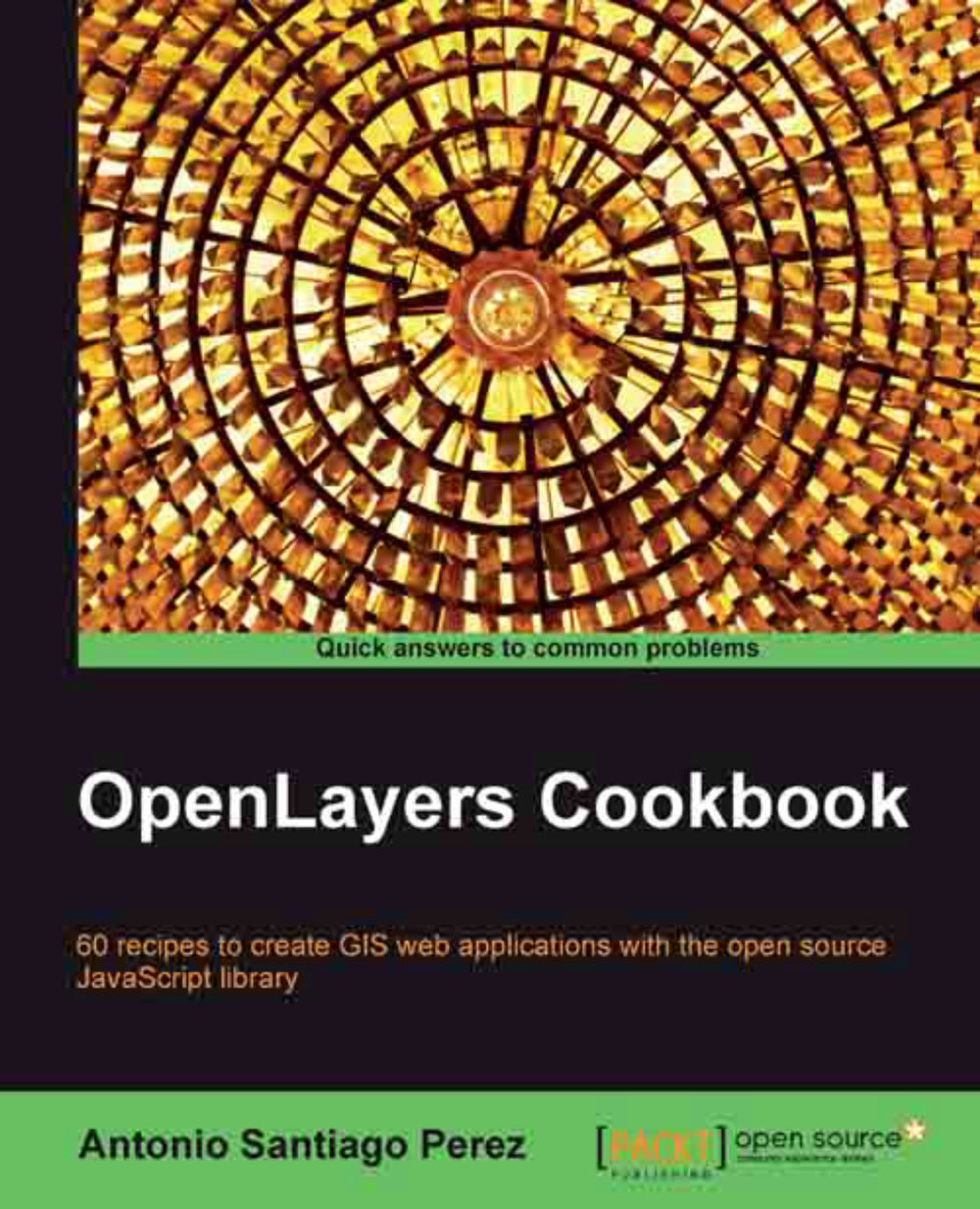
Data visualization and analysis has become an important task for many companies. Understanding the basic concepts of GIS and knowing how to visualize data on a map is a required ability for many professionals today. OpenLayers is a JavaScript library to load, display, and render maps from multiple sources on web pages."OpenLayers Cookbook" teaches how to work with OpenLayers, one of the most important and complete open source JavaScript libraries.Through an extensive set of recipes, this book shows how to work with the main concepts required to build a GIS web applicationñ maps, raster and vector layers, styling, theming, and so on."OpenLayers Cookbook" includes problem solving and how-to recipes for the most common and important tasks. A wide range of topics are covered.The range of recipes includes: creating basic maps, working with raster and vector layers, understanding events and working with main controls, reading features from different data sources, styling features, and understanding the underlying architecture."OpenLayers Cookbook" describes solutions and optimizations to problems commonly found.
Table of Contents (15 chapters)
close
close
OpenLayers Cookbook
Credits
About the Author
About the Reviewers
www.PacktPub.com
Preface
1
Index

Introduction


This chapter is focused on events, which is an important concept in any JavaScript program. Although this chapter is brief, the concepts explained here are very important to understand when working with OpenLayers.

Events are the heart of JavaScript. They are the impulses that allow us to produce a reaction. As programmers of a mapping application, we are interested in reacting when the map zoom changes, when a layer is loaded, or when a feature is added to a layer. Every class susceptible to emit events is responsible for managing its listeners (those interested in being notified when an event is fired) and also to emit events under certain circumstances.

For example, we can register a function listening for the zoomend event on the OpenLayers.Map instance. Every time the map instance changes its zoom, it is responsible to trigger the zoomend event, so all its listeners will be notified by the new event.

To help in all this process, OpenLayers has the OpenLayers.Events class...

CONTINUE READING
83
Tech Concepts
36
Programming languages
73
Tech Tools
Icon Unlimited access to the largest independent learning library in tech of over 8,000 expert-authored tech books and videos.
Icon Innovative learning tools, including AI book assistants, code context explainers, and text-to-speech.
Icon 50+ new titles added per month and exclusive early access to books as they are being written.
OpenLayers Cookbook
notes
bookmark Notes and Bookmarks search Search in title playlist Add to playlist font-size Font size

Change the font size

margin-width Margin width

Change margin width

day-mode Day/Sepia/Night Modes

Change background colour

Close icon Search
Country selected

Close icon Your notes and bookmarks

Confirmation

Modal Close icon
claim successful

Buy this book with your credits?

Modal Close icon
Are you sure you want to buy this book with one of your credits?
Close
YES, BUY

Submit Your Feedback

Modal Close icon
Modal Close icon
Modal Close icon