Sign In Start Free Trial
Account

Add to playlist

Create a Playlist

Modal Close icon
You need to login to use this feature.
  • Book Overview & Buying OpenCL Programming by Example
  • Table Of Contents Toc
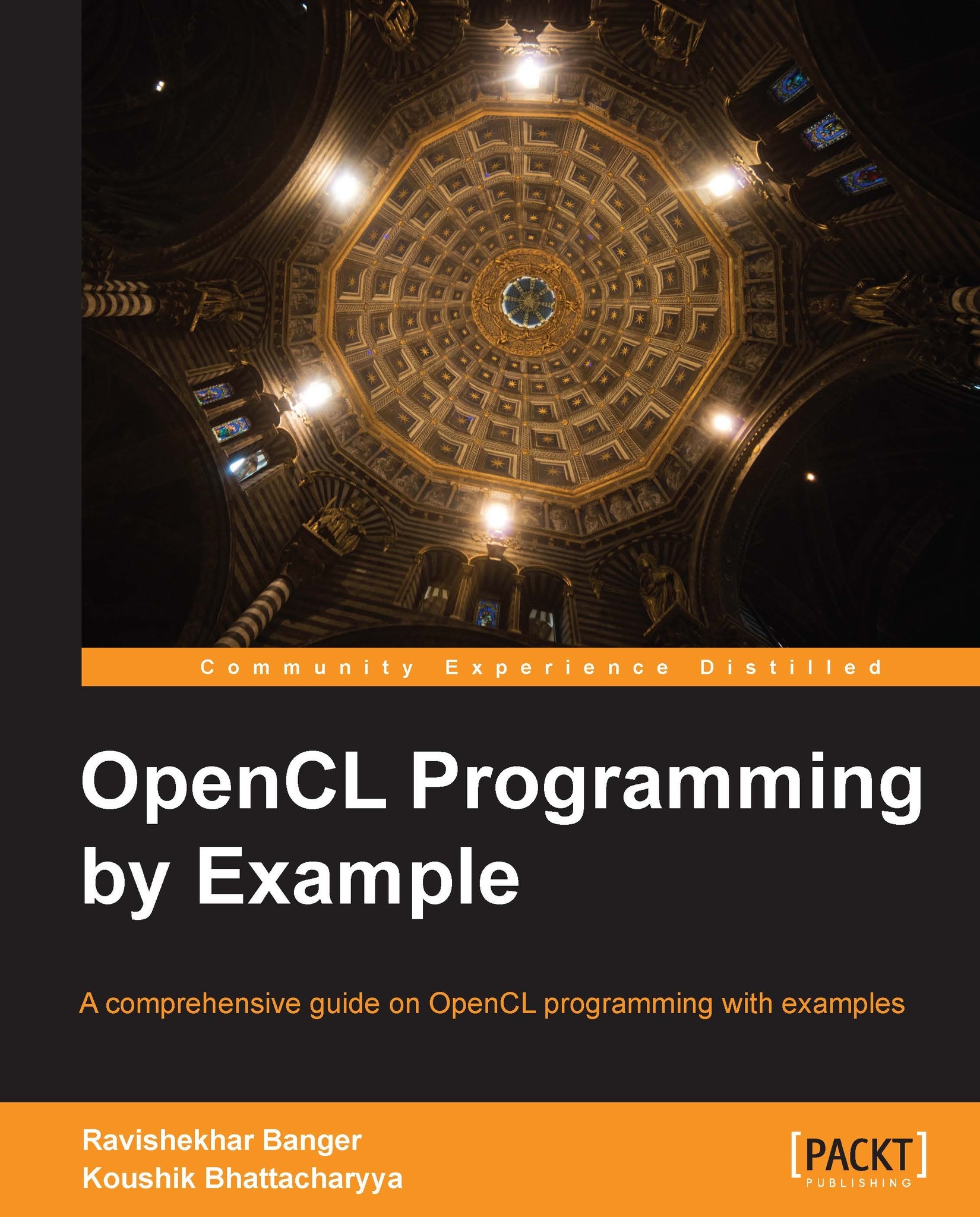
OpenCL Programming by Example

OpenCL Programming by Example

By : Banger, Koushik Bhattacharyya
3.3 (7)
close
close
OpenCL Programming by Example

OpenCL Programming by Example

3.3 (7)
By: Banger, Koushik Bhattacharyya

Overview of this book

Research in parallel programming has been a mainstream topic for a decade, and will continue to be so for many decades to come. Many parallel programming standards and frameworks exist, but only take into account one type of hardware architecture. Today computing platforms come with many heterogeneous devices. OpenCL provides royalty free standard to program heterogeneous hardware. This guide offers you a compact coverage of all the major topics of OpenCL programming. It explains optimization techniques and strategies in-depth, using illustrative examples and also provides case studies from diverse fields. Beginners and advanced application developers will find this book very useful. Beginning with the discussion of the OpenCL models, this book explores their architectural view, programming interfaces and primitives. It slowly demystifies the process of identifying the data and task parallelism in diverse algorithms. It presents examples from different domains to show how the problems within different domains can be solved more efficiently using OpenCL. You will learn about parallel sorting, histogram generation, JPEG compression, linear and parabolic regression and k-nearest neighborhood, a clustering algorithm in pattern recognition. Following on from this, optimization strategies are explained with matrix multiplication examples. You will also learn how to do an interoperation of OpenGL and OpenCL. "OpenCL Programming by Example" explains OpenCL in the simplest possible language, which beginners will find it easy to understand. Developers and programmers from different domains who want to achieve acceleration for their applications will find this book very useful.
Table of Contents (13 chapters)
close
close
12
Index

Preface

This book is designed as a concise introduction to OpenCL programming for developers working on diverse domains. It covers all the major topics of OpenCL programming and illustrates them with code examples and explanations from different fields such as common algorithm, image processing, statistical computation, and machine learning. It also dedicates one chapter to Optimization techniques, where it discusses different optimization strategies on a single simple problem.

Parallel programming is a fast developing field today. As it is becoming increasingly difficult to increase the performance of a single core machine, hardware vendors see advantage in packing multiple cores in a single SOC. The GPU (Graphics Processor Unit) was initially meant for rendering better graphics which ultimately means fast floating point operation for computing pixel values. GPGPU (General purpose Graphics Processor Unit) is the technique of utilization of GPU for a general purpose computation. Since the GPU provides very high performance of floating point operations and data parallel computation, it is very well suited to be used as a co-processor in a computing system for doing data parallel tasks with high arithmetic intensity.

Before NVIDIA® came up with CUDA (Compute Unified Device Architecture) in February 2007, the typical GPGPU approach was to convert general problems' data parallel computation into some form of a graphics problem which is expressible by graphics programming APIs for the GPU. CUDA first gave a user friendly small extension of C language to write code for the GPU. But it was a proprietary framework from NVIDIA and was supposed to work on NVIDIA's GPU only.

With the growing popularity of such a framework, the requirement for an open standard architecture that would be able to support different kinds of devices from various vendors was becoming strongly perceivable. In June 2008, the Khronos compute working group was formed and they published OpenCL1.0 specification in December 2008. Multiple vendors gradually provided a tool-chain for OpenCL programming including NVIDIA OpenCL Drivers and Tools, AMD APP SDK, Intel® SDK for OpenCL application, IBM Server with OpenCL development Kit, and so on. Today OpenCL supports multi-core programming, GPU programming, cell and DSP processor programming, and so on.

In this book we discuss OpenCL with a few examples.

CONTINUE READING
83
Tech Concepts
36
Programming languages
73
Tech Tools
Icon Unlimited access to the largest independent learning library in tech of over 8,000 expert-authored tech books and videos.
Icon Innovative learning tools, including AI book assistants, code context explainers, and text-to-speech.
Icon 50+ new titles added per month and exclusive early access to books as they are being written.
OpenCL Programming by Example
notes
bookmark Notes and Bookmarks search Search in title playlist Add to playlist font-size Font size

Change the font size

margin-width Margin width

Change margin width

day-mode Day/Sepia/Night Modes

Change background colour

Close icon Search
Country selected

Close icon Your notes and bookmarks

Confirmation

Modal Close icon
claim successful

Buy this book with your credits?

Modal Close icon
Are you sure you want to buy this book with one of your credits?
Close
YES, BUY

Submit Your Feedback

Modal Close icon
Modal Close icon
Modal Close icon