
Sign In Start Free Trial
Account

Add to playlist

Create a Playlist

Modal Close icon
You need to login to use this feature.
  • Book Overview & Buying Hands-On Penetration Testing with Python
  • Table Of Contents Toc
Hands-On Penetration Testing with Python

Hands-On Penetration Testing with Python

By : Furqan Khan
3.7 (3)
close
close
Hands-On Penetration Testing with Python

Hands-On Penetration Testing with Python

3.7 (3)
By: Furqan Khan

Overview of this book

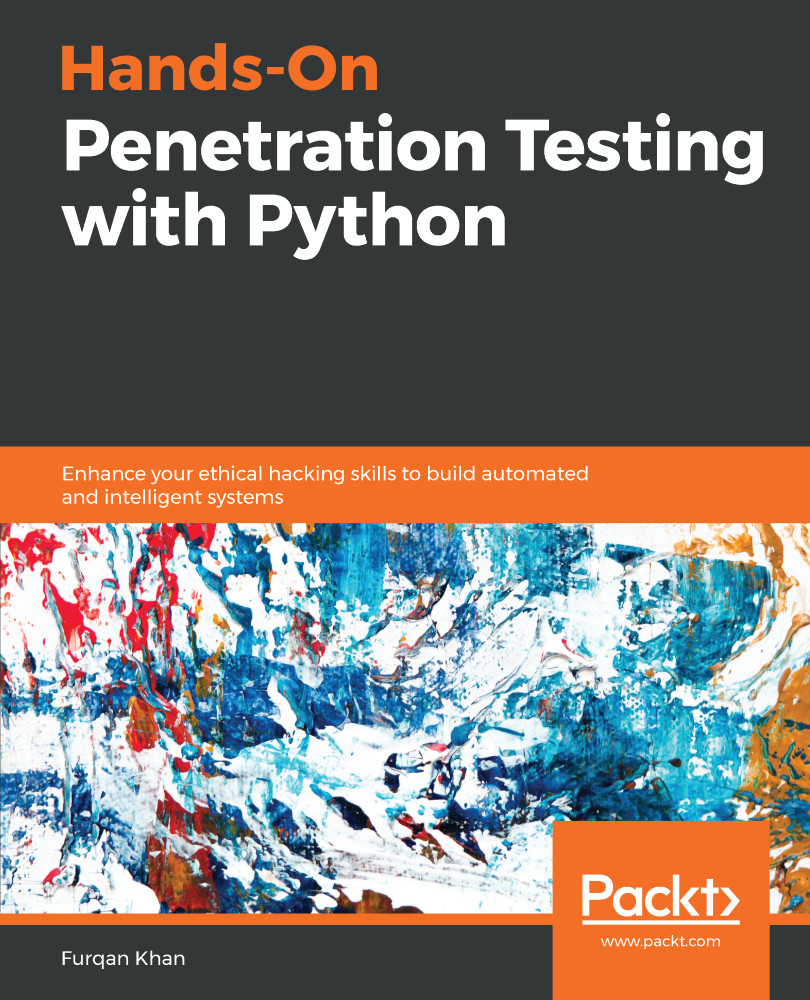
With the current technological and infrastructural shift, penetration testing is no longer a process-oriented activity. Modern-day penetration testing demands lots of automation and innovation; the only language that dominates all its peers is Python. Given the huge number of tools written in Python, and its popularity in the penetration testing space, this language has always been the first choice for penetration testers. Hands-On Penetration Testing with Python walks you through advanced Python programming constructs. Once you are familiar with the core concepts, you’ll explore the advanced uses of Python in the domain of penetration testing and optimization. You’ll then move on to understanding how Python, data science, and the cybersecurity ecosystem communicate with one another. In the concluding chapters, you’ll study exploit development, reverse engineering, and cybersecurity use cases that can be automated with Python. By the end of this book, you’ll have acquired adequate skills to leverage Python as a helpful tool to pentest and secure infrastructure, while also creating your own custom exploits.
Table of Contents (18 chapters)
close
close

Stack buffer overflow in Linux

Most vulnerabilities are flaws that arise due to conditions that the developer hasn't thought of. The most common vulnerability is a stack buffer overflow. This means that we define some sort of buffer that is not large enough for the storage we require. This is more of a problem when the input is controlled by the end-level user because this means it can be exploited.

In software, a stack buffer overflow or stack buffer overrun occurs when a program writes to a memory address on the program's call stack (as we know, every function has its own execution stack or is allocated a stack memory where it is executed) outside the intended data structure, which is usually a fixed-length buffer. A stack buffer overflow almost always results in the corruption of the adjacent data on the stack, and in cases where the overflow was triggered by mistake...

CONTINUE READING
83
Tech Concepts
36
Programming languages
73
Tech Tools
Icon Unlimited access to the largest independent learning library in tech of over 8,000 expert-authored tech books and videos.
Icon Innovative learning tools, including AI book assistants, code context explainers, and text-to-speech.
Icon 50+ new titles added per month and exclusive early access to books as they are being written.
Hands-On Penetration Testing with Python
notes
bookmark Notes and Bookmarks search Search in title playlist Add to playlist download Download options font-size Font size

Change the font size

margin-width Margin width

Change margin width

day-mode Day/Sepia/Night Modes

Change background colour

Close icon Search
Country selected

Close icon Your notes and bookmarks

Confirmation

Modal Close icon
claim successful

Buy this book with your credits?

Modal Close icon
Are you sure you want to buy this book with one of your credits?
Close
YES, BUY

Submit Your Feedback

Modal Close icon
Modal Close icon
Modal Close icon