Sign In Start Free Trial
Account

Add to playlist

Create a Playlist

Modal Close icon
You need to login to use this feature.
  • Book Overview & Buying Hands-On Cryptography with Python
  • Table Of Contents Toc
  • Feedback & Rating feedback
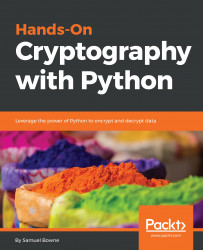
Hands-On Cryptography with Python

Hands-On Cryptography with Python

By : Samuel Bowne
3.8 (4)
close
close
Hands-On Cryptography with Python

Hands-On Cryptography with Python

3.8 (4)
By: Samuel Bowne

Overview of this book

Cryptography is essential for protecting sensitive information, but it is often performed inadequately or incorrectly. Hands-On Cryptography with Python starts by showing you how to encrypt and evaluate your data. The book will then walk you through various data encryption methods,such as obfuscation, hashing, and strong encryption, and will show how you can attack cryptographic systems. You will learn how to create hashes, crack them, and will understand why they are so different from each other. In the concluding chapters, you will use three NIST-recommended systems: the Advanced Encryption Standard (AES), the Secure Hash Algorithm (SHA), and the Rivest-Shamir-Adleman (RSA). By the end of this book, you will be able to deal with common errors in encryption.
Table of Contents (5 chapters)
close
close

MD5 and SHA hashes


After explaining what a hash function is, we will deal with MD5 and then the SHA family: SHA-1, SHA-2, and SHA-3. We will also acquire a bit of information about cracking hashes.

What are hashes?

As mentioned earlier, one point of using hashes is to put a fingerprint on a file. You can take all the bytes in the file and combine them together with a hash algorithm, and this creates a fixed-links hash value. If you change any part of the file and recalculate the hash, you get a completely different value. So, the idea is that if you have two files that are supposed to be identical, you can calculate the hash of each file, and if the hash of both files match, then the files are identical.

A very common hash is MD5; it's been around for a couple of decades. It's 128 bits long, which is rather short for a hash function, and it's reliable enough for most purposes. People use it to put a fingerprint on downloads, and malware samples, and all sorts of things, and they are also sometimes...

Visually different images
CONTINUE READING
83
Tech Concepts
36
Programming languages
73
Tech Tools
Icon Unlimited access to the largest independent learning library in tech of over 8,000 expert-authored tech books and videos.
Icon Innovative learning tools, including AI book assistants, code context explainers, and text-to-speech.
Icon 50+ new titles added per month and exclusive early access to books as they are being written.
Hands-On Cryptography with Python
notes
bookmark Notes and Bookmarks search Search in title playlist Add to playlist download Download options font-size Font size

Change the font size

margin-width Margin width

Change margin width

day-mode Day/Sepia/Night Modes

Change background colour

Close icon Search
Country selected

Close icon Your notes and bookmarks

Confirmation

Modal Close icon
claim successful

Buy this book with your credits?

Modal Close icon
Are you sure you want to buy this book with one of your credits?
Close
YES, BUY

Submit Your Feedback

Modal Close icon
Modal Close icon
Modal Close icon