




Node's process object provides information on and control over the current running process. It is an instance of EventEmitter is accessible from any scope, and exposes very useful low-level pointers. Consider the following program:
const size = process.argv[2];
const n = process.argv[3] || 100;
const buffers = [];
let i;
for (i = 0; i < n; i++) {
  buffers.push(Buffer.alloc(size));
  process.stdout.write(process.memoryUsage().heapTotal + "\n");
}
Have Node run process.js with a command like this:
$ node process.js 1000000 100
The program gets the command-line arguments from process.argv, loops to allocate memory, and reports memory usage back to standard out. Instead of logging back to the terminal, you could stream output to another process, or a file:
$ node process.js 1000000 100 > output.txt
A Node process begins by constructing a single execution stack, with the global context forming the base of the stack. Functions on this stack execute within their own local context (sometimes referred to as scope), which remains enclosed within the global context. This way of keeping the execution of a function together with the environment the function runs in is called closure. Because Node is evented, any given execution context can commit the running thread to handling an eventual execution context. This is the purpose of callback functions.
Consider the following schematic of a simple interface for accessing the filesystem:
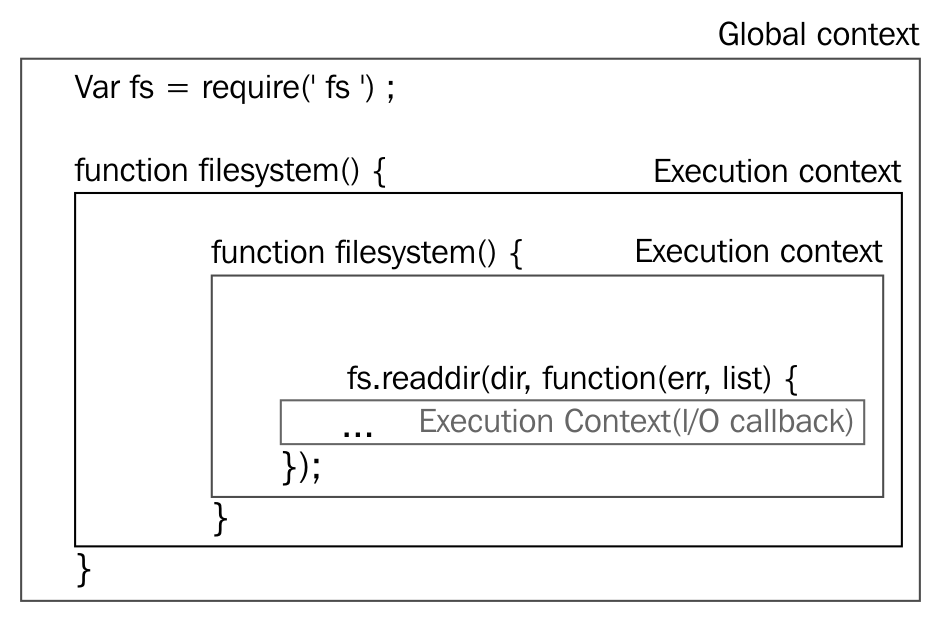
If we were to instantiate Filesystem and call readDir, a nested execution context structure would be created:
(global (fileSystem (readDir (anonymous function) ) ) )
Inside Node, a C library named libuv creates and manages the event loop. It connects to low-level operating system kernel mode objects that can produce events, such as timers that go off, sockets that receive data, files that open for reading, and child processes that complete. It loops while there are still events to process, and calls callbacks associated with events. It does this at a very low level, and with a very performant architecture. Written for Node, libuv is now a building block of a number of software platforms and languages.
The concomitant execution stack is introduced to Node's single-process thread. This stack remains in memory until libuv reports that fs.readdir has completed, at which point the registered anonymous callback fires, resolving the sole pending execution context. As no further events are pending, and the maintenance of closures no longer necessary, the entire structure can be safely torn down (in reverse, beginning with anonymous), and the process can exit, freeing any allocated memory. This method of building up and tearing down a single stack is what Node's event loop is ultimately doing.


