
Sign In Start Free Trial
Account

Add to playlist

Create a Playlist

Modal Close icon
You need to login to use this feature.
  • Book Overview & Buying Mastering  Node.js
  • Table Of Contents Toc
Mastering  Node.js

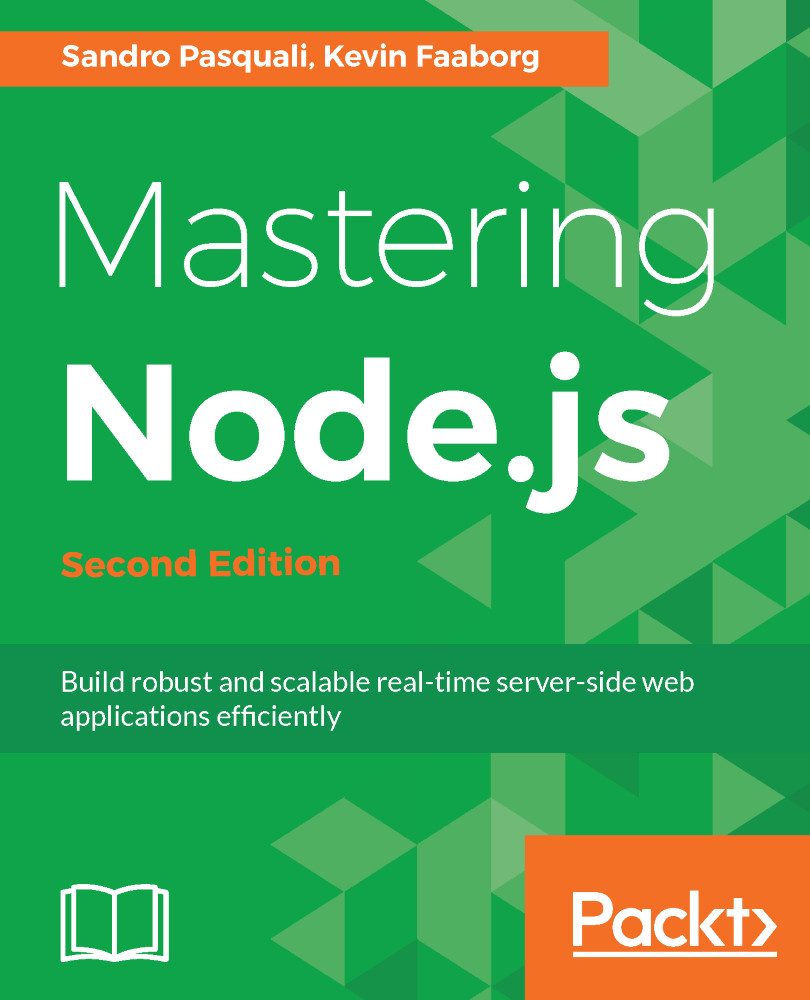
Mastering Node.js - Second Edition

By : Sandro Pasquali, Kevin Faaborg
3.6 (9)
close
close
Mastering  Node.js

Mastering Node.js

3.6 (9)
By: Sandro Pasquali, Kevin Faaborg

Overview of this book

Node.js, a modern development environment that enables developers to write server- and client-side code with JavaScript, thus becoming a popular choice among developers. This book covers the features of Node that are especially helpful to developers creating highly concurrent real-time applications. It takes you on a tour of Node's innovative event non-blocking design, showing you how to build professional applications. This edition has been updated to cover the latest features of Node 9 and ES6. All code examples and demo applications have been completely rewritten using the latest techniques, introducing Promises, functional programming, async/await, and other cutting-edge patterns for writing JavaScript code. Learn how to use microservices to simplify the design and composition of distributed systems. From building serverless cloud functions to native C++ plugins, from chatbots to massively scalable SMS-driven applications, you'll be prepared for building the next generation of distributed software. By the end of this book, you'll be building better Node applications more quickly, with less code and more power, and know how to run them at scale in production environments.
Table of Contents (13 chapters)
close
close

Containerized microservices

The Amazon AWS infrastructure is able to create services like Lambda because their engineers no longer provision hardware (ie. new physical servers) when customers create another cloud function or API. Instead, they provision lightweight VM (Virtual Machines). Nobody is lifting a big new metal box onto a rack when you sign up. Software is the new hardware.

Containers aim for the same general architectural idea and advantages that virtualized servers provide —to mass produce virtualized, independent, machines. The main difference is that while a VM provides its own OS (typically called a Hypervisor), a container requires a host OS to provide actual kernel services (such as a filesystem, other devices, and resource management and scheduling) as they do not need to carry around their own OS but operate parasitically on a host OS containers are very...

CONTINUE READING
83
Tech Concepts
36
Programming languages
73
Tech Tools
Icon Unlimited access to the largest independent learning library in tech of over 8,000 expert-authored tech books and videos.
Icon Innovative learning tools, including AI book assistants, code context explainers, and text-to-speech.
Icon 50+ new titles added per month and exclusive early access to books as they are being written.
Mastering  Node.js
notes
bookmark Notes and Bookmarks search Search in title playlist Add to playlist download Download options font-size Font size

Change the font size

margin-width Margin width

Change margin width

day-mode Day/Sepia/Night Modes

Change background colour

Close icon Search
Country selected

Close icon Your notes and bookmarks

Confirmation

Modal Close icon
claim successful

Buy this book with your credits?

Modal Close icon
Are you sure you want to buy this book with one of your credits?
Close
YES, BUY

Submit Your Feedback

Modal Close icon
Modal Close icon
Modal Close icon