


-
Book Overview & Buying
-
Table Of Contents

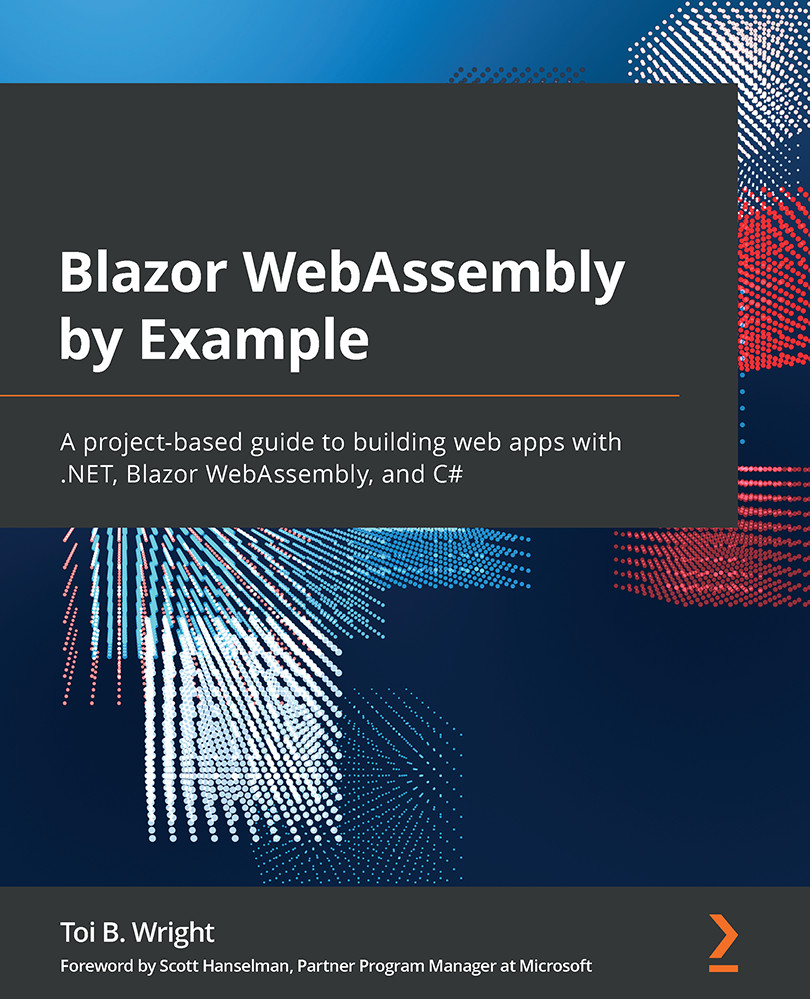
Blazor WebAssembly by Example
By :


Blazor WebAssembly by Example
By:
Overview of this book
Blazor WebAssembly makes it possible to run C# code on the browser instead of having to use JavaScript, and does not rely on plugins or add-ons. The only technical requirement for using Blazor WebAssembly is a browser that supports WebAssembly, which, as of today, all modern browsers do. Blazor WebAssembly by Example is a project-based guide for learning how to build single-page web applications using the Blazor WebAssembly framework. This book emphasizes the practical over the theoretical by providing detailed step-by-step instructions for each project.
You'll start by building simple standalone web applications and progress to developing more advanced hosted web applications with SQL Server backends. Each project covers a different aspect of the Blazor WebAssembly ecosystem, such as Razor components, JavaScript interop, event handling, application state, and dependency injection. The book is designed in such a way that you can complete the projects in any order.
By the end of this book, you will have experience building a wide variety of single-page web applications with .NET, Blazor WebAssembly, and C#.
Table of Contents (11 chapters)
Preface


Chapter 1: Introduction to Blazor WebAssembly
 Free Chapter
Chapter 2: Building Your First Blazor WebAssembly Application
Chapter 3: Building a Modal Dialog Using Templated Components
Chapter 4: Building a Local Storage Service Using JavaScript Interoperability (JS Interop)
Chapter 5: Building a Weather App as a Progressive Web App (PWA)
Chapter 6: Building a Shopping Cart Using Application State
Chapter 7: Building a Kanban Board Using Events
Chapter 8: Building a Task Manager Using ASP.NET Web API
Chapter 9: Building an Expense Tracker Using the EditForm Component


