Sign In Start Free Trial
Account

Add to playlist

Create a Playlist

Modal Close icon
You need to login to use this feature.
  • Book Overview & Buying Learning Angular
  • Table Of Contents Toc
  • Feedback & Rating feedback
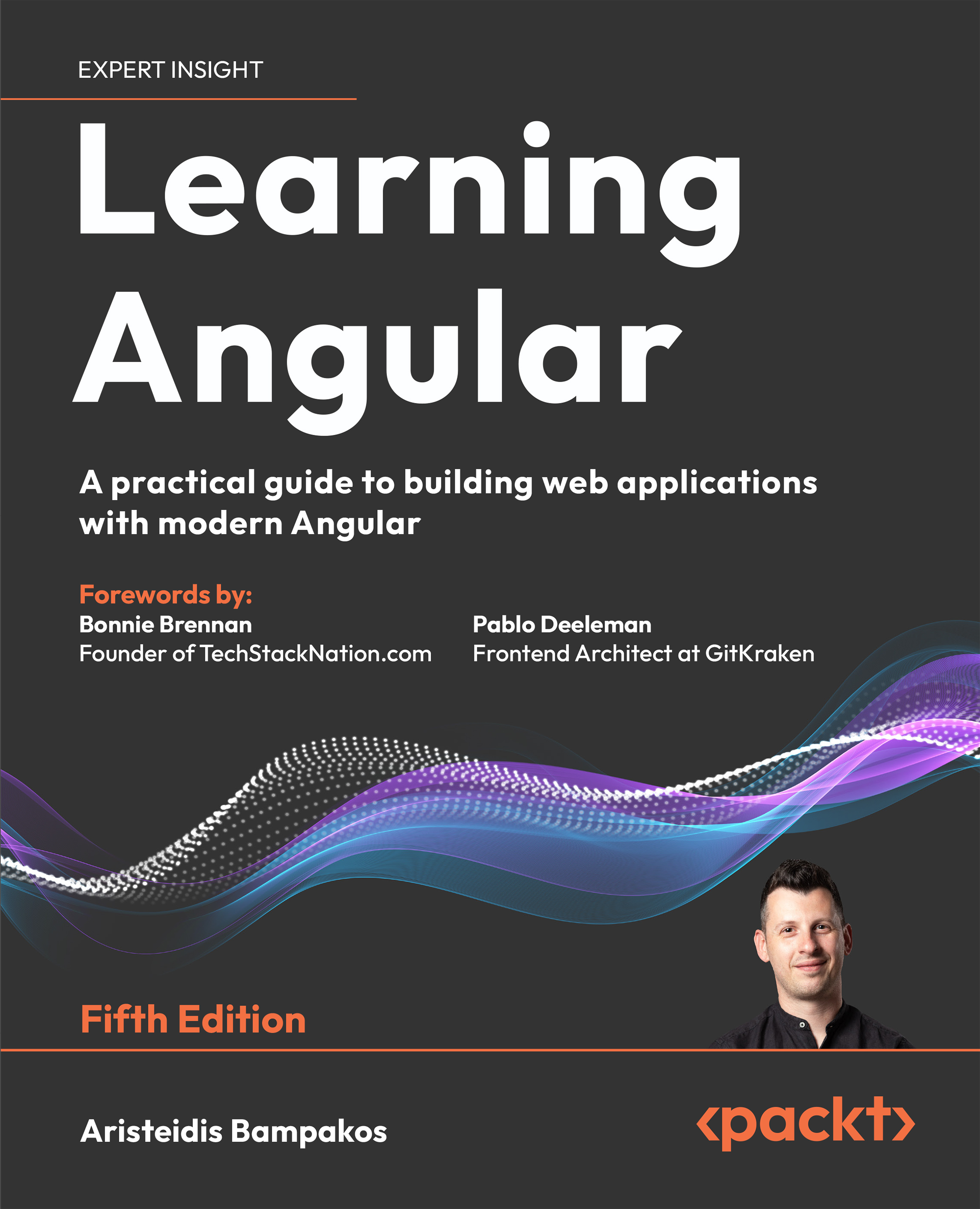
Learning Angular

Learning Angular - Fifth Edition

By : Aristeidis Bampakos
4.1 (7)
close
close
Learning Angular

Learning Angular

4.1 (7)
By: Aristeidis Bampakos

Overview of this book

Dive into Angular Development — With the Most Trusted Guide in the Industry Angular is one of the most powerful and widely adopted JavaScript frameworks, and Learning Angular is your go-to guide for building real-world, production-ready web applications. Written by a seasoned Angular developer and Google Developer Expert, this hands-on book takes you through every step of modern frontend development. This edition reflects the latest “Angular Renaissance,” covering standalone components, Angular Signals, and the new control flow syntax, while showing you how to integrate with legacy code. A new chapter also explores boosting performance with server-side rendering (SSR) and hydration. More than just a tutorial, Learning Angular builds your confidence chapter by chapter from scaffolding your first project to deploying it, with TypeScript best practices throughout. Whether you’re new to Angular or sharpening your skills, this book provides a complete path to becoming a productive, future-ready Angular developer. By the end, you’ll be able to build Angular apps from scratch, with clarity, structure, and confidence.
Table of Contents (19 chapters)
close
close
17
Other Books You May Enjoy
18
Index

Why choose Angular?

The power of the Angular framework is based on the combination of the following characteristics:

  • The main pillars of the framework:
    • Cross-platform
    • Incredible tooling
    • Easy onboarding
  • The usage of Angular worldwide:
    • An amazing community
    • Battle-tested against Google products

In the following sections, we will examine each characteristic in more detail.

Cross-platform

Angular applications can run on different platforms: web, server, desktop, and mobile. Angular can run natively only on the web because it is a web framework; however, it is open-source and is backed by incredible tooling that enables the framework to run on the remaining three using the following tools:

  • Angular SSR: Renders Angular applications server-side
  • Angular service worker: Enables Angular applications to run as Progressive Web Applications (PWAs) that can execute in desktop and native mobile environments
  • Ionic/NativeScript: Allows us to build mobile applications using Angular

The next pillar of the framework describes the tooling available in the Angular ecosystem.

Tooling

The Angular team has built two great tools that make Angular development easy and fun:

  • Angular CLI: A command-line interface that allows us to work with Angular projects, from scaffolding to testing and deployment
  • Angular DevTools: A browser extension that enables us to inspect and profile Angular applications from the comfort of our browser

The Angular CLI is the de facto solution to work with Angular applications. It allows the developer to focus on writing application code, eliminating the boilerplate of configuration tasks such as scaffolding, building, testing, and deploying an Angular application.

Onboarding

It is simple and easy to start with Angular development because when we install Angular, we also get a rich collection of first-party libraries out of the box, including:

  • An Angular HTTP client to communicate with external resources over HTTP
  • Angular forms to create HTML forms to collect input and data from users
  • An Angular router to perform in-app navigations

The preceding libraries are installed by default when we create a new Angular application using the Angular CLI. However, they are only used in our application if we import them explicitly into our project.

The usage of Angular worldwide

Many companies use Angular for their websites and web applications. The website https://www.madewithangular.com contains an extensive list of those companies, including some popular ones.

Additionally, Angular is used in thousands of projects by Google and by millions of developers worldwide. The fact that Angular is already used internally at Google is a crucial factor in the reliability of the framework. Every new version of Angular is thoroughly tested in those projects before becoming available to the public. The testing process helps the Angular team catch bugs early and delivers a top-quality framework to the rest of the developer community.

Angular is backed and supported by a thriving developer community. Developers can access many available communities worldwide, online or locally, to get help and guidance with the Angular framework. On the other hand, communities help the Angular framework progress by sharing feedback on new features, testing new ideas, and reporting issues. Some of the most popular online communities are:

  • Tech Stack Nation: The world’s friendliest Angular study group that brings together Angular developers who are passionate about improving their confidence in building amazing Angular applications. Tech Stack Nation is a community where Angular developers can collaborate, learn from each other’s expertise, and push the boundaries of what Angular can achieve. You can join Tech Stack Nation at https://techstacknation.com.
  • Angular Community Discord: Angular’s official Discord server that brings the incredible Angular community together. Everyone is welcome to join the community with the click of a button. It is the central location to connect Angular team members, Google Developer Experts (GDEs), library authors, meetup groups, and anyone interested in learning the framework. You can join the Angular Community Discord server at https://discord.gg/angular.
  • Angular.love: A community platform for Angular enthusiasts, supported by House of Angular, to facilitate the growth of Angular developers through knowledge-sharing initiatives. It started as a blog where experts published articles about Angular news, features, and best practices. Now, Angular.love also organizes in-person and online meetups, frequently featuring GDEs. You can join Angular.love at https://angular.love.

Now that we have seen what Angular is and why someone should choose it for web development, we will learn how to use it and build great web applications.

Visually different images
CONTINUE READING
83
Tech Concepts
36
Programming languages
73
Tech Tools
Icon Unlimited access to the largest independent learning library in tech of over 8,000 expert-authored tech books and videos.
Icon Innovative learning tools, including AI book assistants, code context explainers, and text-to-speech.
Icon 50+ new titles added per month and exclusive early access to books as they are being written.
Learning Angular
notes
bookmark Notes and Bookmarks search Search in title playlist Add to playlist download Download options font-size Font size

Change the font size

margin-width Margin width

Change margin width

day-mode Day/Sepia/Night Modes

Change background colour

Close icon Search
Country selected

Close icon Your notes and bookmarks

Confirmation

Modal Close icon
claim successful

Buy this book with your credits?

Modal Close icon
Are you sure you want to buy this book with one of your credits?
Close
YES, BUY

Submit Your Feedback

Modal Close icon
Modal Close icon
Modal Close icon