Sign In Start Free Trial
Account

Add to playlist

Create a Playlist

Modal Close icon
You need to login to use this feature.
  • Book Overview & Buying Real-World Web Development with .NET 9
  • Table Of Contents Toc
  • Feedback & Rating feedback
Real-World Web Development with .NET 9

Real-World Web Development with .NET 9

By : Mark J. Price
3.5 (4)
close
close
Real-World Web Development with .NET 9

Real-World Web Development with .NET 9

3.5 (4)
By: Mark J. Price

Overview of this book

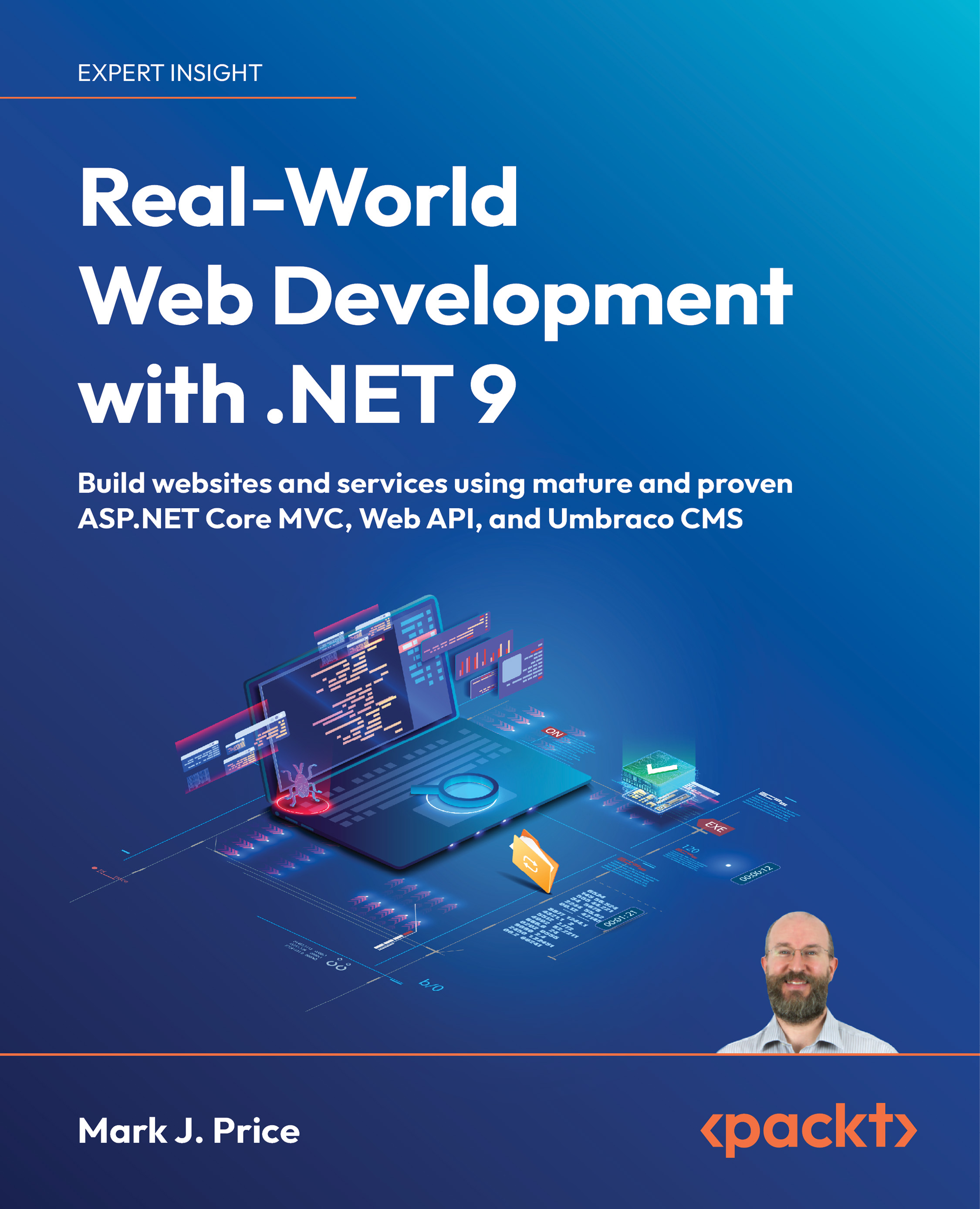
Real-World Web Development with .NET 9 equips you to build professional websites and services using proven technologies like ASP.NET Core MVC, Web API, and OData—trusted by organizations for delivering robust web applications. You’ll learn to design and build efficient web applications with ASP.NET Core MVC, creating well-structured, maintainable code that follows industry best practices. From there, you’ll focus on Web API, building RESTful services that are both secure and scalable. Along the way, you’ll also explore testing, authentication, and containerization for deployment, ensuring that your solutions are fully production ready. In the final part of the book, you will be introduced to Umbraco CMS, a popular content management system for .NET. By mastering this tool, you’ll learn how to empower users to manage website content independently. By the end of this book, you'll not only have a solid grasp of controller-based development but also the practical know-how to build dynamic, content-driven websites using a popular .NET CMS.
Table of Contents (17 chapters)
close
close

Practicing and exploring

Test your knowledge and understanding by answering some questions, getting some hands-on practice, and exploring this chapter’s topics with deeper research.

Exercise 1.1 – Online material

If you have any issues with the code or content of this book, or general feedback or suggestions for me for future editions, then please read the following short article:

https://github.com/markjprice/web-dev-net9/blob/main/docs/ch01-issues-feedback.md

If you are new to web development on the client side using HTML, CSS, and JavaScript, then you can start with an online section found at the following link:

https://github.com/markjprice/web-dev-net9/blob/main/docs/ch01-web-dev.md

One of the best sites for learning client-side web development is W3Schools, found at https://www.w3schools.com/.

A summary of what’s new with ASP.NET Core 9 can be found at the following link:

https://learn.microsoft.com/en-us/aspnet/core/release-notes/aspnetcore-9.0

If you need to decide between ASP.NET Core web UIs, check this link:

https://learn.microsoft.com/en-us/aspnet/core/tutorials/choose-web-ui

You can learn about ASP.NET Core best practices at https://learn.microsoft.com/en-us/aspnet/core/fundamentals/best-practices.

Exercise 1.2 – Practice exercises

The following practice exercises help you to explore the topics in this chapter more deeply.

Troubleshooting web development

It is common to have temporary issues with web development because there are so many moving parts. Sometimes, variations of the classic “turn it off and on again” can fix these!

  1. Delete the project’s bin and release folders.
  2. Restart the web server to clear its caches.
  3. Reboot the computer.

Exercise 1.3 – Test your knowledge

Answer the following questions:

  1. What was the name of Microsoft’s first dynamic server-side-executed web page technology and why is it still useful to know this history today?
  2. What are the names of two Microsoft web servers?
  3. What are some differences between a microservice and a nanoservice?
  4. What is Blazor?
  5. What was the first version of ASP.NET Core that could not be hosted on .NET Framework?
  6. What is a user agent?
  7. What impact does the HTTP request-response communication model have on web developers?
  8. Name and describe four components of a URL.
  9. What capabilities does Developer Tools give you?
  10. What are the three main client-side web development technologies and what do they do?

Know your webbreviations

What do the following web abbreviations stand for and what do they do?

  1. URI
  2. URL
  3. WCF
  4. TLD
  5. API
  6. SPA
  7. CMS
  8. Wasm
  9. SASS
  10. REST

Exercise 1.4 – Explore topics

Use the links on the following page to learn more details about the topics covered in this chapter:

https://github.com/markjprice/web-dev-net9/blob/main/docs/book-links.md#chapter-1---introducing-web-development-using-controllers

Visually different images
CONTINUE READING
83
Tech Concepts
36
Programming languages
73
Tech Tools
Icon Unlimited access to the largest independent learning library in tech of over 8,000 expert-authored tech books and videos.
Icon Innovative learning tools, including AI book assistants, code context explainers, and text-to-speech.
Icon 50+ new titles added per month and exclusive early access to books as they are being written.
Real-World Web Development with .NET 9
notes
bookmark Notes and Bookmarks search Search in title playlist Add to playlist download Download options font-size Font size

Change the font size

margin-width Margin width

Change margin width

day-mode Day/Sepia/Night Modes

Change background colour

Close icon Search
Country selected

Close icon Your notes and bookmarks

Confirmation

Modal Close icon
claim successful

Buy this book with your credits?

Modal Close icon
Are you sure you want to buy this book with one of your credits?
Close
YES, BUY

Submit Your Feedback

Modal Close icon
Modal Close icon
Modal Close icon