


-
Book Overview & Buying
-
Table Of Contents

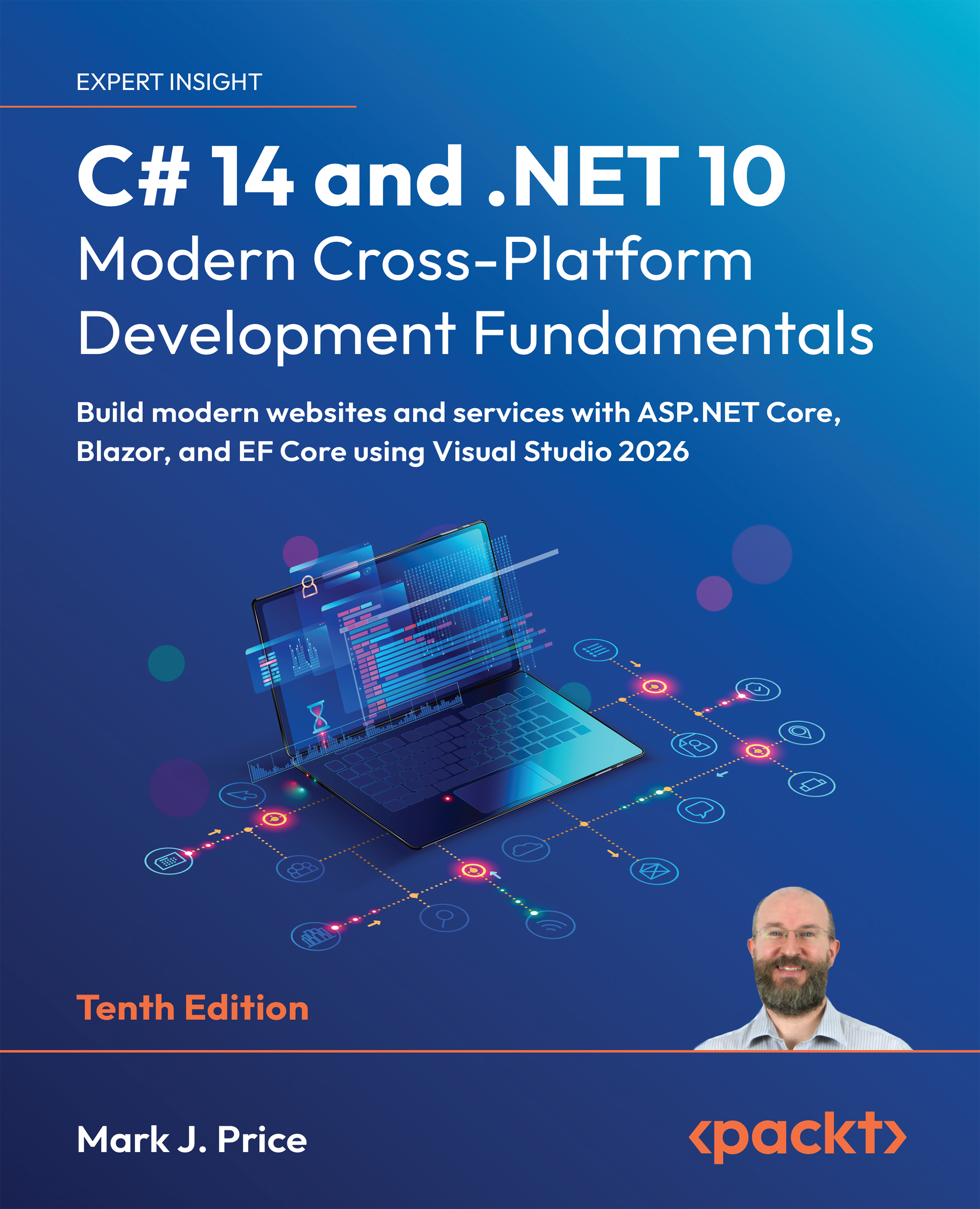
C# 14 and .NET 10 – Modern Cross-Platform Development Fundamentals - Tenth Edition
By :


C# 14 and .NET 10 – Modern Cross-Platform Development Fundamentals
By:
Overview of this book
C# and .NET continue to power modern cross-platform and enterprise development. With the release of C# 14 and .NET 10, developers gain access to a more capable, efficient, and future-ready platform for building websites, services, and applications across Windows, Linux, and macOS.
This fully updated tenth edition takes a practical, hands-on approach. You’ll start with core C# and object-oriented programming concepts, then progress through building, testing, and debugging applications while working with .NET libraries, filesystems, serialization, and LINQ. The book covers key C# 14 enhancements—such as field modifiers, partial events, and instance constructors, explained through real-world examples.
You’ll also build modern web solutions using ASP.NET Core 10, Blazor, and Minimal APIs, including support for native AOT compilation, making this book well suited for cloud-native, microservice, and container-based development.
By the end of the book, you’ll be confident in building maintainable, high-performance websites and services aligned with modern .NET development practices.
Table of Contents (19 chapters)
Preface


 Free Chapter
Hello, C#! Welcome, .NET!
Speaking C#
Controlling Flow, Converting Types, and Handling Exceptions
Writing, Debugging, and Testing Functions
Building Your Own Types with Object-Oriented Programming
Implementing Interfaces and Inheriting Classes

Packaging and Distributing .NET Types
Working with Common .NET Types
Working with Files, Streams, and Serialization
Working with Data Using Entity Framework Core
Querying and Manipulating Data Using LINQ
Introducing Modern Web Development Using .NET
Building Websites Using ASP.NET Core
Building Interactive Web Components Using Blazor
Building and Consuming Web Services
Unlock Your Exclusive Benefits
Epilogue
Index


