Sign In Start Free Trial
Account

Add to playlist

Create a Playlist

Modal Close icon
You need to login to use this feature.
  • Book Overview & Buying Django 3 By Example
  • Table Of Contents Toc
Django 3 By Example

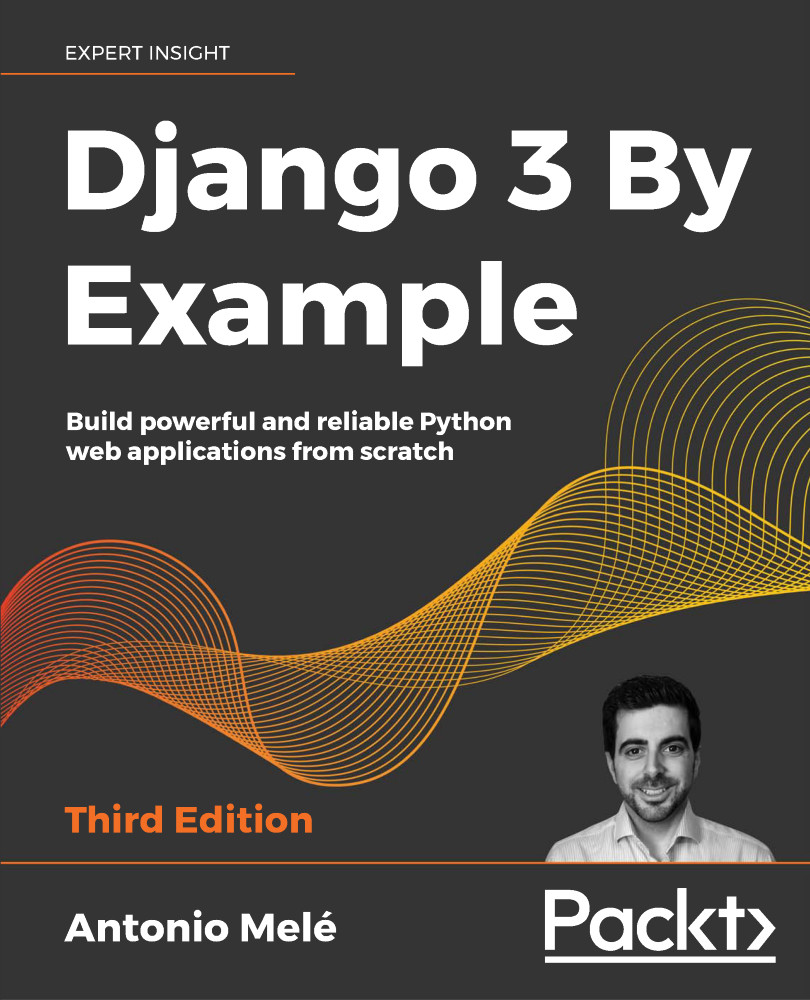
Django 3 By Example - Third Edition

By : Antonio Melé
4.3 (26)
close
close
Django 3 By Example

Django 3 By Example

4.3 (26)
By: Antonio Melé

Overview of this book

If you want to learn the entire process of developing professional web applications with Python and Django, then this book is for you. In the process of building four professional Django projects, you will learn about Django 3 features, how to solve common web development problems, how to implement best practices, and how to successfully deploy your applications. In this book, you will build a blog application, a social image bookmarking website, an online shop, and an e-learning platform. Step-by-step guidance will teach you how to integrate popular technologies, enhance your applications with AJAX, create RESTful APIs, and set up a production environment for your Django projects. By the end of this book, you will have mastered Django 3 by building advanced web applications.
Table of Contents (17 chapters)
close
close
15
Other Books You May Enjoy
16
Index

Adding pagination

When you start adding content to your blog, you might easily reach the point where tens or hundreds of posts are stored in your database. Instead of displaying all the posts on a single page, you may want to split the list of posts across several pages. This can be achieved through pagination. You can define the number of posts you want to be displayed per page and retrieve the posts that correspond to the page requested by the user. Django has a built-in pagination class that allows you to manage paginated data easily.

Edit the views.py file of the blog application to import the Django paginator classes and modify the post_list view, as follows:

from django.core.paginator import Paginator, EmptyPage,\
                                  PageNotAnInteger
def post_list(request):
    object_list = Post.published.all()
    paginator = Paginator(object_list, 3) # 3 posts in each page
    page = request.GET.get('page')
    try:
        posts = paginator...
Visually different images
CONTINUE READING
83
Tech Concepts
36
Programming languages
73
Tech Tools
Icon Unlimited access to the largest independent learning library in tech of over 8,000 expert-authored tech books and videos.
Icon Innovative learning tools, including AI book assistants, code context explainers, and text-to-speech.
Icon 50+ new titles added per month and exclusive early access to books as they are being written.
Django 3 By Example
notes
bookmark Notes and Bookmarks search Search in title playlist Add to playlist download Download options font-size Font size

Change the font size

margin-width Margin width

Change margin width

day-mode Day/Sepia/Night Modes

Change background colour

Close icon Search
Country selected

Close icon Your notes and bookmarks

Confirmation

Modal Close icon
claim successful

Buy this book with your credits?

Modal Close icon
Are you sure you want to buy this book with one of your credits?
Close
YES, BUY

Submit Your Feedback

Modal Close icon
Modal Close icon
Modal Close icon