Sign In Start Free Trial
Account

Add to playlist

Create a Playlist

Modal Close icon
You need to login to use this feature.
  • Book Overview & Buying Django 3 By Example
  • Table Of Contents Toc
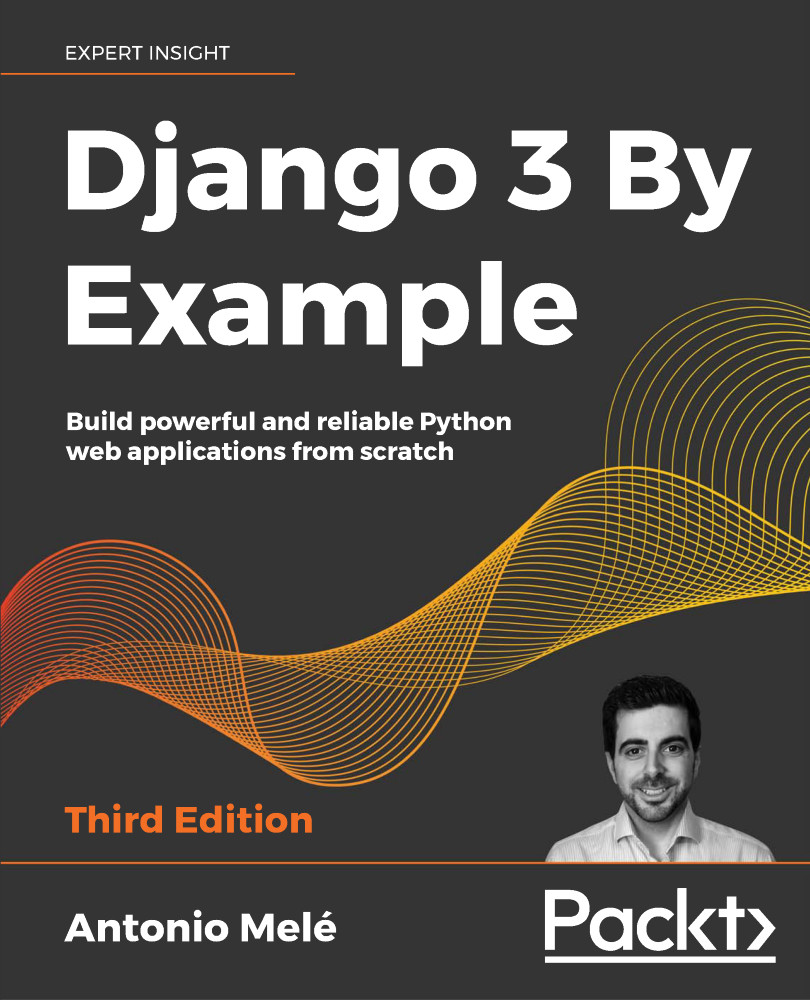
Django 3 By Example

Django 3 By Example - Third Edition

By : Antonio Melé
4.3 (26)
close
close
Django 3 By Example

Django 3 By Example

4.3 (26)
By: Antonio Melé

Overview of this book

If you want to learn the entire process of developing professional web applications with Python and Django, then this book is for you. In the process of building four professional Django projects, you will learn about Django 3 features, how to solve common web development problems, how to implement best practices, and how to successfully deploy your applications. In this book, you will build a blog application, a social image bookmarking website, an online shop, and an e-learning platform. Step-by-step guidance will teach you how to integrate popular technologies, enhance your applications with AJAX, create RESTful APIs, and set up a production environment for your Django projects. By the end of this book, you will have mastered Django 3 by building advanced web applications.
Table of Contents (17 chapters)
close
close
15
Other Books You May Enjoy
16
Index

Enhancing Your Blog with Advanced Features

In the preceding chapter, you created a basic blog application. Next, you will turn your application into a fully functional blog with the advanced functionalities that many blogs feature nowadays. You will implement the following features in your blog:

  • Sharing posts via email: When readers like an article, they might want to share it with somebody else. You will implement the functionality to share posts via email.
  • Adding comments to a post: Many people want to allow their audience to comment on posts and create discussions. You will let your readers add comments to your blog posts.
  • Tagging posts: Tags allow you to categorize content in a non-hierarchical manner, using simple keywords. You will implement a tagging system, which is a very popular feature for blogs.
  • Recommending similar posts: Once you have a classification method in place, such as a tagging system, you can use it to provide content recommendations to your readers. You will build a system that recommends other posts that share tags with a certain blog post.

These functionalities will turn your application into a fully featured blog.

In this chapter, we will cover the following topics:

  • Sending emails with Django
  • Creating forms and handling them in views
  • Creating forms from models
  • Integrating third-party applications
  • Building complex QuerySets
Visually different images
CONTINUE READING
83
Tech Concepts
36
Programming languages
73
Tech Tools
Icon Unlimited access to the largest independent learning library in tech of over 8,000 expert-authored tech books and videos.
Icon Innovative learning tools, including AI book assistants, code context explainers, and text-to-speech.
Icon 50+ new titles added per month and exclusive early access to books as they are being written.
Django 3 By Example
notes
bookmark Notes and Bookmarks search Search in title playlist Add to playlist download Download options font-size Font size

Change the font size

margin-width Margin width

Change margin width

day-mode Day/Sepia/Night Modes

Change background colour

Close icon Search
Country selected

Close icon Your notes and bookmarks

Confirmation

Modal Close icon
claim successful

Buy this book with your credits?

Modal Close icon
Are you sure you want to buy this book with one of your credits?
Close
YES, BUY

Submit Your Feedback

Modal Close icon
Modal Close icon
Modal Close icon