Sign In Start Free Trial
Account

Add to playlist

Create a Playlist

Modal Close icon
You need to login to use this feature.
  • Book Overview & Buying Learning Adobe Muse
  • Table Of Contents Toc
Learning Adobe Muse

Learning Adobe Muse

By : Jennifer Farley
4.2 (5)
close
close
Learning Adobe Muse

Learning Adobe Muse

4.2 (5)
By: Jennifer Farley

Overview of this book

Adobe Muse is an exciting new tool from the world's foremost design software company which allows users to create beautiful and fully functioning websites without writing any code. It provides graphic designers the power to use their print design skills over the Web. This book will help web designers as well as graphic designers to master Adobe Muse quickly. It will provide step-by-step instructions that guide you through building a website with Adobe Muse."Learning Adobe Muse" will teach you how to plan, design and publish websites using Adobe Muse. It starts by covering the tools and interface of the program and moves on to the concepts you'll need to understand for laying out your web pages. You'll learn how to format text using reusable styles, add images, create a clean navigation system, and add interactive elements such as panels and slideshows to your pages and all this without writing a single line of code!By the end of the book you will have created a smartlydesigned, fully-functioning website.
Table of Contents (18 chapters)
close
close
Learning Adobe Muse
Credits
About the Author
About the Reviewers
www.PacktPub.com
Preface

Pages


The vast majority of websites are made up of at least two pages, which are linked together. Again, in most of these websites there will be shared or consistent attributes across the pages that make up the site. As we saw in the previous chapter, Muse lets us easily create a site structure where we can organize and maintain our pages.

When creating our websites, it's a good practice to follow a style or standard format throughout all the pages in the site. While the content, which is the information you provide, will change from page to page, some elements such as the logo or navigation bar will remain the same, having the same size and position on the pages.

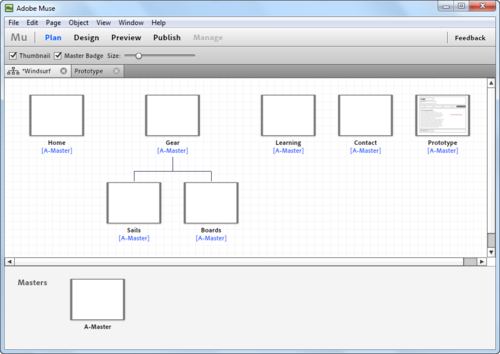
In this chapter, we'll continue building using the site structure we set up for the Windsurfing site and make changes to the master page, so that those design elements will appear on each page of our site. The following screenshot shows the sitemap as seen in the Muse's Plan view:

Notice that the Prototype thumbnail shows us the content...

CONTINUE READING
83
Tech Concepts
36
Programming languages
73
Tech Tools
Icon Unlimited access to the largest independent learning library in tech of over 8,000 expert-authored tech books and videos.
Icon Innovative learning tools, including AI book assistants, code context explainers, and text-to-speech.
Icon 50+ new titles added per month and exclusive early access to books as they are being written.
Learning Adobe Muse
notes
bookmark Notes and Bookmarks search Search in title playlist Add to playlist font-size Font size

Change the font size

margin-width Margin width

Change margin width

day-mode Day/Sepia/Night Modes

Change background colour

Close icon Search
Country selected

Close icon Your notes and bookmarks

Confirmation

Modal Close icon
claim successful

Buy this book with your credits?

Modal Close icon
Are you sure you want to buy this book with one of your credits?
Close
YES, BUY

Submit Your Feedback

Modal Close icon
Modal Close icon
Modal Close icon