Sign In Start Free Trial
Account

Add to playlist

Create a Playlist

Modal Close icon
You need to login to use this feature.
  • Book Overview & Buying Bioinformatics with Python Cookbook
  • Table Of Contents Toc
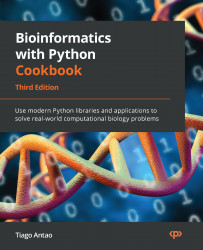
Bioinformatics with Python Cookbook

Bioinformatics with Python Cookbook - Third Edition

By : Tiago Antao
4 (8)
close
close
Bioinformatics with Python Cookbook

Bioinformatics with Python Cookbook

4 (8)
By: Tiago Antao

Overview of this book

Bioinformatics is an active research field that uses a range of simple-to-advanced computations to extract valuable information from biological data, and this book will show you how to manage these tasks using Python. This updated third edition of the Bioinformatics with Python Cookbook begins with a quick overview of the various tools and libraries in the Python ecosystem that will help you convert, analyze, and visualize biological datasets. Next, you'll cover key techniques for next-generation sequencing, single-cell analysis, genomics, metagenomics, population genetics, phylogenetics, and proteomics with the help of real-world examples. You'll learn how to work with important pipeline systems, such as Galaxy servers and Snakemake, and understand the various modules in Python for functional and asynchronous programming. This book will also help you explore topics such as SNP discovery using statistical approaches under high-performance computing frameworks, including Dask and Spark. In addition to this, you’ll explore the application of machine learning algorithms in bioinformatics. By the end of this bioinformatics Python book, you'll be equipped with the knowledge you need to implement the latest programming techniques and frameworks, empowering you to deal with bioinformatics data on every scale.
Table of Contents (15 chapters)
close
close

Comparing sequences

Here, we will compare the sequences we aligned in the previous recipe. We will perform gene-wide and genome-wide comparisons.

Getting ready

We will use DendroPy and will require the results from the previous two recipes. As usual, this information is available in the corresponding notebook at Chapter07/Comparison.py.

How to do it...

Take a look at the following steps:

  1. Let’s start analyzing the gene data. For simplicity, we will only use data from two other species of the genus Ebola virus that are available in the extended dataset, that is, the Reston virus (RESTV) and the Sudan virus (SUDV):
    import os
    from collections import OrderedDict
    import dendropy
    from dendropy.calculate import popgenstat
    genes_species = OrderedDict()
    my_species = ['RESTV', 'SUDV']
    my_genes = ['NP', 'L', 'VP35', 'VP40']
    for name in my_genes:
        gene_name = name.split('.')[0...
CONTINUE READING
83
Tech Concepts
36
Programming languages
73
Tech Tools
Icon Unlimited access to the largest independent learning library in tech of over 8,000 expert-authored tech books and videos.
Icon Innovative learning tools, including AI book assistants, code context explainers, and text-to-speech.
Icon 50+ new titles added per month and exclusive early access to books as they are being written.
Bioinformatics with Python Cookbook
notes
bookmark Notes and Bookmarks search Search in title playlist Add to playlist download Download options font-size Font size

Change the font size

margin-width Margin width

Change margin width

day-mode Day/Sepia/Night Modes

Change background colour

Close icon Search
Country selected

Close icon Your notes and bookmarks

Confirmation

Modal Close icon
claim successful

Buy this book with your credits?

Modal Close icon
Are you sure you want to buy this book with one of your credits?
Close
YES, BUY

Submit Your Feedback

Modal Close icon
Modal Close icon
Modal Close icon