


-
Book Overview & Buying
-
Table Of Contents

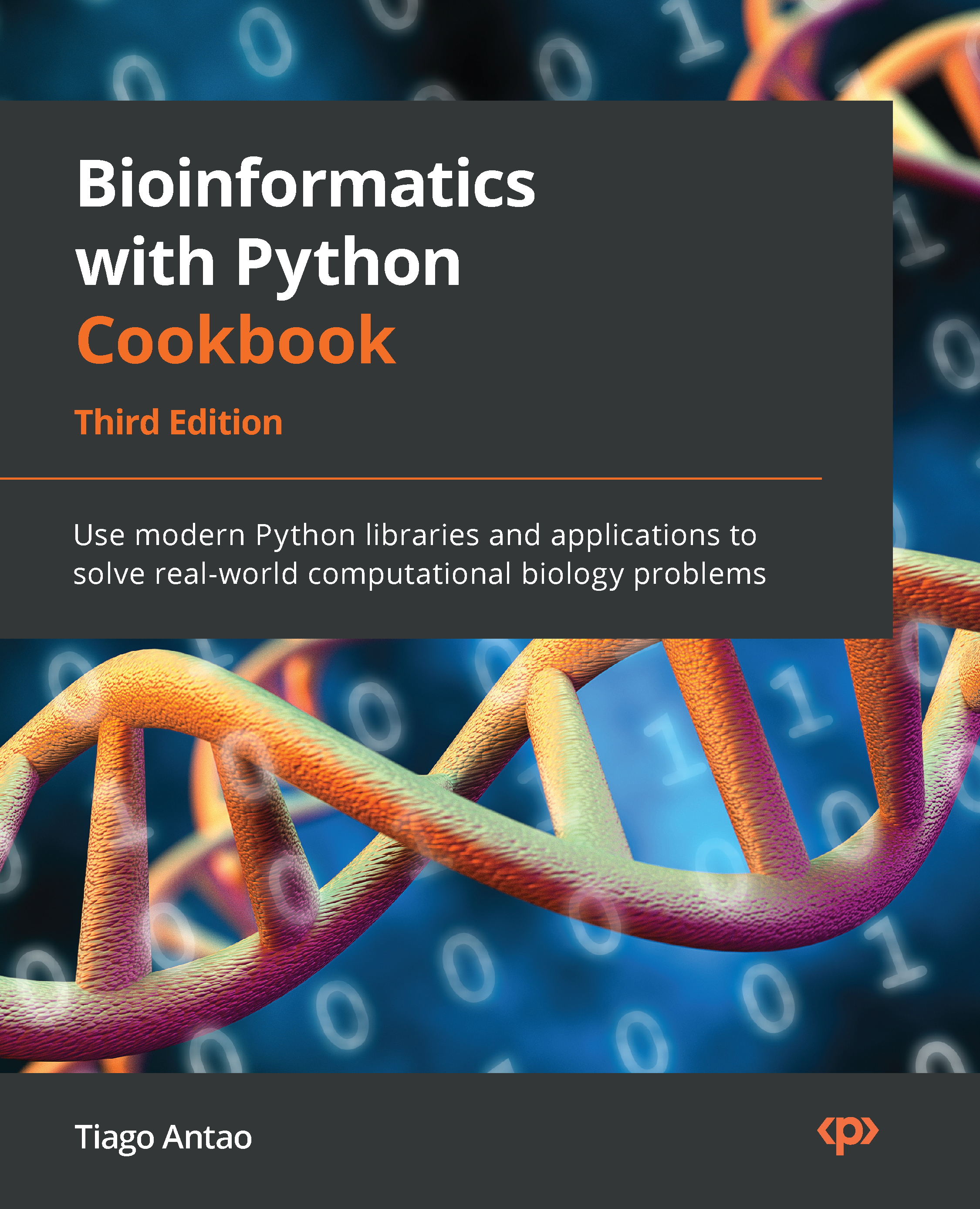
Bioinformatics with Python Cookbook - Third Edition
By :


Bioinformatics with Python Cookbook
By:
Overview of this book
Bioinformatics is an active research field that uses a range of simple-to-advanced computations to extract valuable information from biological data, and this book will show you how to manage these tasks using Python.
This updated third edition of the Bioinformatics with Python Cookbook begins with a quick overview of the various tools and libraries in the Python ecosystem that will help you convert, analyze, and visualize biological datasets. Next, you'll cover key techniques for next-generation sequencing, single-cell analysis, genomics, metagenomics, population genetics, phylogenetics, and proteomics with the help of real-world examples. You'll learn how to work with important pipeline systems, such as Galaxy servers and Snakemake, and understand the various modules in Python for functional and asynchronous programming. This book will also help you explore topics such as SNP discovery using statistical approaches under high-performance computing frameworks, including Dask and Spark. In addition to this, you’ll explore the application of machine learning algorithms in bioinformatics.
By the end of this bioinformatics Python book, you'll be equipped with the knowledge you need to implement the latest programming techniques and frameworks, empowering you to deal with bioinformatics data on every scale.
Table of Contents (15 chapters)
Preface


Chapter 1: Python and the Surrounding Software Ecology

 Free Chapter
Chapter 2: Getting to Know NumPy, pandas, Arrow, and Matplotlib
Chapter 3: Next-Generation Sequencing
Chapter 4: Advanced NGS Data Processing
Chapter 5: Working with Genomes
Chapter 6: Population Genetics
Chapter 7: Phylogenetics
Chapter 8: Using the Protein Data Bank
Chapter 9: Bioinformatics Pipelines
Chapter 10: Machine Learning for Bioinformatics
Chapter 11: Parallel Processing with Dask and Zarr
Chapter 12: Functional Programming for Bioinformatics
Index
Other Books You May Enjoy


