
Sign In Start Free Trial
Account

Add to playlist

Create a Playlist

Modal Close icon
You need to login to use this feature.
  • Book Overview & Buying Learning Ansible 2.7
  • Table Of Contents Toc
Learning Ansible 2.7

Learning Ansible 2.7 - Third Edition

By : Fabio Alessandro Locati
2.7 (3)
close
close
Learning Ansible 2.7

Learning Ansible 2.7

2.7 (3)
By: Fabio Alessandro Locati

Overview of this book

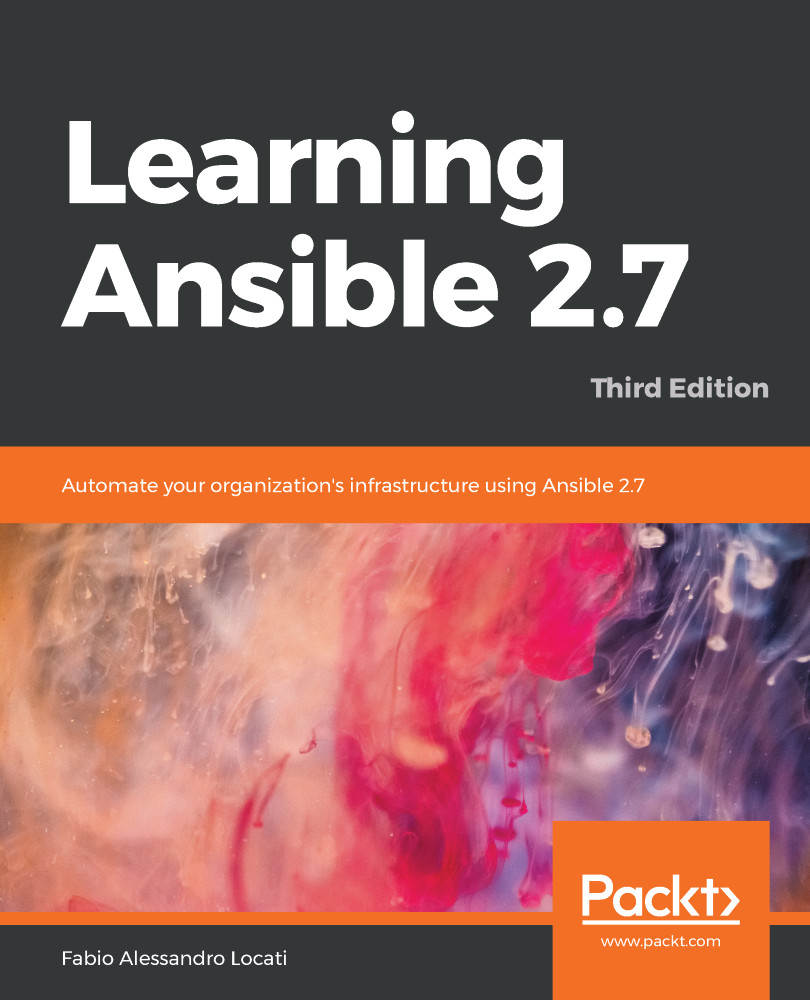
Ansible is an open source automation platform that assists organizations with tasks such as application deployment, orchestration, and task automation. With the release of Ansible 2.7, even complex tasks can be handled much more easily than before. Learning Ansible 2.7 will help you take your first steps toward understanding the fundamentals and practical aspects of Ansible by introducing you to topics such as playbooks, modules, and the installation of Linux, Berkeley Software Distribution (BSD), and Windows support. In addition to this, you will focus on various testing strategies, deployment, and orchestration to build on your knowledge. The book will then help you get accustomed to features including cleaner architecture, task blocks, and playbook parsing, which can help you to streamline automation processes. Next, you will learn how to integrate Ansible with cloud platforms such as Amazon Web Services (AWS) before gaining insights into the enterprise versions of Ansible, Ansible Tower and Ansible Galaxy. This will help you to use Ansible to interact with different operating systems and improve your working efficiency. By the end of this book, you will be equipped with the Ansible skills you need to automate complex tasks for your organization.
Table of Contents (18 chapters)
close
close
Lock Free Chapter
1
Section 1: Creating a Web Server Using Ansible
4
Section 2: Deploying Playbooks in a Production Environment
9
Section 3: Deploying an Application with Ansible
13
Section 4: Deploying an Application with Ansible

Encrypting user passwords

Ansible Vault takes care of passwords that are checked in and helps you to handle them while running Ansible playbooks or commands. However, when Ansible plays are run, at times, you might need your users to enter passwords. You also want to make sure that these passwords don't appear in the comprehensive Ansible logs (the default /var/log/ansible.log location) or on stdout.

Ansible uses Passlib, which is a password-hashing library for Python, to handle encryption for prompted passwords. You can use any of the following algorithms supported by Passlib:

  • des_crypt: DES crypt
  • bsdi_crypt: BSDi crypt
  • bigcrypt: BigCrypt
  • crypt16: Crypt16
  • md5_crypt: MD5 crypt
  • bcrypt: BCrypt
  • sha1_crypt: SHA-1 crypt
  • sun_md5_crypt: Sun MD5 crypt
  • sha256_crypt: SHA-256 crypt
  • sha512_crypt: SHA-512 crypt
  • apr_md5_crypt: Apache's MD5-crypt variant
  • phpass: PHPass portable hash...
CONTINUE READING
83
Tech Concepts
36
Programming languages
73
Tech Tools
Icon Unlimited access to the largest independent learning library in tech of over 8,000 expert-authored tech books and videos.
Icon Innovative learning tools, including AI book assistants, code context explainers, and text-to-speech.
Icon 50+ new titles added per month and exclusive early access to books as they are being written.
Learning Ansible 2.7
notes
bookmark Notes and Bookmarks search Search in title playlist Add to playlist font-size Font size

Change the font size

margin-width Margin width

Change margin width

day-mode Day/Sepia/Night Modes

Change background colour

Close icon Search
Country selected

Close icon Your notes and bookmarks

Confirmation

Modal Close icon
claim successful

Buy this book with your credits?

Modal Close icon
Are you sure you want to buy this book with one of your credits?
Close
YES, BUY

Submit Your Feedback

Modal Close icon
Modal Close icon
Modal Close icon