Sign In Start Free Trial
Account

Add to playlist

Create a Playlist

Modal Close icon
You need to login to use this feature.
  • Book Overview & Buying Cloud Security Handbook
  • Table Of Contents Toc
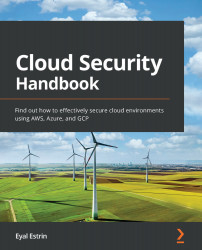
Cloud Security Handbook

Cloud Security Handbook

By : Eyal Estrin
4 (4)
close
close
Cloud Security Handbook

Cloud Security Handbook

4 (4)
By: Eyal Estrin

Overview of this book

Securing resources in the cloud is challenging, given that each provider has different mechanisms and processes. Cloud Security Handbook helps you to understand how to embed security best practices in each of the infrastructure building blocks that exist in public clouds. This book will enable information security and cloud engineers to recognize the risks involved in public cloud and find out how to implement security controls as they design, build, and maintain environments in the cloud. You'll begin by learning about the shared responsibility model, cloud service models, and cloud deployment models, before getting to grips with the fundamentals of compute, storage, networking, identity management, encryption, and more. Next, you'll explore common threats and discover how to stay in compliance in cloud environments. As you make progress, you'll implement security in small-scale cloud environments through to production-ready large-scale environments, including hybrid clouds and multi-cloud environments. This book not only focuses on cloud services in general, but it also provides actual examples for using AWS, Azure, and GCP built-in services and capabilities. By the end of this cloud security book, you'll have gained a solid understanding of how to implement security in cloud environments effectively.
Table of Contents (19 chapters)
close
close
1
Section 1: Securing Infrastructure Cloud Services
6
Section 2: Deep Dive into IAM, Auditing, and Encryption
10
Section 3: Threats and Compliance Management
14
Section 4: Advanced Use of Cloud Services

Detecting and mitigating insufficient IAM and key management in cloud services

Insufficient IAM can happen in a scenario where we have a large number of user identities (such as in an enterprise organization) but we fail to properly manage the identities. Or we might use cryptography to protect sensitive data but fail to follow key rotation best practices, and as a result, increase the chance of data exposure by unauthorized persons.

Here are some common consequences of insufficient IAM and key management:

  • Failing to follow the principle of least privileged, which leads to excessive permissions being granted
  • Failing to configure access controls – for example, allowing unauthorized access to sensitive data (such as PII, credit card data, healthcare data, and so on), which leads to exposed credentials
  • Not enforcing the password policy (for example, allowing short passwords, not enforcing password changes, allowing password reuse, and so on), which leads to...
CONTINUE READING
83
Tech Concepts
36
Programming languages
73
Tech Tools
Icon Unlimited access to the largest independent learning library in tech of over 8,000 expert-authored tech books and videos.
Icon Innovative learning tools, including AI book assistants, code context explainers, and text-to-speech.
Icon 50+ new titles added per month and exclusive early access to books as they are being written.
Cloud Security Handbook
notes
bookmark Notes and Bookmarks search Search in title playlist Add to playlist font-size Font size

Change the font size

margin-width Margin width

Change margin width

day-mode Day/Sepia/Night Modes

Change background colour

Close icon Search
Country selected

Close icon Your notes and bookmarks

Confirmation

Modal Close icon
claim successful

Buy this book with your credits?

Modal Close icon
Are you sure you want to buy this book with one of your credits?
Close
YES, BUY

Submit Your Feedback

Modal Close icon
Modal Close icon
Modal Close icon