Sign In Start Free Trial
Account

Add to playlist

Create a Playlist

Modal Close icon
You need to login to use this feature.
  • Book Overview & Buying The Self-Taught Cloud Computing Engineer
  • Table Of Contents Toc
The Self-Taught Cloud Computing Engineer

The Self-Taught Cloud Computing Engineer

By : Dr. Logan Song
5 (180)
close
close
The Self-Taught Cloud Computing Engineer

The Self-Taught Cloud Computing Engineer

5 (180)
By: Dr. Logan Song

Overview of this book

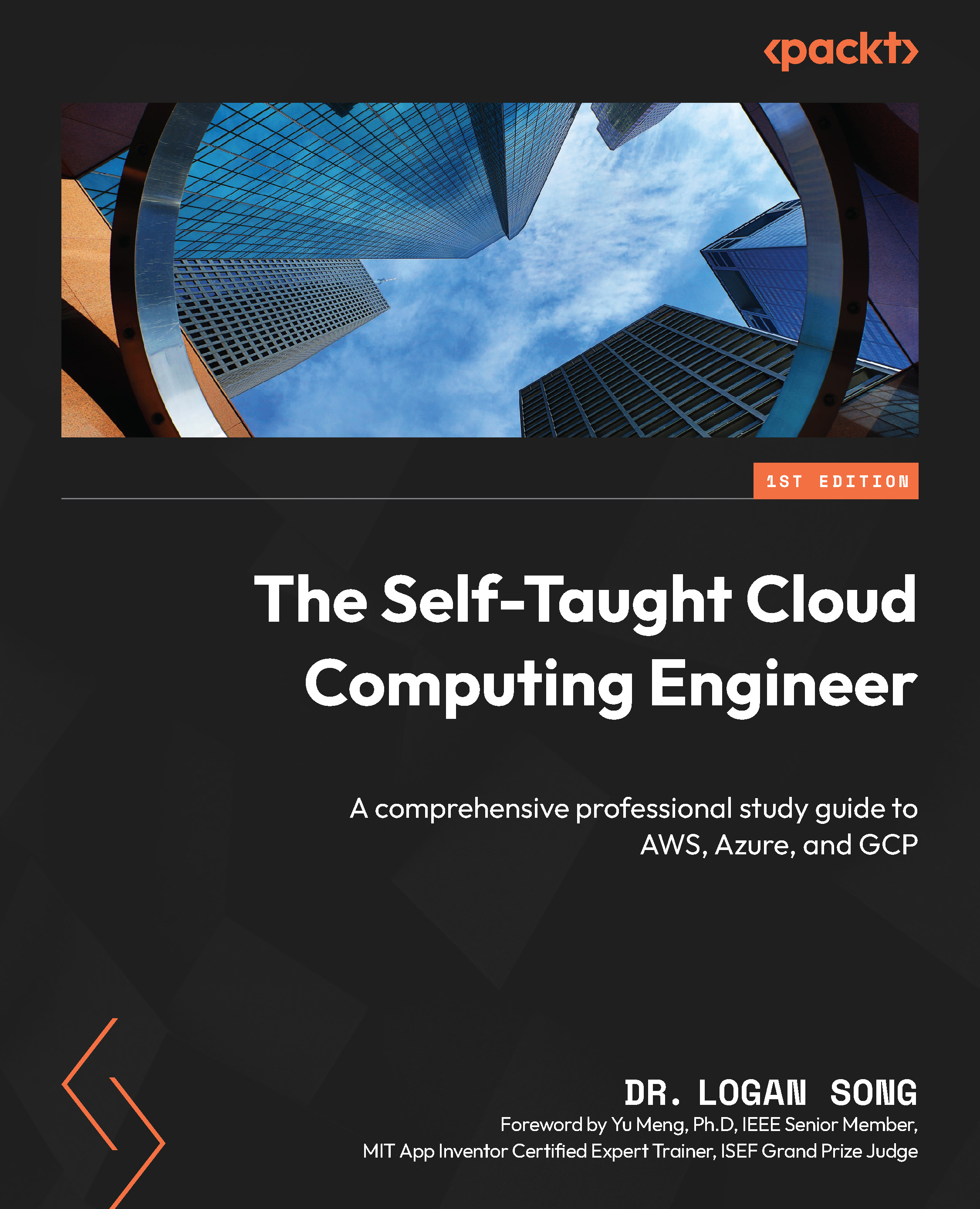
As cloud computing continues to revolutionize IT, professionals face the challenge of keeping up with rapidly evolving technologies. This book provides a clear roadmap for mastering cloud concepts, developing hands-on expertise, and obtaining professional certifications, making it an essential resource for those looking to advance their careers in cloud computing. Starting with a focus on the Amazon cloud, you’ll be introduced to fundamental AWS cloud services, followed by advanced AWS cloud services in the domains of data, machine learning, and security. Next, you’ll build proficiency in Microsoft Azure cloud and Google Cloud Platform (GCP) by examining the common attributes of the three clouds, differentiating their unique features, along with leveraging real-life cloud project implementations on these cloud platforms. Through hands-on projects and real-world applications, you’ll gain the skills needed to work confidently across different cloud platforms. The book concludes with career development guidance, including certification paths and industry insights to help you succeed in the cloud computing landscape. Walking through this cloud computing book, you’ll systematically establish a robust footing in AWS, Azure, and GCP, and emerge as a cloud-savvy professional, equipped with cloud certificates to validate your skills.
Table of Contents (24 chapters)
close
close
1
Part 1: Learning about the Amazon Cloud
9
Part 2:Comprehending GCP Cloud Services
14
Part 3:Mastering Azure Cloud Services
19
Part 4:Developing a Successful Cloud Career

Practice questions

  1. Which of the following is not a valid source option when configuring SG rules for an EC2 instance?
    1. Tag name for another EC2 instance
    2. IP address for another EC2 instance
    3. IP address ranges for a network
    4. SG name used by another EC2 instance
  2. An AWS cloud engineer signed up for a new AWS account, then logged in to the account and created a Linux EC2 instance in the default VPC/subnet. They were able to SSH to the EC2 instance. From the EC2 instance, They:
    1. can access www.google.com
    2. cannot access www.google.com
    3. can access www.google.com only after they configure SG rules
    4. can access www.google.com only after they configure Network Access Control List (NACL) rules
  3. Alice launched an EC2 Linux instance in the AWS cloud, and then successfully SSH-ed to the instance from her laptop at home with the default ec2-user username. Which keys are used during this process?
    1. ec2-user’s public key, which is stored on the EC2 instance, and the private key on the laptop
    2. The root user’s public key on the EC2 instance
    3. ec2-user’s public key, which is stored on the laptop
    4. ec2-user’s private key, which is stored on the cloud EC2 instance
    5. ec2-user’s symmetric key, which is stored on both the laptop and EC2 instance
  4. www.zbestbuy.com is configured with ELB and ASG. At peak time, it needs 10 AWS EC2 instances. How do you make sure the website will never be down and can scale as needed?
    1. Set ASG’s minimum instances = 2, maximum instances = 10
    2. Set ASG’s minimum instances = 1, maximum instances = 10
    3. Set ASG’s minimum instances = 0, maximum instances = 10
    4. Set ASG’s minimum instances = 2, maximum instances = 2
  5. A middle school has an education application system using ASG to automatically scale resources as needed. The students report that every morning at 8:30 A.M., the system becomes very slow for about 15 minutes. Initial checking shows that a large percentage of the classes start at 8:30 A.M., and it does not have enough time to scale out to meet the demand. How can we resolve this problem?
    1. Schedule the ASGs accordingly to scale out the necessary resources at 8:15 A.M. every morning
    2. Use Reserved Instances to ensure the system has reserved the capacity for scale-up events
    3. Change the ASG to scale based on network utilization
    4. Permanently keep the running instances that are needed at 8:30 A.M. to guarantee available resources
  6. AWS engineer Alice is launching an EC2 instance to host a web server. How should Alice configure the EC2 instance’s SG?
    1. Open ports 80 and 443 inbound to 0.0.0.0/0
    2. Open ports 80 and 443 outbound to 0.0.0.0/0
    3. Open ports 80 and 443 inbound to 10.10.10.0/24
    4. Open ports 80 and 443 outbound to my IP
  7. An AWS cloud engineer signed up for a new AWS account, then logged in to the account and created an EC2-1 Windows instance and an EC2-2 Linux instance in one subnet (172.31.48.0/20) in the default VPC, using an SG that has SSH and RDP open to 172.31.0.0/16 only. They were able to RDP to the EC2-1 instance. From the EC2-1 instance, they:
    1. can SSH to EC2-2
    2. can ping EC2-2
    3. cannot ping EC2-1
    4. cannot SSH to EC2-2
  8. www.zbestbuy.com has a need for 10,000 EC2 instances in the next 3 years. What should they use to get these computing resources?
    1. Reserved Instances
    2. Spot Instances
    3. On-demand instances
    4. Dedicated-host instances
  9. AWS engineer Alice needs to log in to an EC2-100 Linux instance that no one can access since the AWS engineer who was managing it left the company. What does Alice need to do?
    1. Generate a key pair, and add the public key to EC2-100 using user-data
    2. Generate a key pair, and add the public key to EC2-100 using meta-data
    3. Generate a key pair, and copy the public key to EC2-100 using Secure Copy Protocol (SCP)
    4. Remove the old private key from EC2-100
  10. An AWS architect launched an EC2 instance using the t2.large type, installed databases and web applications on the instance, then found that the instance was too small, so they want to move to an M4.xlarge instance type. What do they need to do?
CONTINUE READING
83
Tech Concepts
36
Programming languages
73
Tech Tools
Icon Unlimited access to the largest independent learning library in tech of over 8,000 expert-authored tech books and videos.
Icon Innovative learning tools, including AI book assistants, code context explainers, and text-to-speech.
Icon 50+ new titles added per month and exclusive early access to books as they are being written.
The Self-Taught Cloud Computing Engineer
notes
bookmark Notes and Bookmarks search Search in title playlist Add to playlist download Download options font-size Font size

Change the font size

margin-width Margin width

Change margin width

day-mode Day/Sepia/Night Modes

Change background colour

Close icon Search
Country selected

Close icon Your notes and bookmarks

Confirmation

Modal Close icon
claim successful

Buy this book with your credits?

Modal Close icon
Are you sure you want to buy this book with one of your credits?
Close
YES, BUY

Submit Your Feedback

Modal Close icon
Modal Close icon
Modal Close icon