
Sign In Start Free Trial
Account

Add to playlist

Create a Playlist

Modal Close icon
You need to login to use this feature.
  • Book Overview & Buying Hands-On RTOS with Microcontrollers
  • Table Of Contents Toc
Hands-On RTOS with Microcontrollers

Hands-On RTOS with Microcontrollers

By : Brian Amos
4.6 (20)
close
close
Hands-On RTOS with Microcontrollers

Hands-On RTOS with Microcontrollers

4.6 (20)
By: Brian Amos

Overview of this book

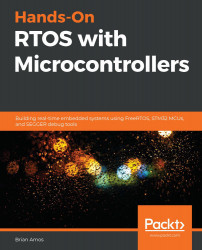
A real-time operating system (RTOS) is used to develop systems that respond to events within strict timelines. Real-time embedded systems have applications in various industries, from automotive and aerospace through to laboratory test equipment and consumer electronics. These systems provide consistent and reliable timing and are designed to run without intervention for years. This microcontrollers book starts by introducing you to the concept of RTOS and compares some other alternative methods for achieving real-time performance. Once you've understood the fundamentals, such as tasks, queues, mutexes, and semaphores, you'll learn what to look for when selecting a microcontroller and development environment. By working through examples that use an STM32F7 Nucleo board, the STM32CubeIDE, and SEGGER debug tools, including SEGGER J-Link, Ozone, and SystemView, you'll gain an understanding of preemptive scheduling policies and task communication. The book will then help you develop highly efficient low-level drivers and analyze their real-time performance and CPU utilization. Finally, you'll cover tips for troubleshooting and be able to take your new-found skills to the next level. By the end, you'll have built on your embedded system skills and will be able to create real-time systems using microcontrollers and FreeRTOS.
Table of Contents (24 chapters)
close
close
1
Section 1: Introduction and RTOS Concepts
5
Section 2: Toolchain Setup
9
Section 3: RTOS Application Examples
13
Section 4: Advanced RTOS Techniques

Summary

In this chapter, we took a deep dive into creating an efficient interface to a complex driver stack that was very convenient to use. Using stream buffers, we analyzed trade-offs between decreasing latency and minimizing CPU usage. After a basic interface was in place, it was extended to be used across multiple tasks. We also saw an example of how a mutex could be used for ensuring that a multi-stage transaction remained atomic, even while the peripheral was shared between tasks.

Throughout the examples, we focused on performance versus ease of use and coding effort. Now that you have a good understanding of why design decisions are being made, you should be in a good position to make informed decisions regarding your own code base and implementations. When the time comes to implement your design, you'll also have a solid understanding of the steps that need to be...

CONTINUE READING
83
Tech Concepts
36
Programming languages
73
Tech Tools
Icon Unlimited access to the largest independent learning library in tech of over 8,000 expert-authored tech books and videos.
Icon Innovative learning tools, including AI book assistants, code context explainers, and text-to-speech.
Icon 50+ new titles added per month and exclusive early access to books as they are being written.
Hands-On RTOS with Microcontrollers
notes
bookmark Notes and Bookmarks search Search in title playlist Add to playlist download Download options font-size Font size

Change the font size

margin-width Margin width

Change margin width

day-mode Day/Sepia/Night Modes

Change background colour

Close icon Search
Country selected

Close icon Your notes and bookmarks

Confirmation

Modal Close icon
claim successful

Buy this book with your credits?

Modal Close icon
Are you sure you want to buy this book with one of your credits?
Close
YES, BUY

Submit Your Feedback

Modal Close icon
Modal Close icon
Modal Close icon