
All you need for this chapter is access to the internet in order to browse a few websites.
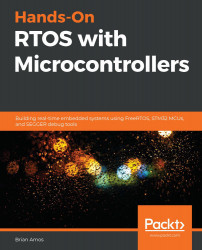
Hands-On RTOS with Microcontrollers
By :
Hands-On RTOS with Microcontrollers
By:
Overview of this book
A real-time operating system (RTOS) is used to develop systems that respond to events within strict timelines. Real-time embedded systems have applications in various industries, from automotive and aerospace through to laboratory test equipment and consumer electronics. These systems provide consistent and reliable timing and are designed to run without intervention for years.
This microcontrollers book starts by introducing you to the concept of RTOS and compares some other alternative methods for achieving real-time performance. Once you've understood the fundamentals, such as tasks, queues, mutexes, and semaphores, you'll learn what to look for when selecting a microcontroller and development environment. By working through examples that use an STM32F7 Nucleo board, the STM32CubeIDE, and SEGGER debug tools, including SEGGER J-Link, Ozone, and SystemView, you'll gain an understanding of preemptive scheduling policies and task communication. The book will then help you develop highly efficient low-level drivers and analyze their real-time performance and CPU utilization. Finally, you'll cover tips for troubleshooting and be able to take your new-found skills to the next level.
By the end of this book, you'll have built on your embedded system skills and will be able to create real-time systems using microcontrollers and FreeRTOS.
Related Content you might be interested in
Current Title:
Hands-On RTOS with Microcontrollers
Table of Contents (24 chapters)
Preface

Section 1: Introduction and RTOS Concepts

 Free Chapter
Introducing Real-Time Systems
Understanding RTOS Tasks
Task Signaling and Communication Mechanisms
Section 2: Toolchain Setup
Selecting the Right MCU
Selecting an IDE
Debugging Tools for Real-Time Systems
Section 3: RTOS Application Examples
The FreeRTOS Scheduler
Protecting Data and Synchronizing Tasks
Intertask Communication
Section 4: Advanced RTOS Techniques
Drivers and ISRs
Sharing Hardware Peripherals across Tasks
Tips for Creating a Well-Abstracted Architecture
Creating Loose Coupling with Queues
Choosing an RTOS API
FreeRTOS Memory Management
Multi-Processor and Multi-Core Systems
Troubleshooting Tips and Next Steps
Assessments
Other Books You May Enjoy
Customer Reviews