Sign In Start Free Trial
Account

Add to playlist

Create a Playlist

Modal Close icon
You need to login to use this feature.
  • Book Overview & Buying Kubernetes - A Complete DevOps Cookbook
  • Table Of Contents Toc
  • Feedback & Rating feedback
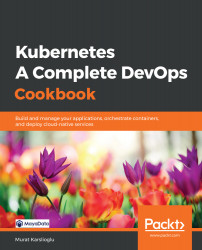
Kubernetes - A Complete DevOps Cookbook

Kubernetes - A Complete DevOps Cookbook

By : Karslioglu
4.5 (4)
close
close
Kubernetes - A Complete DevOps Cookbook

Kubernetes - A Complete DevOps Cookbook

4.5 (4)
By: Karslioglu

Overview of this book

Kubernetes is a popular open source orchestration platform for managing containers in a cluster environment. With this Kubernetes cookbook, you’ll learn how to implement Kubernetes using a recipe-based approach. The book will prepare you to create highly available Kubernetes clusters on multiple clouds such as Amazon Web Services (AWS), Google Cloud Platform (GCP), Azure, Alibaba, and on-premises data centers. Starting with recipes for installing and configuring Kubernetes instances, you’ll discover how to work with Kubernetes clients, services, and key metadata. You’ll then learn how to build continuous integration/continuous delivery (CI/CD) pipelines for your applications, and understand various methods to manage containers. As you advance, you’ll delve into Kubernetes' integration with Docker and Jenkins, and even perform a batch process and configure data volumes. You’ll get to grips with methods for scaling, security, monitoring, logging, and troubleshooting. Additionally, this book will take you through the latest updates in Kubernetes, including volume snapshots, creating high availability clusters with kops, running workload operators, new inclusions around kubectl and more. By the end of this book, you’ll have developed the skills required to implement Kubernetes in production and manage containers proficiently.
Table of Contents (12 chapters)
close
close

Logging for your Jenkins CI/CD environment

CI/CD pipelines can generate a great amount of metadata every day in busy build environments. Elasticsearch is the perfect platform for feeding this kind of data from Jenkins.

In this section, we will learn how to enable and access the logs of our Jenkins instance and analyze team efficiency.

Getting ready

All the operations mentioned in this recipe require a fully functional Jenkins deployment, as described in Chapter 3, Building CI/CD Pipelines, in the Setting up a CI/CD pipeline in Jenkins X section.

Clone the k8sdevopscookbook/src repository to your workstation to use the manifest files in the chapter10 directory:

$ git clone https://github.com/k8sdevopscookbook/src.git
$ cd src/chapter10

Make sure you have a Kubernetes cluster, Jenkins X, and an EFK stack ready and that kubectl has been configured so that you can manage the cluster resources.

How to do it…

This section will show you how to feed Jenkins logs to Elasticsearch. This section...

Visually different images
CONTINUE READING
83
Tech Concepts
36
Programming languages
73
Tech Tools
Icon Unlimited access to the largest independent learning library in tech of over 8,000 expert-authored tech books and videos.
Icon Innovative learning tools, including AI book assistants, code context explainers, and text-to-speech.
Icon 50+ new titles added per month and exclusive early access to books as they are being written.
Kubernetes - A Complete DevOps Cookbook
notes
bookmark Notes and Bookmarks search Search in title playlist Add to playlist download Download options font-size Font size

Change the font size

margin-width Margin width

Change margin width

day-mode Day/Sepia/Night Modes

Change background colour

Close icon Search
Country selected

Close icon Your notes and bookmarks

Confirmation

Modal Close icon
claim successful

Buy this book with your credits?

Modal Close icon
Are you sure you want to buy this book with one of your credits?
Close
YES, BUY

Submit Your Feedback

Modal Close icon
Modal Close icon
Modal Close icon