Sign In Start Free Trial
Account

Add to playlist

Create a Playlist

Modal Close icon
You need to login to use this feature.
  • Book Overview & Buying R for Data Science Cookbook (n)
  • Table Of Contents Toc
  • Feedback & Rating feedback
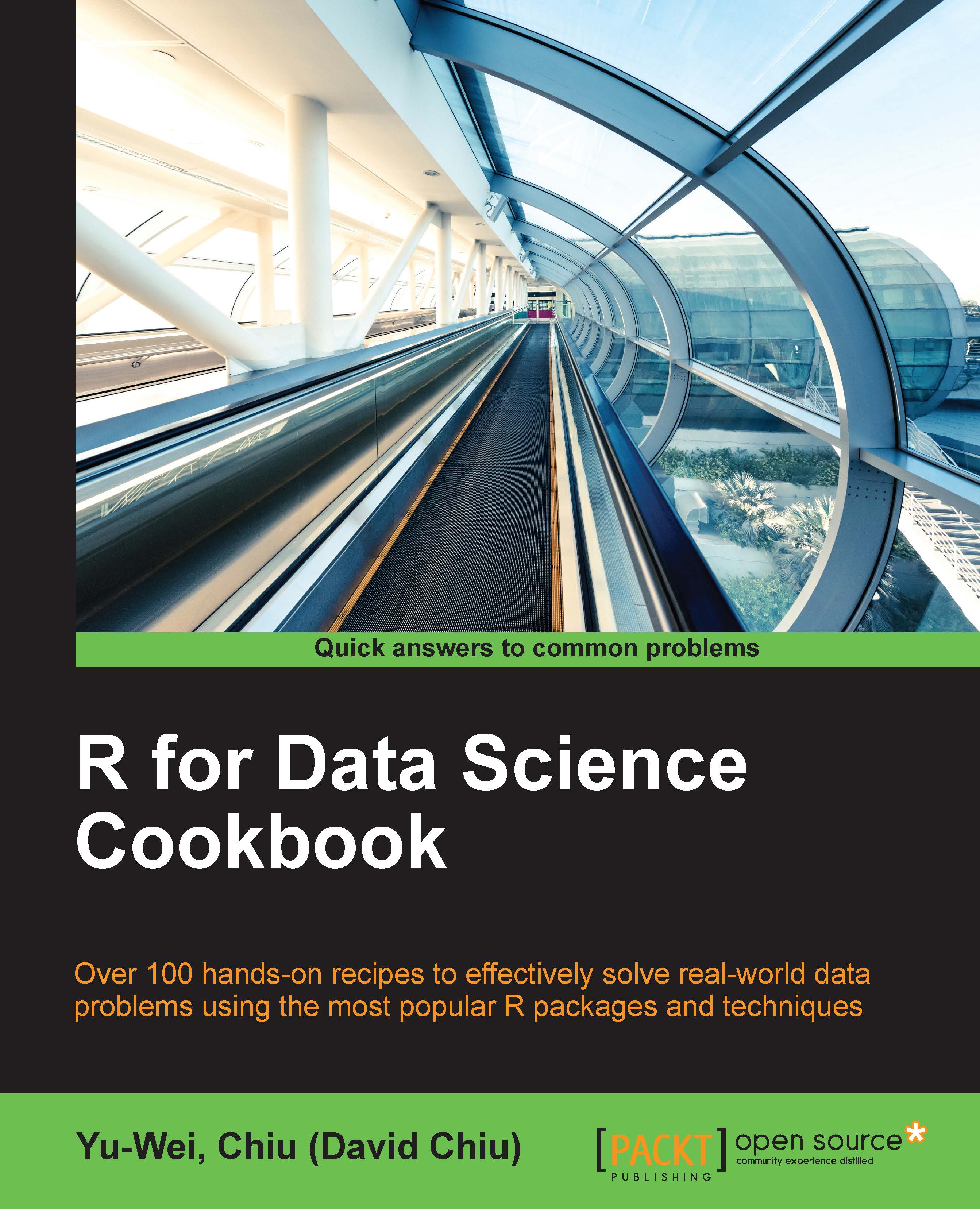
R for Data Science Cookbook (n)

R for Data Science Cookbook (n)

By : Yu-Wei, Chiu (David Chiu)
4.3 (3)
close
close
R for Data Science Cookbook (n)

R for Data Science Cookbook (n)

4.3 (3)
By: Yu-Wei, Chiu (David Chiu)

Overview of this book

This cookbook offers a range of data analysis samples in simple and straightforward R code, providing step-by-step resources and time-saving methods to help you solve data problems efficiently. The first section deals with how to create R functions to avoid the unnecessary duplication of code. You will learn how to prepare, process, and perform sophisticated ETL for heterogeneous data sources with R packages. An example of data manipulation is provided, illustrating how to use the “dplyr” and “data.table” packages to efficiently process larger data structures. We also focus on “ggplot2” and show you how to create advanced figures for data exploration. In addition, you will learn how to build an interactive report using the “ggvis” package. Later chapters offer insight into time series analysis on financial data, while there is detailed information on the hot topic of machine learning, including data classification, regression, clustering, association rule mining, and dimension reduction. By the end of this book, you will understand how to resolve issues and will be able to comfortably offer solutions to problems encountered while performing data analysis.
Table of Contents (14 chapters)
close
close
13
Index

Creating R functions

The R language is a collection of functions; a user can apply built-in functions from various packages to their project, or they can define a function for a particular purpose. In this recipe, we will show you how to create an R function.

Getting ready

If you are new to the R language, you can find a detailed introduction, language history, and functionality on the official R site (http://www.r-project.org/). When you are ready to download and install R, please connect to the comprehensive R archive network (http://cran.r-project.org/).

How to do it...

Perform the following steps in order to create your first R function:

  1. Type the following code on your R console to create your first function:
    >addnum<- function(x, y){
    + s <- x+y
    + return(s)
    + }
    
  2. Execute the addnum user-defined function with the following command:
    >addnum (3,7)
    [1] 10
    

    Or, you can define your function without a return statement:

    >addnum2<- function(x, y){
    + x+y
    + }
    
  3. Execute the addnum2 user-defined function with the following command:
    >addnum2(3,7)
    [1] 10
    
  4. You can view the definition of a function by typing its function name:
    >addnum2
    function(x, y){
    x+y
    }
    
  5. Finally, you can use body and formals to examine the body and formal arguments of a function:
    >body(addnum2)
    {
    x + y
    }
    >formals(addnum2)
    $x
    $y
    >args(addnum2)
    function (x, y)
    NULL
    

How it works...

R functions are a block of organized and reusable statements, which makes programming less repetitive by allowing you to reuse code. Additionally, by modularizing statements within a function, your R code will become more readable and maintainable.

By following these steps, you can now create two addnum and addnum2 R functions, and you can successfully add two input arguments with either function. In R, the function usually takes the following form:

FunctionName<- function (arg1, arg2) {
body
return(expression)
}

FunctionName is the name of the function, and arg1 and arg2 are arguments. Inside the curly braces, we can see the function body, where a body is a collection of a valid statement, expression, or assignment. At the bottom of the function, we can find the return statement, which passes expression back to the caller and exits the function.

The addnum function is in standard function syntax, which contains both body and return statement. However, you do not necessarily need to put a return statement at the end of the function. Similar to the addnum2 function, the function itself will return the last expression back to the caller.

If you want to view the composition of the function, simply type the function name on the interactive shell. You can also examine the body and formal arguments of the function further using the body and formal functions. Alternatively, you can use the args function to obtain the argument list of the function.

There's more...

If you want to see the documentation of a function in R, you can use the help function or simply type ? in front of the function name. For example, if you want to examine the documentation of the sum function, you would do the following:

>help(sum)
> ?sum
Visually different images
CONTINUE READING
83
Tech Concepts
36
Programming languages
73
Tech Tools
Icon Unlimited access to the largest independent learning library in tech of over 8,000 expert-authored tech books and videos.
Icon Innovative learning tools, including AI book assistants, code context explainers, and text-to-speech.
Icon 50+ new titles added per month and exclusive early access to books as they are being written.
R for Data Science Cookbook (n)
notes
bookmark Notes and Bookmarks search Search in title playlist Add to playlist font-size Font size

Change the font size

margin-width Margin width

Change margin width

day-mode Day/Sepia/Night Modes

Change background colour

Close icon Search
Country selected

Close icon Your notes and bookmarks

Confirmation

Modal Close icon
claim successful

Buy this book with your credits?

Modal Close icon
Are you sure you want to buy this book with one of your credits?
Close
YES, BUY

Submit Your Feedback

Modal Close icon
Modal Close icon
Modal Close icon