Sign In Start Free Trial
Account

Add to playlist

Create a Playlist

Modal Close icon
You need to login to use this feature.
  • Book Overview & Buying R for Data Science Cookbook
  • Table Of Contents Toc
R for Data Science Cookbook

R for Data Science Cookbook

By : Yu-Wei, Chiu (David Chiu), Prabhanjan Narayanachar Tattar
4.3 (3)
close
close
R for Data Science Cookbook

R for Data Science Cookbook

4.3 (3)
By: Yu-Wei, Chiu (David Chiu), Prabhanjan Narayanachar Tattar

Overview of this book

This cookbook offers a range of data analysis samples in simple and straightforward R code, providing step-by-step resources and time-saving methods to help you solve data problems efficiently. The first section deals with how to create R functions to avoid the unnecessary duplication of code. You will learn how to prepare, process, and perform sophisticated ETL for heterogeneous data sources with R packages. An example of data manipulation is provided, illustrating how to use the “dplyr” and “data.table” packages to efficiently process larger data structures. We also focus on “ggplot2” and show you how to create advanced figures for data exploration. In addition, you will learn how to build an interactive report using the “ggvis” package. Later chapters offer insight into time series analysis on financial data, while there is detailed information on the hot topic of machine learning, including data classification, regression, clustering, association rule mining, and dimension reduction. By the end of this book, you will understand how to resolve issues and will be able to comfortably offer solutions to problems encountered while performing data analysis.
Table of Contents (14 chapters)
close
close
13
Index

Preface

Big data, the Internet of Things, and artificial intelligence have become the hottest technology buzzwords in recent years. Although there are many different terms used to define these technologies, the common concept is that they're all driven by data. Simply having data is not enough; being able to unlock its value is essential. Therefore, data scientists have begun to focus on how to gain insights from raw data.

Data science has become one of the most popular subjects among academic and industry groups. However, as data science is a very broad discipline, learning how to master it can be challenging. A beginner must learn how to prepare, process, aggregate, and visualize data. More advanced techniques involve machine learning, mining various data formats (text, image, and video), and, most importantly, using data to generate business value. The role of a data scientist is challenging and requires a great deal of effort. A successful data scientist requires a useful tool to help solve day-to-day problems.

In this field, the most widely used tool by data scientists is the R language, which is open source and free. Being a machine language, it provides many data processes, learning packages, and visualization functions, allowing users to analyze data on the fly. R helps users quickly perform analysis and execute machine learning algorithms on their dataset without knowing every detail of the sophisticated mathematical models.

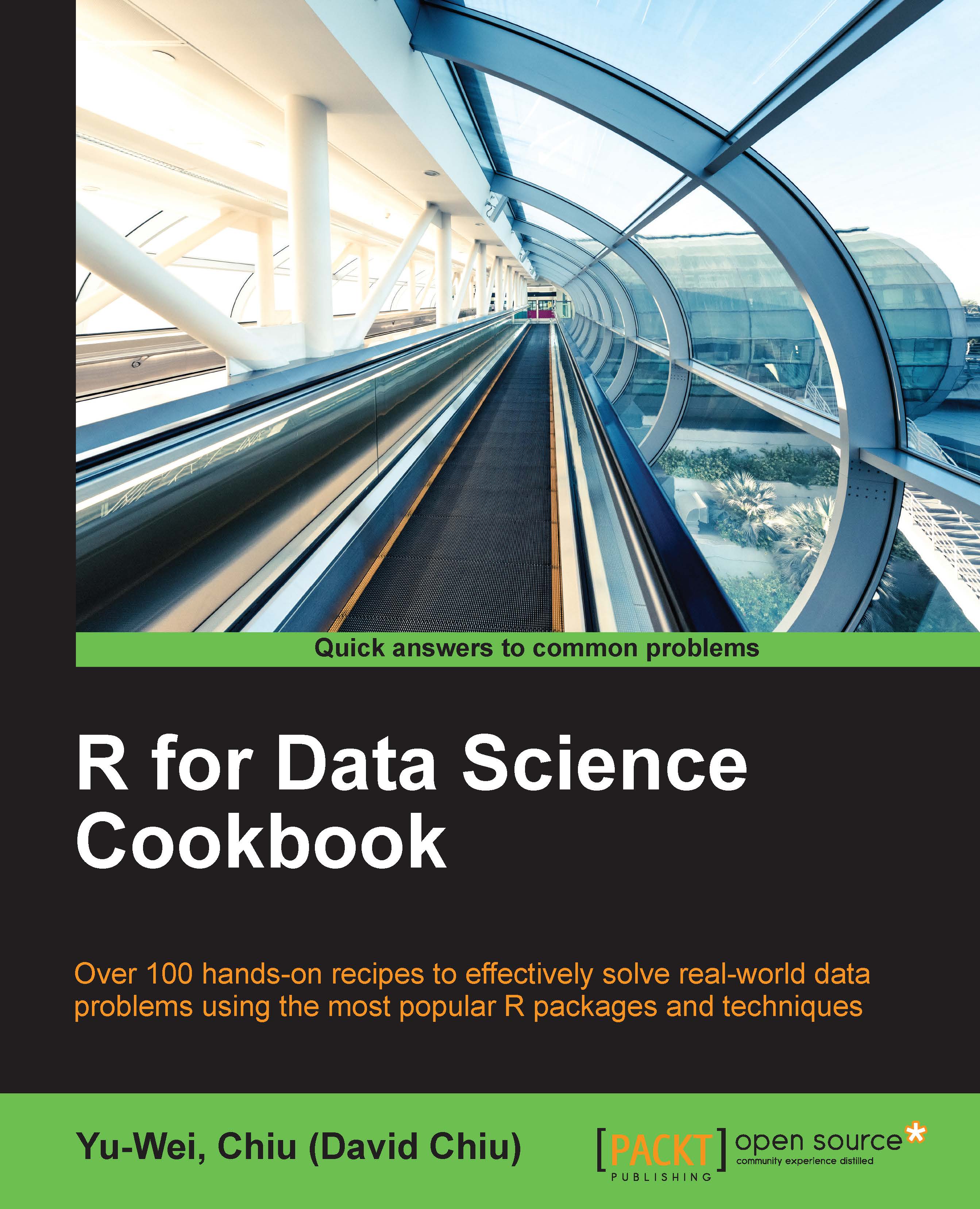
R for Data Science Cookbook takes a practical approach to teaching you how to put data science into practice with R. The book has 12 chapters, each of which is introduced by breaking down the topic into several simple recipes. Through the step-by-step instructions in each recipe, you can apply what you have learned from the book by using a variety of packages in R.

The first section of this book deals with how to create R functions to avoid unnecessary duplication of code. You will learn how to prepare, process, and perform sophisticated ETL operations for heterogeneous data sources with R packages. An example of data manipulation is provided that illustrates how to use the dplyr and data.table packages to process larger data structures efficiently, while there is a section focusing on ggplot2 that covers how to create advanced figures for data exploration. Also, you will learn how to build an interactive report using the ggvis package.

This book also explains how to use data mining to discover items that are frequently purchased together. Later chapters offer insight into time series analysis on financial data, while there is detailed information on the hot topic of machine learning, including data classification, regression, clustering, and dimension reduction.

With R for Data Science Cookbook in hand, I can assure you that you will find data science has never been easier.

CONTINUE READING
83
Tech Concepts
36
Programming languages
73
Tech Tools
Icon Unlimited access to the largest independent learning library in tech of over 8,000 expert-authored tech books and videos.
Icon Innovative learning tools, including AI book assistants, code context explainers, and text-to-speech.
Icon 50+ new titles added per month and exclusive early access to books as they are being written.
R for Data Science Cookbook
notes
bookmark Notes and Bookmarks search Search in title playlist Add to playlist font-size Font size

Change the font size

margin-width Margin width

Change margin width

day-mode Day/Sepia/Night Modes

Change background colour

Close icon Search
Country selected

Close icon Your notes and bookmarks

Confirmation

Modal Close icon
claim successful

Buy this book with your credits?

Modal Close icon
Are you sure you want to buy this book with one of your credits?
Close
YES, BUY

Submit Your Feedback

Modal Close icon
Modal Close icon
Modal Close icon