
Sign In Start Free Trial
Account

Add to playlist

Create a Playlist

Modal Close icon
You need to login to use this feature.
  • Book Overview & Buying Keras Reinforcement Learning Projects
  • Table Of Contents Toc
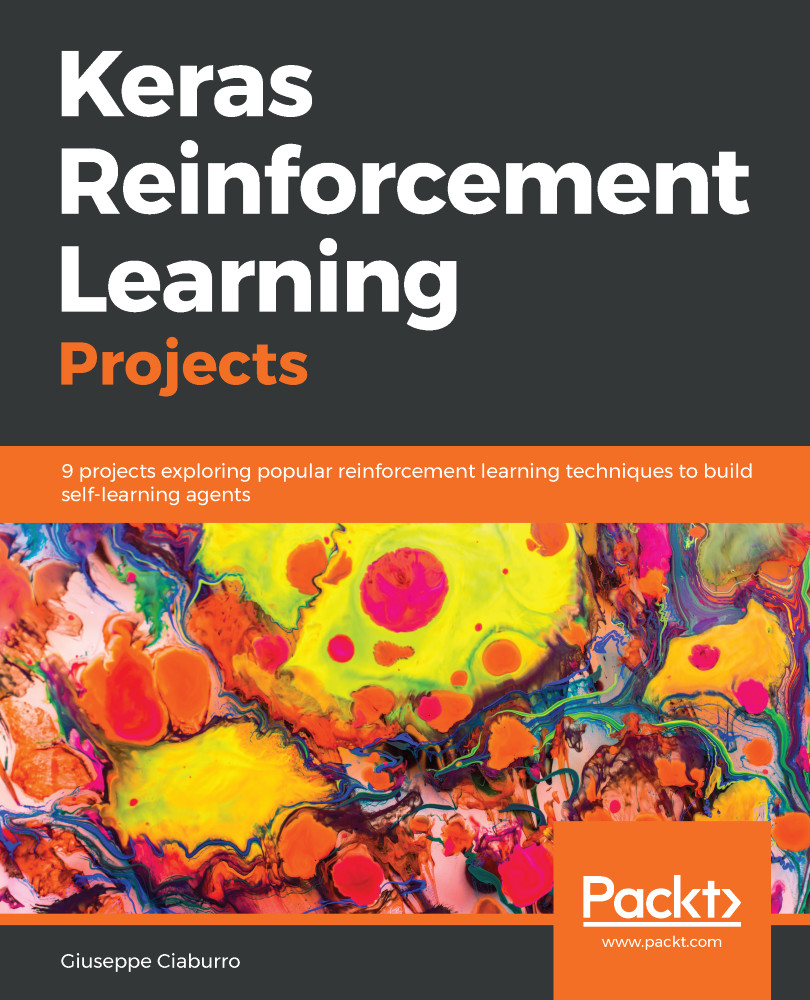
Keras Reinforcement Learning Projects

Keras Reinforcement Learning Projects

By : Giuseppe Ciaburro, Sudharsan Ravichandiran, Suriyadeepan Ramamoorthy
2.3 (3)
close
close
Keras Reinforcement Learning Projects

Keras Reinforcement Learning Projects

2.3 (3)
By: Giuseppe Ciaburro, Sudharsan Ravichandiran, Suriyadeepan Ramamoorthy

Overview of this book

Reinforcement learning has evolved a lot in the last couple of years and proven to be a successful technique in building smart and intelligent AI networks. Keras Reinforcement Learning Projects installs human-level performance into your applications using algorithms and techniques of reinforcement learning, coupled with Keras, a faster experimental library. The book begins with getting you up and running with the concepts of reinforcement learning using Keras. You’ll learn how to simulate a random walk using Markov chains and select the best portfolio using dynamic programming (DP) and Python. You’ll also explore projects such as forecasting stock prices using Monte Carlo methods, delivering vehicle routing application using Temporal Distance (TD) learning algorithms, and balancing a Rotating Mechanical System using Markov decision processes. Once you’ve understood the basics, you’ll move on to Modeling of a Segway, running a robot control system using deep reinforcement learning, and building a handwritten digit recognition model in Python using an image dataset. Finally, you’ll excel in playing the board game Go with the help of Q-Learning and reinforcement learning algorithms. By the end of this book, you’ll not only have developed hands-on training on concepts, algorithms, and techniques of reinforcement learning but also be all set to explore the world of AI.
Table of Contents (13 chapters)
close
close

Summary

Reinforcement learning aims to create algorithms that can learn and adapt to environmental changes. This programming technique is based on the concept of receiving external stimuli depending on the algorithm choices. A correct choice will involve a reward, while an incorrect choice will lead to a penalty. The goal of the system is to achieve the best possible result, of course. In this chapter, we dealt with the basics of reinforcement learning.

To start, we explored the amazing world of machine learning and took a tour of the most popular machine learning algorithms to choose the right one for our needs. To understand what is most suitable for our needs, we learned to perform a preliminary analysis. Then we analyzed how to build machine learning models step by step.

In the central part of the chapter, we saw that the goal of learning with reinforcement is to create intelligent agents that are able to learn from their experience. So we analyzed the steps to follow to correctly apply a reinforcement learning algorithm. Later we explored the agent-environment interface. The entity that must achieve the goal is called an agent. The entity with which the agent must interact is called the environment, which corresponds to everything outside the agent.

To avoid load problems and computational difficulties, the agent-environment interaction is considered an MDP. An MDP is a stochastic control process. Then the discount factor concept was introduced. The discount factor is used during the learning process to highlight or not highlight particular actions or states. An optimal policy can cause the reinforcement obtained in performing a single action to be even low (or negative), provided that overall this leads to greater reinforcement.

Finally, we analyzed the most common reinforcement learning techniques. Q-learning, TD learning, and Deep Q-learning networks were covered.

In the next chapter, the reader will know the basic concepts of the Markov process,
the basic concepts of random walks, understand how the random walk algorithms work,
know how to use a Markov chain to forecast the weather, and learn how to simulate
random walks using Markov chains.

CONTINUE READING
83
Tech Concepts
36
Programming languages
73
Tech Tools
Icon Unlimited access to the largest independent learning library in tech of over 8,000 expert-authored tech books and videos.
Icon Innovative learning tools, including AI book assistants, code context explainers, and text-to-speech.
Icon 50+ new titles added per month and exclusive early access to books as they are being written.
Keras Reinforcement Learning Projects
notes
bookmark Notes and Bookmarks search Search in title playlist Add to playlist download Download options font-size Font size

Change the font size

margin-width Margin width

Change margin width

day-mode Day/Sepia/Night Modes

Change background colour

Close icon Search
Country selected

Close icon Your notes and bookmarks

Confirmation

Modal Close icon
claim successful

Buy this book with your credits?

Modal Close icon
Are you sure you want to buy this book with one of your credits?
Close
YES, BUY

Submit Your Feedback

Modal Close icon
Modal Close icon
Modal Close icon