


In this chapter, we presented different techniques that can be employed for both dimensionality reduction and dictionary learning. PCA is a very well-known method that involves finding the most import components of the dataset associated with the directions where the variance is larger. This method has the double effect of diagonalizing the covariance matrix and providing an immediate measure of the importance of each feature, so as to simplify the selection and maximize the residual explained variance (the amount of variance that it is possible to explain with a smaller number of components). As PCA is intrinsically a linear method, it cannot often be employed with non-linear datasets. For this reason, a kernel-based variant has been developed. In our example, you saw how an RBF kernel is able to project a non-linearly separable dataset onto a subspace, where PCA can...
-
Book Overview & Buying
-
Table Of Contents

Hands-On Unsupervised Learning with Python
By :


Hands-On Unsupervised Learning with Python
By:
Overview of this book
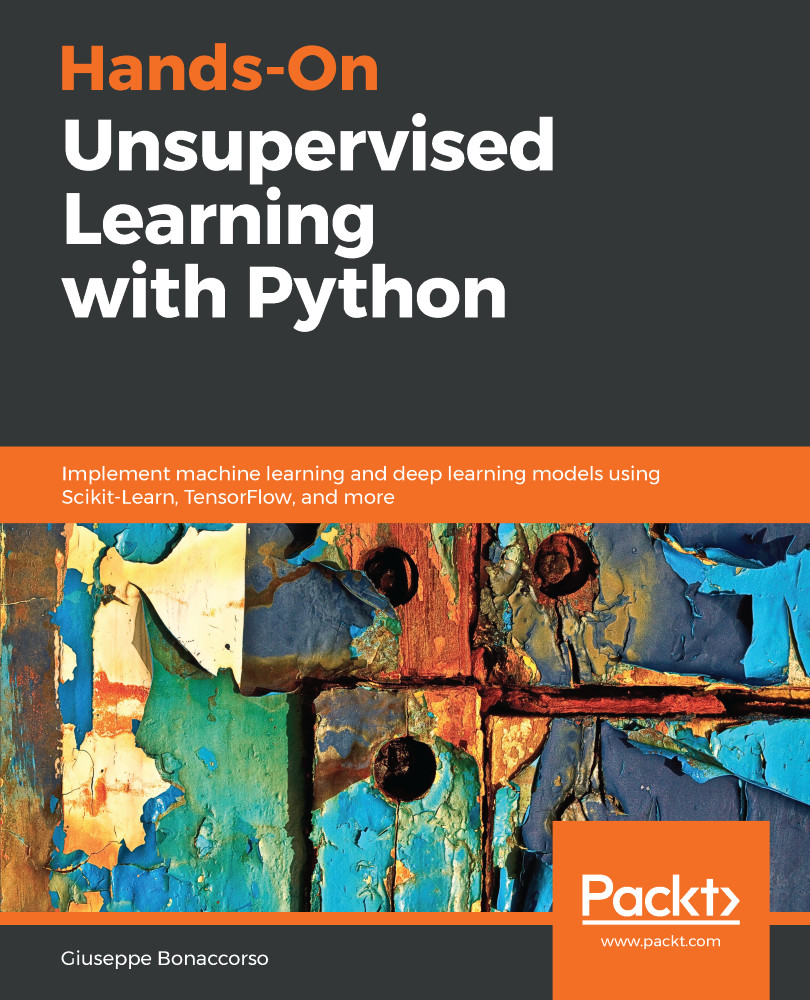
Unsupervised learning is about making use of raw, untagged data and applying learning algorithms to it to help a machine predict its outcome. With this book, you will explore the concept of unsupervised learning to cluster large sets of data and analyze them repeatedly until the desired outcome is found using Python.
This book starts with the key differences between supervised, unsupervised, and semi-supervised learning. You will be introduced to the best-used libraries and frameworks from the Python ecosystem and address unsupervised learning in both the machine learning and deep learning domains. You will explore various algorithms, techniques that are used to implement unsupervised learning in real-world use cases. You will learn a variety of unsupervised learning approaches, including randomized optimization, clustering, feature selection and transformation, and information theory. You will get hands-on experience with how neural networks can be employed in unsupervised scenarios. You will also explore the steps involved in building and training a GAN in order to process images.
By the end of this book, you will have learned the art of unsupervised learning for different real-world challenges.
Table of Contents (12 chapters)
Preface

 Free Chapter
Getting Started with Unsupervised Learning
Clustering Fundamentals
Advanced Clustering
Hierarchical Clustering in Action
Soft Clustering and Gaussian Mixture Models
Anomaly Detection
Dimensionality Reduction and Component Analysis

Unsupervised Neural Network Models
Generative Adversarial Networks and SOMs
Assessments
Other Books You May Enjoy


