
Sign In Start Free Trial
Account

Add to playlist

Create a Playlist

Modal Close icon
You need to login to use this feature.
  • Book Overview & Buying Python Deep Learning
  • Table Of Contents Toc
Python Deep Learning

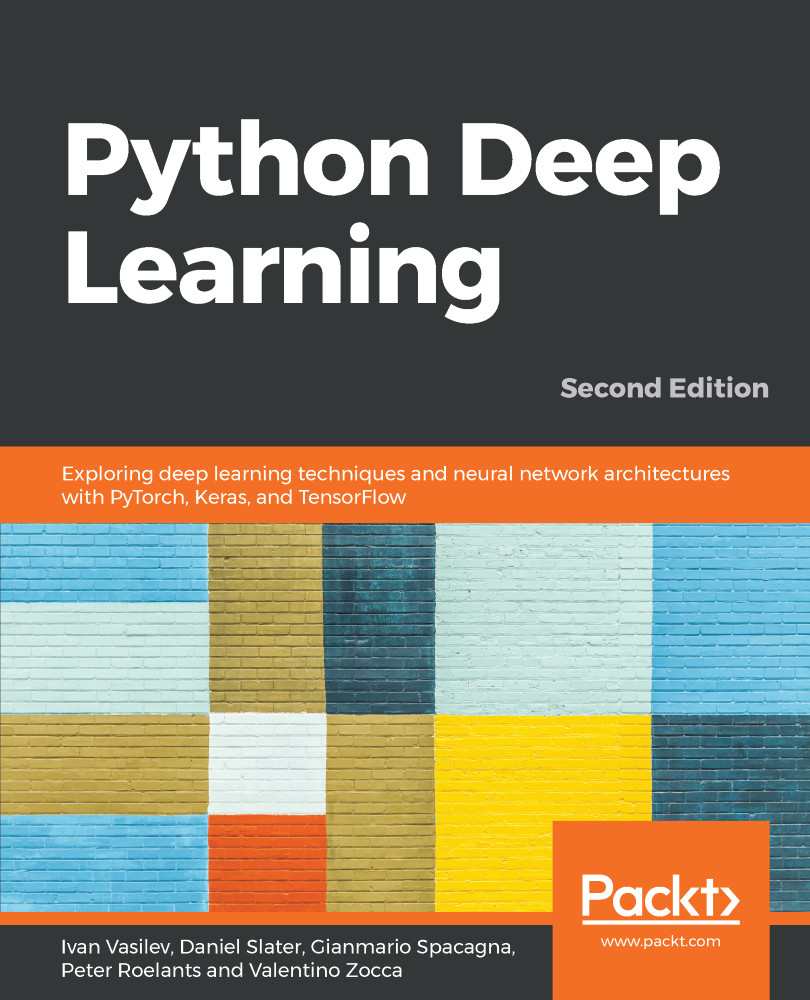
Python Deep Learning - Second Edition

By : Valentino Zocca, Ivan Vasilev, Daniel Slater, Gianmario Spacagna, Peter Roelants
4 (8)
close
close
Python Deep Learning

Python Deep Learning

4 (8)
By: Valentino Zocca, Ivan Vasilev, Daniel Slater, Gianmario Spacagna, Peter Roelants

Overview of this book

With the surge in artificial intelligence in applications catering to both business and consumer needs, deep learning is more important than ever for meeting current and future market demands. With this book, you’ll explore deep learning, and learn how to put machine learning to use in your projects. This second edition of Python Deep Learning will get you up to speed with deep learning, deep neural networks, and how to train them with high-performance algorithms and popular Python frameworks. You’ll uncover different neural network architectures, such as convolutional networks, recurrent neural networks, long short-term memory (LSTM) networks, and capsule networks. You’ll also learn how to solve problems in the fields of computer vision, natural language processing (NLP), and speech recognition. You'll study generative model approaches such as variational autoencoders and Generative Adversarial Networks (GANs) to generate images. As you delve into newly evolved areas of reinforcement learning, you’ll gain an understanding of state-of-the-art algorithms that are the main components behind popular games Go, Atari, and Dota. By the end of the book, you will be well-versed with the theory of deep learning along with its real-world applications.
Table of Contents (12 chapters)
close
close

Recurrent Neural Networks and Language Models

The neural network architectures we discussed in the previous chapters take in fixed sized input and provide fixed sized output. This chapter will lift this constraint by introducing Recurrent Neural Networks (RNNs). RNNs help us deal with sequences of variable length by defining a recurrence relation over these sequences (hence the name).

The ability to process arbitrary sequences of input makes RNNs applicable for natural language processing (NLP) and speech recognition tasks. In fact, RNNs can be applied to any problem since it has been proven that they are Turing complete – theoretically, they can simulate any program that a regular computer would not be able to compute. For example, Google's DeepMind has proposed a model called Differentiable Neural Computer, which can learn how to execute simple algorithms, such...

Visually different images
CONTINUE READING
83
Tech Concepts
36
Programming languages
73
Tech Tools
Icon Unlimited access to the largest independent learning library in tech of over 8,000 expert-authored tech books and videos.
Icon Innovative learning tools, including AI book assistants, code context explainers, and text-to-speech.
Icon 50+ new titles added per month and exclusive early access to books as they are being written.
Python Deep Learning
notes
bookmark Notes and Bookmarks search Search in title playlist Add to playlist download Download options font-size Font size

Change the font size

margin-width Margin width

Change margin width

day-mode Day/Sepia/Night Modes

Change background colour

Close icon Search
Country selected

Close icon Your notes and bookmarks

Confirmation

Modal Close icon
claim successful

Buy this book with your credits?

Modal Close icon
Are you sure you want to buy this book with one of your credits?
Close
YES, BUY

Submit Your Feedback

Modal Close icon
Modal Close icon
Modal Close icon