
Sign In Start Free Trial
Account

Add to playlist

Create a Playlist

Modal Close icon
You need to login to use this feature.
  • Book Overview & Buying Learn T-SQL Querying
  • Table Of Contents Toc
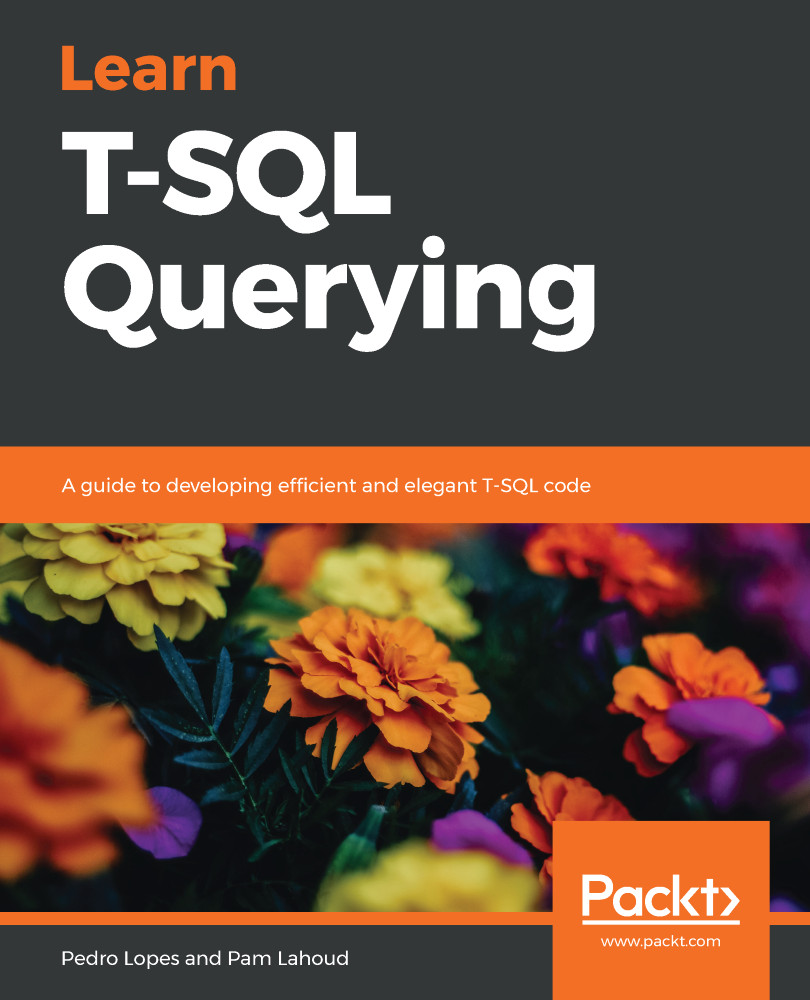
Learn T-SQL Querying

Learn T-SQL Querying

By : Pedro Lopes, Pam Lahoud
4.2 (9)
close
close
Learn T-SQL Querying

Learn T-SQL Querying

4.2 (9)
By: Pedro Lopes, Pam Lahoud

Overview of this book

Transact-SQL (T-SQL) is Microsoft's proprietary extension to the SQL language used with Microsoft SQL Server and Azure SQL Database. This book will be a usefu to learning the art of writing efficient T-SQL code in modern SQL Server versions as well as the Azure SQL Database. The book will get you started with query processing fundamentals to help you write powerful, performant T-SQL queries. You will then focus on query execution plans and leverage them for troubleshooting. In later chapters, you will explain how to identify various T-SQL patterns and anti-patterns. This will help you analyze execution plans to gain insights into current performance, and determine whether or not a query is scalable. You will also build diagnostic queries using dynamic management views (DMVs) and dynamic management functions (DMFs) to address various challenges in T-SQL execution. Next, you will work with the built-in tools of SQL Server to shorten the time taken to address query performance and scalability issues. In the concluding chapters, this will guide you through implementing various features, such as Extended Events, Query Store, and Query Tuning Assistant, using hands-on examples. By the end of the book, you will have developed the skills to determine query performance bottlenecks, avoid pitfalls, and discover the anti-patterns in use.
Table of Contents (18 chapters)
close
close
Lock Free Chapter
1
Section 1: Query Processing Fundamentals
5
Section 2: Dos and Donts of T-SQL
10
Section 3: Assemble Your Query Troubleshooting Toolbox

Query Plan Comparison

Throughout their careers, database professionals are likely to encounter some of the following scenarios:

  • Troubleshooting point-in-time performance regressions. In other words, the scenario where a query had been meeting performance expectations, but after an event it started to slow down. Finding the root cause may uncover opportunities to prevent queries that avoid regressions from reoccurring.
  • Determining what the impact is of rewriting a T-SQL query. For example, when tuning a query, you may be required to rewrite it in part entirely. Does it actually perform better?
  • Determining the impact of changing or adding a schema object such as an index. We discussed how these may be required in the Indexing strategy section of Chapter 5, Writing Elegant T-SQL Queries.

For all these scenarios, typically, we must compare query plans to determine what differences...

CONTINUE READING
83
Tech Concepts
36
Programming languages
73
Tech Tools
Icon Unlimited access to the largest independent learning library in tech of over 8,000 expert-authored tech books and videos.
Icon Innovative learning tools, including AI book assistants, code context explainers, and text-to-speech.
Icon 50+ new titles added per month and exclusive early access to books as they are being written.
Learn T-SQL Querying
notes
bookmark Notes and Bookmarks search Search in title playlist Add to playlist download Download options font-size Font size

Change the font size

margin-width Margin width

Change margin width

day-mode Day/Sepia/Night Modes

Change background colour

Close icon Search
Country selected

Close icon Your notes and bookmarks

Confirmation

Modal Close icon
claim successful

Buy this book with your credits?

Modal Close icon
Are you sure you want to buy this book with one of your credits?
Close
YES, BUY

Submit Your Feedback

Modal Close icon
Modal Close icon
Modal Close icon