


In this chapter, we explored the fundamental theory behind autoencoders at a high level, and conceptualized the underlying mathematics that permits these models to learn. We saw several variations of the autoencoder architecture, including shallow, deep, undercomplete, and overcomplete models. This allowed us to overview considerations related to the representational power of each type of model and their propensity to overfit given too much capacity. We also explored some regularization techniques that let us compensate for the overfitting problem, such as the sparse and contractive autoencoders. Finally, we trained several different types of autoencoder networks, including shallow, deep, and convolutional networks, for the tasks of image reconstruction and denoising. We saw that with very little learning capacity and training time, convolutional autoencoders outperformed...
-
Book Overview & Buying
-
Table Of Contents

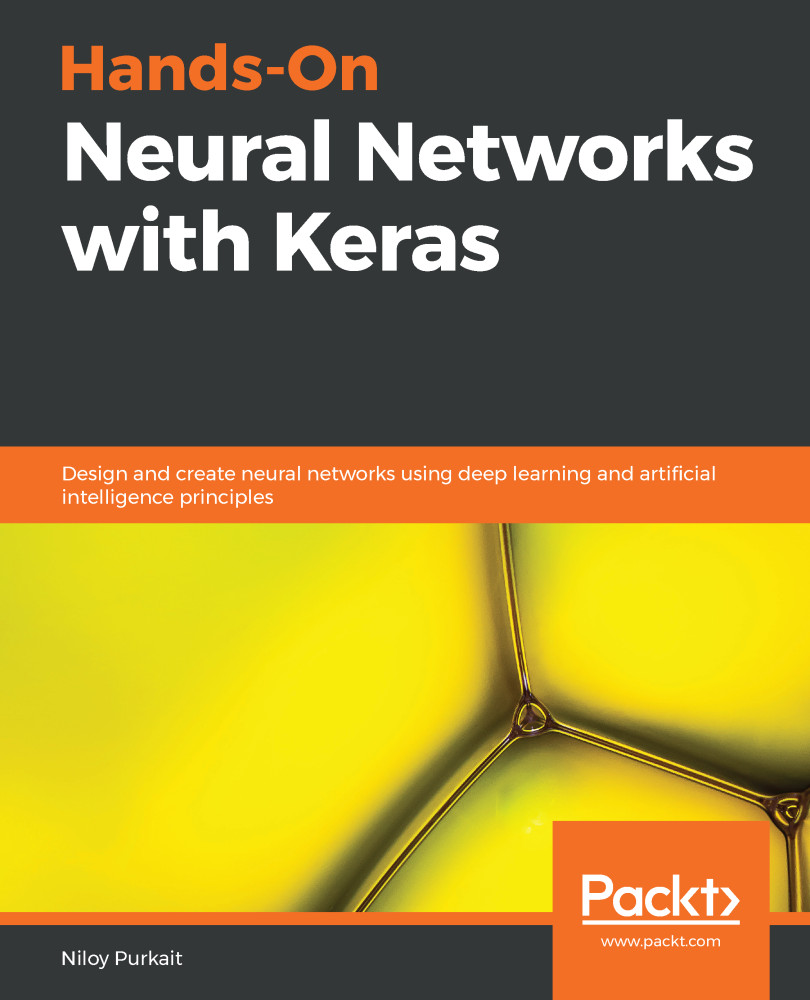
Hands-On Neural Networks with Keras
By :


Hands-On Neural Networks with Keras
By:
Overview of this book
Neural networks are used to solve a wide range of problems in different areas of AI and deep learning.
Hands-On Neural Networks with Keras will start with teaching you about the core concepts of neural networks. You will delve into combining different neural network models and work with real-world use cases, including computer vision, natural language understanding, synthetic data generation, and many more. Moving on, you will become well versed with convolutional neural networks (CNNs), recurrent neural networks (RNNs), long short-term memory (LSTM) networks, autoencoders, and generative adversarial networks (GANs) using real-world training datasets. We will examine how to use CNNs for image recognition, how to use reinforcement learning agents, and many more. We will dive into the specific architectures of various networks and then implement each of them in a hands-on manner using industry-grade frameworks.
By the end of this book, you will be highly familiar with all prominent deep learning models and frameworks, and the options you have when applying deep learning to real-world scenarios and embedding artificial intelligence as the core fabric of your organization.
Table of Contents (16 chapters)
Preface

Overview of Neural Networks
A Deeper Dive into Neural Networks
Signal Processing - Data Analysis with Neural Networks
Section 2: Advanced Neural Network Architectures
Convolutional Neural Networks
Recurrent Neural Networks
Long Short-Term Memory Networks
Reinforcement Learning with Deep Q-Networks
Section 3: Hybrid Model Architecture
Autoencoders

Generative Networks
Section 4: Road Ahead
Contemplating Present and Future Developments
Other Books You May Enjoy


