
Sign In Start Free Trial
Account

Add to playlist

Create a Playlist

Modal Close icon
You need to login to use this feature.
  • Book Overview & Buying Machine Learning for OpenCV 4
  • Table Of Contents Toc
Machine Learning for OpenCV 4

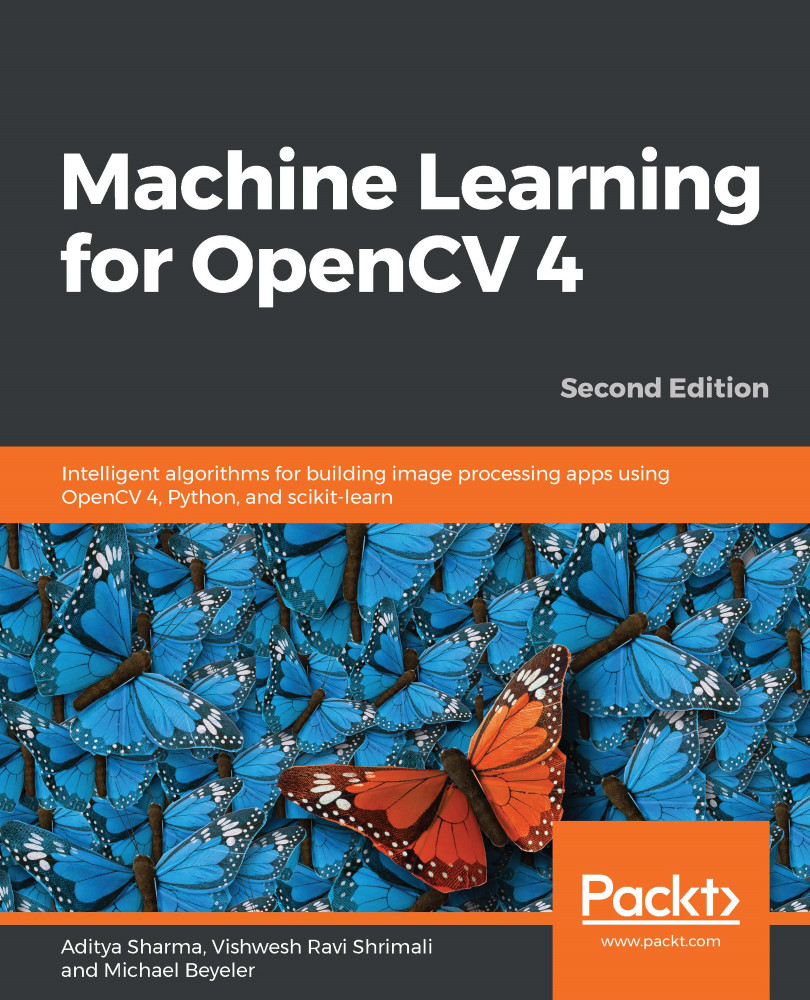
Machine Learning for OpenCV 4 - Second Edition

By : Sharma, Michael Beyeler (USD), Vishwesh Ravi Shrimali , Michael Beyeler
close
close
Machine Learning for OpenCV 4

Machine Learning for OpenCV 4

By: Sharma, Michael Beyeler (USD), Vishwesh Ravi Shrimali , Michael Beyeler

Overview of this book

OpenCV is an opensource library for building computer vision apps. The latest release, OpenCV 4, offers a plethora of features and platform improvements that are covered comprehensively in this up-to-date second edition. You'll start by understanding the new features and setting up OpenCV 4 to build your computer vision applications. You will explore the fundamentals of machine learning and even learn to design different algorithms that can be used for image processing. Gradually, the book will take you through supervised and unsupervised machine learning. You will gain hands-on experience using scikit-learn in Python for a variety of machine learning applications. Later chapters will focus on different machine learning algorithms, such as a decision tree, support vector machines (SVM), and Bayesian learning, and how they can be used for object detection computer vision operations. You will then delve into deep learning and ensemble learning, and discover their real-world applications, such as handwritten digit classification and gesture recognition. Finally, you’ll get to grips with the latest Intel OpenVINO for building an image processing system. By the end of this book, you will have developed the skills you need to use machine learning for building intelligent computer vision applications with OpenCV 4.
Table of Contents (18 chapters)
close
close
Lock Free Chapter
1
Section 1: Fundamentals of Machine Learning and OpenCV
6
Section 2: Operations with OpenCV
11
Section 3: Advanced Machine Learning with OpenCV

Summary

In this chapter, we covered quite a lot of ground, didn't we?

In short, we learned a lot about different supervised learning algorithms, how to apply them to real datasets, and how to implement everything in OpenCV. We introduced classification algorithms such as k-NN and logistic regression and discussed how they could be used to predict labels as two or more discrete categories. We introduced various variants of linear regression (such as Lasso regression and ridge regression) and discussed how they could be used to predict continuous variables. Last but not least, we got acquainted with the Iris and Boston datasets, two classics in the history of machine learning.

In the following chapters, we will go into much greater depth within these topics and explore some more interesting examples of where these concepts can be useful.

But first, we need to talk about another...

CONTINUE READING
83
Tech Concepts
36
Programming languages
73
Tech Tools
Icon Unlimited access to the largest independent learning library in tech of over 8,000 expert-authored tech books and videos.
Icon Innovative learning tools, including AI book assistants, code context explainers, and text-to-speech.
Icon 50+ new titles added per month and exclusive early access to books as they are being written.
Machine Learning for OpenCV 4
notes
bookmark Notes and Bookmarks search Search in title playlist Add to playlist download Download options font-size Font size

Change the font size

margin-width Margin width

Change margin width

day-mode Day/Sepia/Night Modes

Change background colour

Close icon Search
Country selected

Close icon Your notes and bookmarks

Confirmation

Modal Close icon
claim successful

Buy this book with your credits?

Modal Close icon
Are you sure you want to buy this book with one of your credits?
Close
YES, BUY

Submit Your Feedback

Modal Close icon
Modal Close icon
Modal Close icon