
Sign In Start Free Trial
Account

Add to playlist

Create a Playlist

Modal Close icon
You need to login to use this feature.
  • Book Overview & Buying Hands-On Neural Networks with TensorFlow 2.0
  • Table Of Contents Toc
Hands-On Neural Networks with TensorFlow 2.0

Hands-On Neural Networks with TensorFlow 2.0

By : Galeone
3.7 (7)
close
close
Hands-On Neural Networks with TensorFlow 2.0

Hands-On Neural Networks with TensorFlow 2.0

3.7 (7)
By: Galeone

Overview of this book

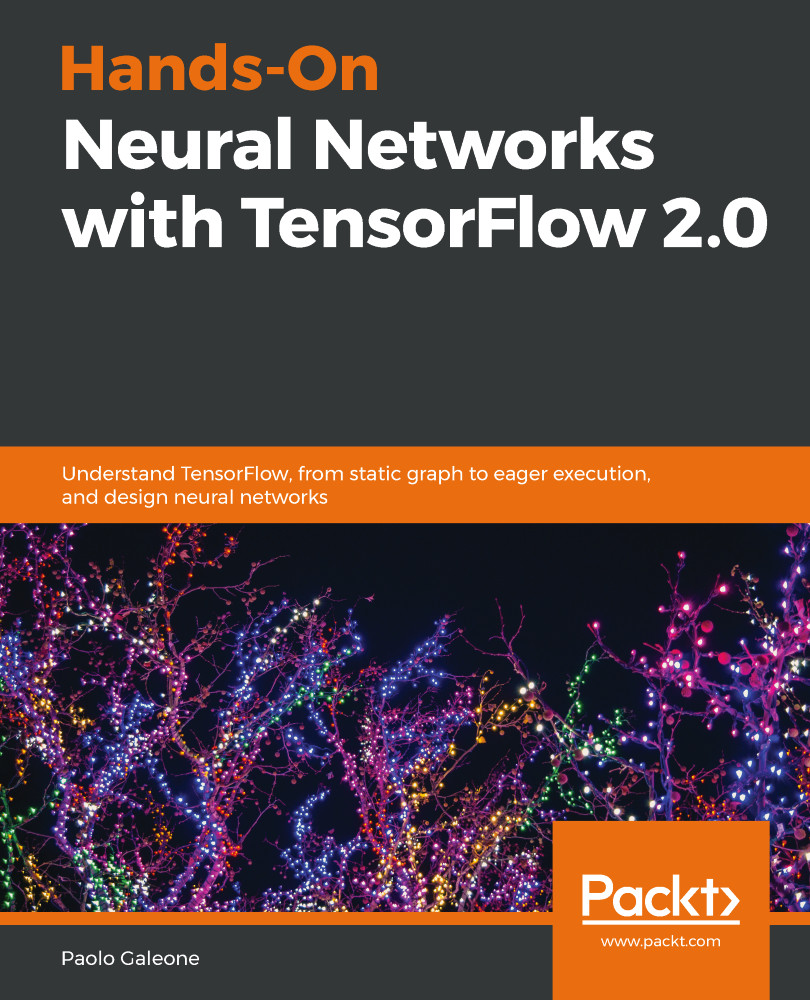
TensorFlow, the most popular and widely used machine learning framework, has made it possible for almost anyone to develop machine learning solutions with ease. With TensorFlow (TF) 2.0, you'll explore a revamped framework structure, offering a wide variety of new features aimed at improving productivity and ease of use for developers. This book covers machine learning with a focus on developing neural network-based solutions. You'll start by getting familiar with the concepts and techniques required to build solutions to deep learning problems. As you advance, you’ll learn how to create classifiers, build object detection and semantic segmentation networks, train generative models, and speed up the development process using TF 2.0 tools such as TensorFlow Datasets and TensorFlow Hub. By the end of this TensorFlow book, you'll be ready to solve any machine learning problem by developing solutions using TF 2.0 and putting them into production.
Table of Contents (15 chapters)
close
close
Lock Free Chapter
1
Section 1: Neural Network Fundamentals
4
Section 2: TensorFlow Fundamentals
8
Section 3: The Application of Neural Networks

Interacting with the graph using Python

Python is the language of choice to train a TensorFlow model; however, after defining a computational graph in Python, there are no constraints regarding using it with another language to execute the learning operations defined.

Always keep in mind that we use Python to define a graph and this definition can be exported in a portable and language-agnostic representation (Protobuf)—this representation can then be used in any other language to create a concrete graph and using it within a session.

The TensorFlow Python API is complete and easy to use. Therefore, we can extend the previous example to measure the accuracy (defining the accuracy measurement operation in the graph) and use this metric to perform model selection.

Selecting the best model means storing the model parameters at the end of each epoch and moving the parameters...

Visually different images
CONTINUE READING
83
Tech Concepts
36
Programming languages
73
Tech Tools
Icon Unlimited access to the largest independent learning library in tech of over 8,000 expert-authored tech books and videos.
Icon Innovative learning tools, including AI book assistants, code context explainers, and text-to-speech.
Icon 50+ new titles added per month and exclusive early access to books as they are being written.
Hands-On Neural Networks with TensorFlow 2.0
notes
bookmark Notes and Bookmarks search Search in title playlist Add to playlist download Download options font-size Font size

Change the font size

margin-width Margin width

Change margin width

day-mode Day/Sepia/Night Modes

Change background colour

Close icon Search
Country selected

Close icon Your notes and bookmarks

Confirmation

Modal Close icon
claim successful

Buy this book with your credits?

Modal Close icon
Are you sure you want to buy this book with one of your credits?
Close
YES, BUY

Submit Your Feedback

Modal Close icon
Modal Close icon
Modal Close icon