Sign In Start Free Trial
Account

Add to playlist

Create a Playlist

Modal Close icon
You need to login to use this feature.
  • Book Overview & Buying TinyML Cookbook
  • Table Of Contents Toc
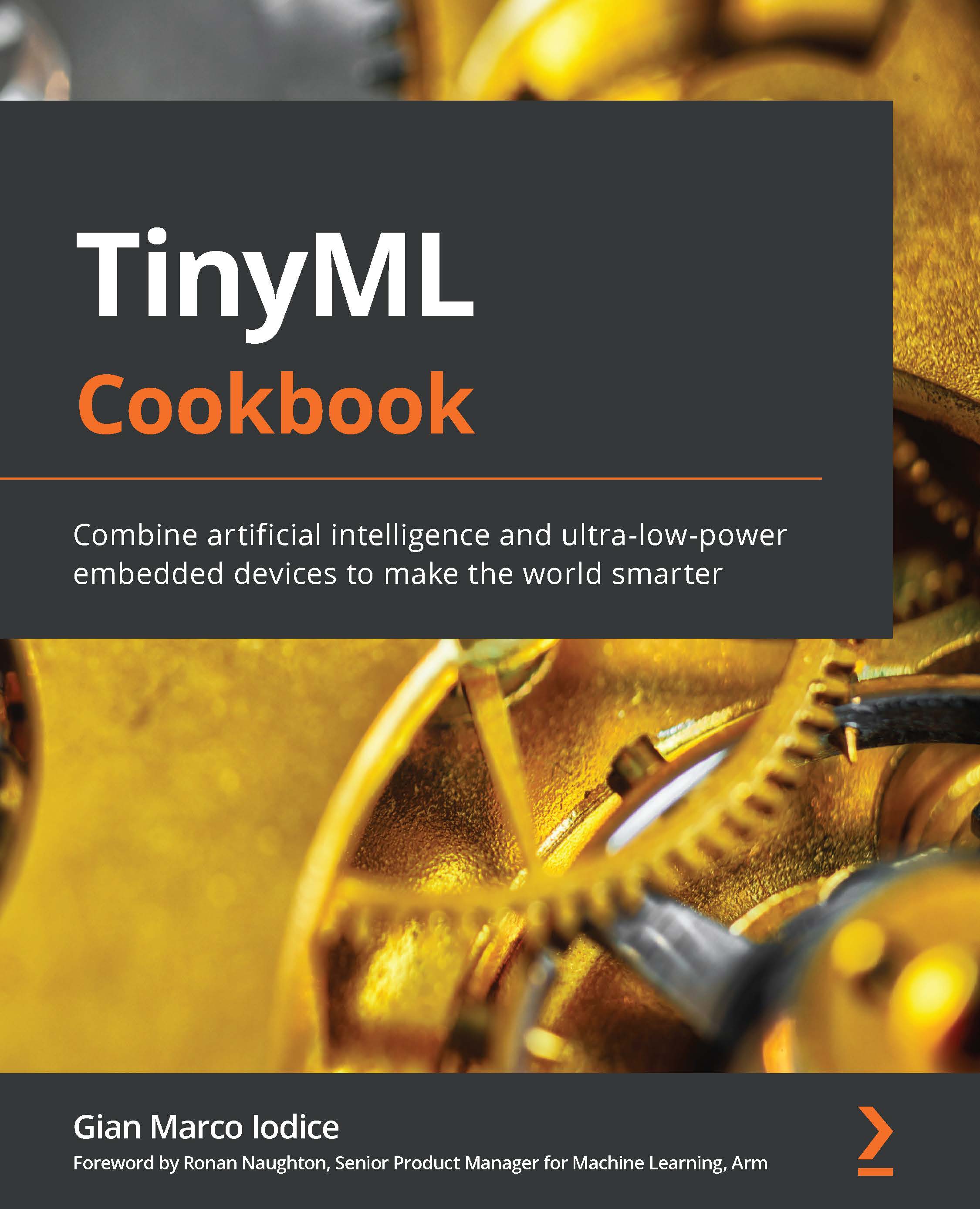
TinyML Cookbook

TinyML Cookbook

By : Gian Marco Iodice
4.9 (11)
close
close
TinyML Cookbook

TinyML Cookbook

4.9 (11)
By: Gian Marco Iodice

Overview of this book

This book explores TinyML, a fast-growing field at the unique intersection of machine learning and embedded systems to make AI ubiquitous with extremely low-powered devices such as microcontrollers. The TinyML Cookbook starts with a practical introduction to this multidisciplinary field to get you up to speed with some of the fundamentals for deploying intelligent applications on Arduino Nano 33 BLE Sense and Raspberry Pi Pico. As you progress, you’ll tackle various problems that you may encounter while prototyping microcontrollers, such as controlling the LED state with GPIO and a push-button, supplying power to microcontrollers with batteries, and more. Next, you’ll cover recipes relating to temperature, humidity, and the three “V” sensors (Voice, Vision, and Vibration) to gain the necessary skills to implement end-to-end smart applications in different scenarios. Later, you’ll learn best practices for building tiny models for memory-constrained microcontrollers. Finally, you’ll explore two of the most recent technologies, microTVM and microNPU that will help you step up your TinyML game. By the end of this book, you’ll be well-versed with best practices and machine learning frameworks to develop ML apps easily on microcontrollers and have a clear understanding of the key aspects to consider during the development phase.
Table of Contents (10 chapters)
close
close

Preface

This book is about tinyML, the technology that allows smartness in a minimally intrusive way using machine learning (ML) on low-powered devices like microcontrollers.

This technology has been around us for many years, for example, in smartwatches, intelligent assistants, and drones, just to name a few. However, today, it is witnessing an incredible growth in all market segments because of the continued success in reducing the complexity of ML model deployment, the proliferation of low-cost devices with extraordinary computing capabilities, and the invaluable contributions from the open-source community. Therefore, tinyML is not a niche technology designed by a few people to solve a few technological problems. Instead, it is a technology in the hands of many developers to solve big real-world problems.

tinyML is an exciting field full of opportunities. With a few tens of dollars, you can give life to objects that interact with the environment smartly and transform how we live for the better. However, this field can be challenging for those unfamiliar with microcontroller programming. Therefore, this book aims to dispel these barriers and demonstrate that tinyML is for everyone through practical examples.

Whether new to this field or looking to expand your ML knowledge, this improved second edition of TinyML Cookbook has something for all. Each chapter is structured to be a self-contained project to learn how to use some of the key tinyML technologies, such as Arduino, CMSIS-DSP, Edge Impulse, emlearn, Raspberry Pi Pico SDK, TensorFlow, TensorFlow Lite for Microcontrollers, and Zephyr.

Your practical journey into tinyML will start with an introduction to this multidisciplinary field and get you up to speed with some of the fundamentals for deploying applications on microcontrollers. For example, you will tackle problems you may encounter while prototyping microcontrollers, such as controlling the LED light or reading the push-button state using the GPIO peripheral.

After preparing for microcontroller programming, you will focus on tinyML projects using real-world sensors. Here, you will employ the temperature, humidity, and three “V” sensors (Voice, Vision, and Vibration) to implement end-to-end smart applications in different scenarios and learn best practices for building models for memory-constrained microcontrollers.

This second edition includes new recipes featuring an LSTM neural network to recognize music genres and the Edge Impulse Faster-Objects-More-Objects (FOMO) algorithm for detecting objects in a scene. These will help you stay updated with the latest developments in the tinyML community.

Finally, you will take your tinyML solutions to the next level with TVM, Arm Ethos-U55 microNPU, on-device learning, and the scikit-learn model deployment on microcontrollers.

TinyML Cookbook is a practical book with a focus on the principles. Although most of the presented projects are based on the Arduino Nano 33 BLE Sense and Raspberry Pi Pico, this second edition also features the SparkFun RedBoard Artemis Nano to help you practice the learned principles on an alternative microcontroller.

Therefore, by the end of this book, you will be well versed in best practices and ML frameworks to develop ML applications easily on microcontrollers.

CONTINUE READING
83
Tech Concepts
36
Programming languages
73
Tech Tools
Icon Unlimited access to the largest independent learning library in tech of over 8,000 expert-authored tech books and videos.
Icon Innovative learning tools, including AI book assistants, code context explainers, and text-to-speech.
Icon 50+ new titles added per month and exclusive early access to books as they are being written.
TinyML Cookbook
notes
bookmark Notes and Bookmarks search Search in title playlist Add to playlist download Download options font-size Font size

Change the font size

margin-width Margin width

Change margin width

day-mode Day/Sepia/Night Modes

Change background colour

Close icon Search
Country selected

Close icon Your notes and bookmarks

Confirmation

Modal Close icon
claim successful

Buy this book with your credits?

Modal Close icon
Are you sure you want to buy this book with one of your credits?
Close
YES, BUY

Submit Your Feedback

Modal Close icon
Modal Close icon
Modal Close icon