


-
Book Overview & Buying
-
Table Of Contents

Practical Deep Learning at Scale with MLflow
By :


Practical Deep Learning at Scale with MLflow
By:
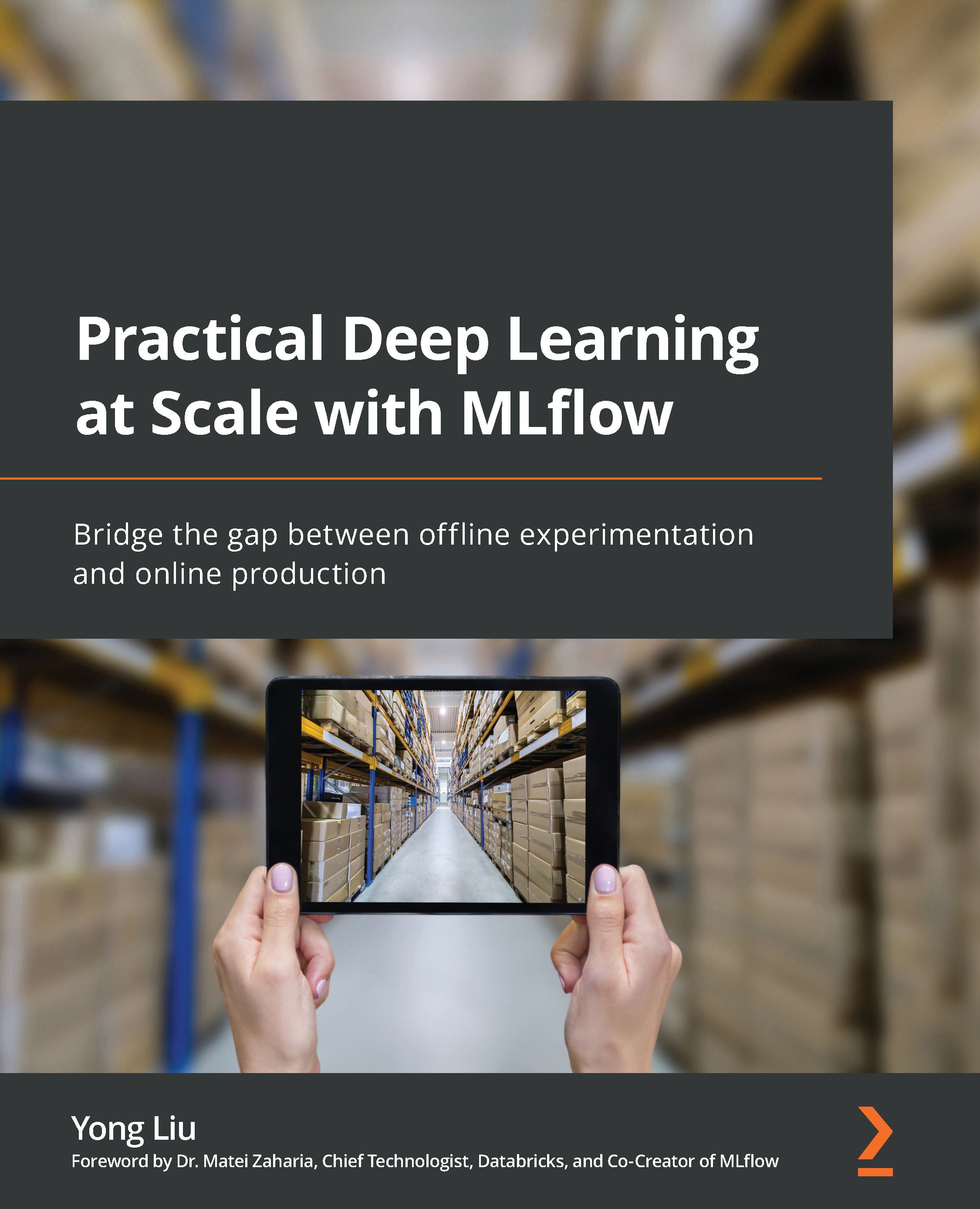
Overview of this book
The book starts with an overview of the deep learning (DL) life cycle and the emerging Machine Learning Ops (MLOps) field, providing a clear picture of the four pillars of deep learning: data, model, code, and explainability and the role of MLflow in these areas.
From there onward, it guides you step by step in understanding the concept of MLflow experiments and usage patterns, using MLflow as a unified framework to track DL data, code and pipelines, models, parameters, and metrics at scale. You’ll also tackle running DL pipelines in a distributed execution environment with reproducibility and provenance tracking, and tuning DL models through hyperparameter optimization (HPO) with Ray Tune, Optuna, and HyperBand. As you progress, you’ll learn how to build a multi-step DL inference pipeline with preprocessing and postprocessing steps, deploy a DL inference pipeline for production using Ray Serve and AWS SageMaker, and finally create a DL explanation as a service (EaaS) using the popular Shapley Additive Explanations (SHAP) toolbox.
By the end of this book, you’ll have built the foundation and gained the hands-on experience you need to develop a DL pipeline solution from initial offline experimentation to final deployment and production, all within a reproducible and open source framework.
Table of Contents (17 chapters)
Preface


Section 1 - Deep Learning Challenges and MLflow Prime
 Free Chapter
Chapter 1: Deep Learning Life Cycle and MLOps Challenges
Chapter 2: Getting Started with MLflow for Deep Learning
Section 2 –
Tracking a Deep Learning Pipeline at Scale
Chapter 3: Tracking Models, Parameters, and Metrics
Chapter 4: Tracking Code and Data Versioning
Section 3 –
Running Deep Learning Pipelines at Scale
Chapter 5: Running DL Pipelines in Different Environments

Chapter 6: Running Hyperparameter Tuning at Scale
Section 4 –
Deploying a Deep Learning Pipeline at Scale
Chapter 7: Multi-Step Deep Learning Inference Pipeline
Chapter 8: Deploying a DL Inference Pipeline at Scale
Section 5 – Deep Learning Model Explainability at Scale
Chapter 9: Fundamentals of Deep Learning Explainability
Chapter 10: Implementing DL Explainability with MLflow
Other Books You May Enjoy


