Sign In Start Free Trial
Account

Add to playlist

Create a Playlist

Modal Close icon
You need to login to use this feature.
  • Book Overview & Buying Practical Deep Learning at Scale with MLflow
  • Table Of Contents Toc
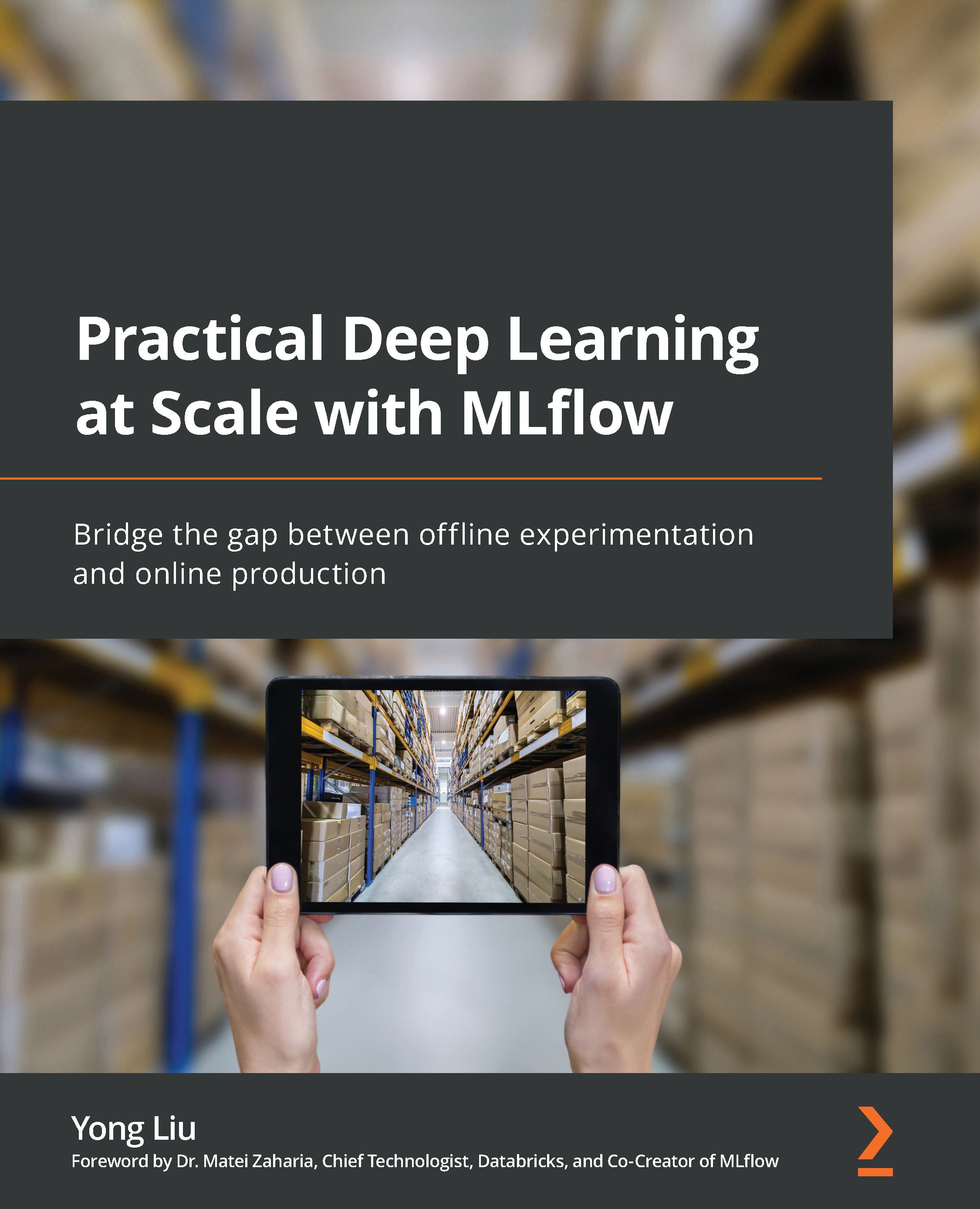
Practical Deep Learning at Scale with MLflow

Practical Deep Learning at Scale with MLflow

By : Yong Liu
4.5 (11)
close
close
Practical Deep Learning at Scale with MLflow

Practical Deep Learning at Scale with MLflow

4.5 (11)
By: Yong Liu

Overview of this book

The book starts with an overview of the deep learning (DL) life cycle and the emerging Machine Learning Ops (MLOps) field, providing a clear picture of the four pillars of deep learning: data, model, code, and explainability and the role of MLflow in these areas. From there onward, it guides you step by step in understanding the concept of MLflow experiments and usage patterns, using MLflow as a unified framework to track DL data, code and pipelines, models, parameters, and metrics at scale. You’ll also tackle running DL pipelines in a distributed execution environment with reproducibility and provenance tracking, and tuning DL models through hyperparameter optimization (HPO) with Ray Tune, Optuna, and HyperBand. As you progress, you’ll learn how to build a multi-step DL inference pipeline with preprocessing and postprocessing steps, deploy a DL inference pipeline for production using Ray Serve and AWS SageMaker, and finally create a DL explanation as a service (EaaS) using the popular Shapley Additive Explanations (SHAP) toolbox. By the end of this book, you’ll have built the foundation and gained the hands-on experience you need to develop a DL pipeline solution from initial offline experimentation to final deployment and production, all within a reproducible and open source framework.
Table of Contents (17 chapters)
close
close
1
Section 1 - Deep Learning Challenges and MLflow Prime
4
Section 2 –
Tracking a Deep Learning Pipeline at Scale
7
Section 3 –
Running Deep Learning Pipelines at Scale
10
Section 4 –
Deploying a Deep Learning Pipeline at Scale
13
Section 5 – Deep Learning Model Explainability at Scale

Preface

Starting from AlexNet in 2012, which won the large-scale ImageNet competition, to the BERT pre-trained language model in 2018, which topped many natural language processing (NLP) leaderboards, the revolution of modern deep learning (DL) in the broader artificial intelligence (AI) and machine learning (ML) community continues. Yet, the challenges of moving these DL models from offline experimentation to a production environment remain. This is largely due to the complexity and lack of a unified open source framework for supporting the full life cycle development of DL. This book will help you understand the big picture of DL full life cycle development, and implement DL pipelines that can scale from a local offline experiment to a distributed environment and online production clouds, with an emphasis on hands-on project-based learning to support the end-to-end DL process using the popular open source MLflow framework.

The book starts with an overview of the DL full life cycle and the emerging machine learning operations (MLOps) field, providing a clear picture of the four pillars of DL (data, model, code, and explainability) and the role of MLflow in these areas. A basic transfer learning-based NLP sentiment model using PyTorch Lightning Flash is built in the first chapter, which is further developed, tuned, and deployed to production throughout the rest of the book. From there onward, it guides you step-by-step to understand the concept of MLflow experiments and usage patterns, using MLflow as a unified framework to track DL data, code and pipeline, model, parameters, and metrics at scale. We'll run DL pipelines in a distributed execution environment with reproducibility and provenance tracking, and tune DL models through hyperparameter optimization (HPO) with Ray Tune, Optuna and HyperBand. We'll also build a multi-step DL inference pipeline with preprocessing and postprocessing steps, deploy a DL inference pipeline for production using Ray Serve and AWS SageMaker, and finally, provide a DL Explanation-as-a-Service using SHapley Additive exPlanations (SHAP) and MLflow integration.

By the end of this book, you'll have the foundation and hands-on experience to build a DL pipeline from initial offline experimentation to final deployment and production, all within a reproducible and open source framework. Along the way, you will also learn the unique challenges with DL pipelines and how we overcome them with practical and scalable solutions such as using multi-core CPUs, graphical processing units (GPUs), distributed and parallel computing frameworks, and the cloud.

CONTINUE READING
83
Tech Concepts
36
Programming languages
73
Tech Tools
Icon Unlimited access to the largest independent learning library in tech of over 8,000 expert-authored tech books and videos.
Icon Innovative learning tools, including AI book assistants, code context explainers, and text-to-speech.
Icon 50+ new titles added per month and exclusive early access to books as they are being written.
Practical Deep Learning at Scale with MLflow
notes
bookmark Notes and Bookmarks search Search in title playlist Add to playlist download Download options font-size Font size

Change the font size

margin-width Margin width

Change margin width

day-mode Day/Sepia/Night Modes

Change background colour

Close icon Search
Country selected

Close icon Your notes and bookmarks

Confirmation

Modal Close icon
claim successful

Buy this book with your credits?

Modal Close icon
Are you sure you want to buy this book with one of your credits?
Close
YES, BUY

Submit Your Feedback

Modal Close icon
Modal Close icon
Modal Close icon