


-
Book Overview & Buying
-
Table Of Contents

LLM Design Patterns
By :


LLM Design Patterns
By:
Overview of this book
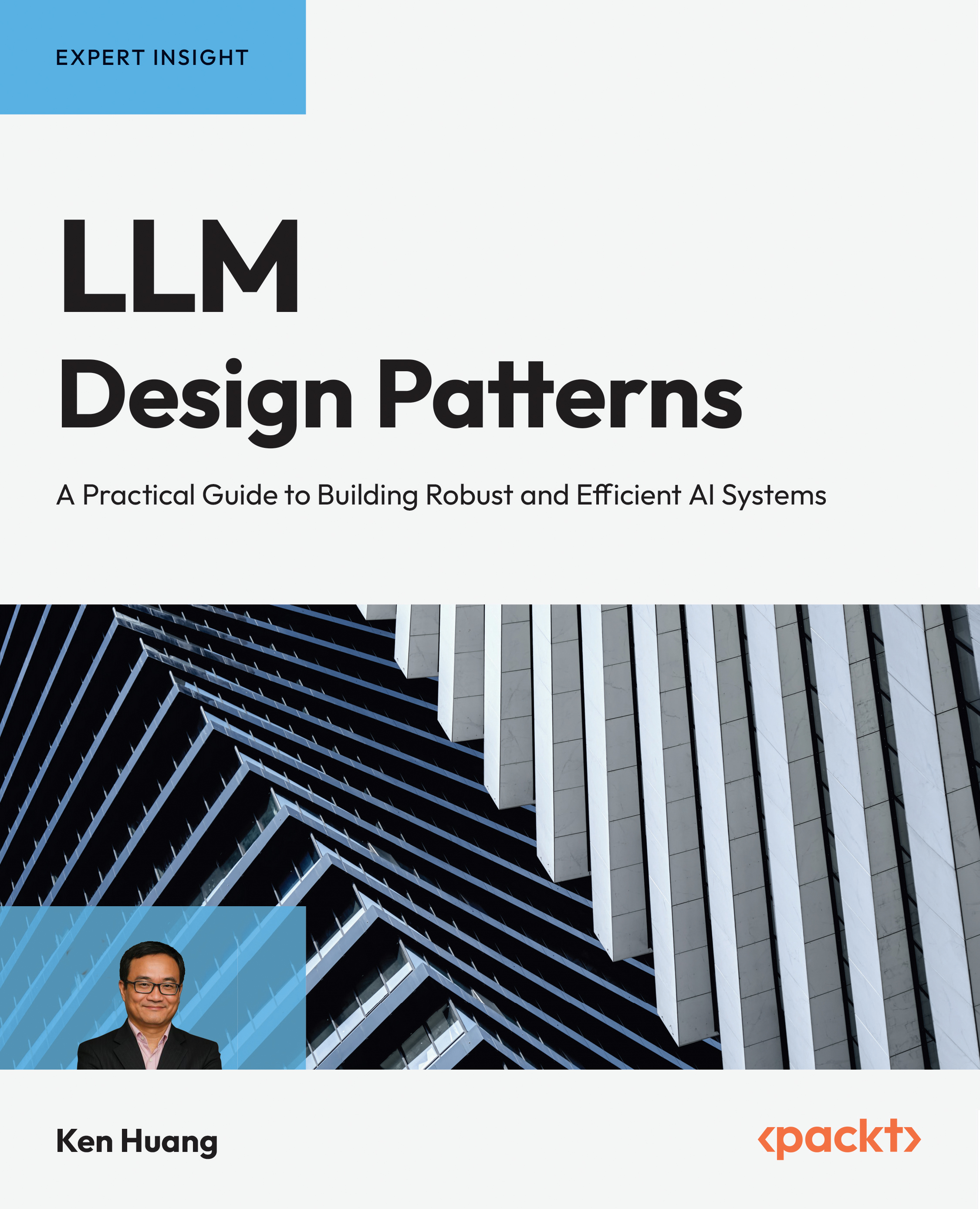
This practical guide for AI professionals enables you to build on the power of design patterns to develop robust, scalable, and efficient large language models (LLMs). Written by a global AI expert and popular author driving standards and innovation in Generative AI, security, and strategy, this book covers the end-to-end lifecycle of LLM development and introduces reusable architectural and engineering solutions to common challenges in data handling, model training, evaluation, and deployment.
You’ll learn to clean, augment, and annotate large-scale datasets, architect modular training pipelines, and optimize models using hyperparameter tuning, pruning, and quantization. The chapters help you explore regularization, checkpointing, fine-tuning, and advanced prompting methods, such as reason-and-act, as well as implement reflection, multi-step reasoning, and tool use for intelligent task completion. The book also highlights Retrieval-Augmented Generation (RAG), graph-based retrieval, interpretability, fairness, and RLHF, culminating in the creation of agentic LLM systems.
By the end of this book, you’ll be equipped with the knowledge and tools to build next-generation LLMs that are adaptable, efficient, safe, and aligned with human values.
Table of Contents (38 chapters)
Preface


Chapter 1: Introduction to LLM Design Patterns
Chapter 2: Data Cleaning for LLM Training
Chapter 3: Data Augmentation
Chapter 4: Handling Large Datasets for LLM Training
Chapter 5: Data Versioning
Chapter 6: Dataset Annotation and Labeling
Part 2: Training and Optimization of Large Language Models
Chapter 7: Training Pipeline
Chapter 8: Hyperparameter Tuning
Chapter 9: Regularization

Chapter 10: Checkpointing and Recovery
Chapter 11: Fine-Tuning
Chapter 12: Model Pruning
Chapter 13: Quantization
Part 3: Evaluation and Interpretation of Large Language Models
Chapter 14: Evaluation Metrics
Chapter 15: Cross-Validation
Chapter 16: Interpretability
Chapter 17: Fairness and Bias Detection
Chapter 18: Adversarial Robustness
Chapter 19: Reinforcement Learning from Human Feedback
Part 4: Advanced Prompt Engineering Techniques
Chapter 20: Chain-of-Thought Prompting
Chapter 21: Tree-of-Thoughts Prompting
Chapter 22: Reasoning and Acting
Chapter 23: Reasoning WithOut Observation
Chapter 24: Reflection Techniques
Chapter 25: Automatic Multi-Step Reasoning and Tool Use
Part 5: Retrieval and Knowledge Integration in Large Language Models
Chapter 26: Retrieval-Augmented Generation
Chapter 27: Graph-Based RAG
Chapter 28: Advanced RAG
Chapter 29: Evaluating RAG Systems
Chapter 30: Agentic Patterns
Index


