Sign In Start Free Trial
Account

Add to playlist

Create a Playlist

Modal Close icon
You need to login to use this feature.
  • Book Overview & Buying Applied Supervised Learning with R
  • Table Of Contents Toc
Applied Supervised Learning with R

Applied Supervised Learning with R

By : Karthik Ramasubramanian, Jojo Moolayil
close
close
Applied Supervised Learning with R

Applied Supervised Learning with R

By: Karthik Ramasubramanian, Jojo Moolayil

Overview of this book

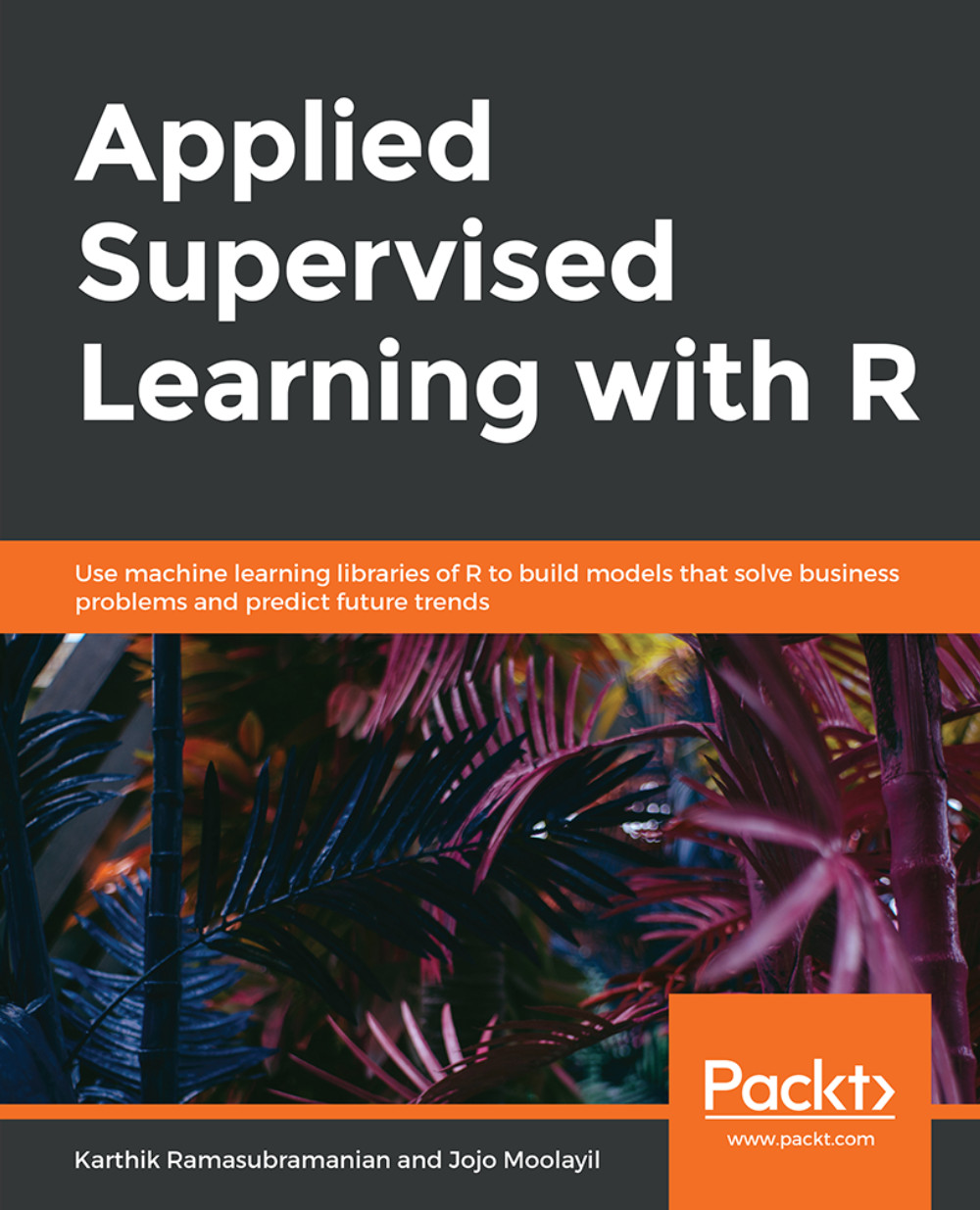
R provides excellent visualization features that are essential for exploring data before using it in automated learning. Applied Supervised Learning with R helps you cover the complete process of employing R to develop applications using supervised machine learning algorithms for your business needs. The book starts by helping you develop your analytical thinking to create a problem statement using business inputs and domain research. You will then learn different evaluation metrics that compare various algorithms, and later progress to using these metrics to select the best algorithm for your problem. After finalizing the algorithm you want to use, you will study the hyperparameter optimization technique to fine-tune your set of optimal parameters. The book demonstrates how you can add different regularization terms to avoid overfitting your model. By the end of this book, you will have gained the advanced skills you need for modeling a supervised machine learning algorithm that precisely fulfills your business needs.
Table of Contents (12 chapters)
close
close
Applied Supervised Learning with R
Preface

Variable Clustering


Variable clustering is used for measuring collinearity, calculating redundancy, and for separating variables into clusters that can be counted as a single variable, thus resulting in data reduction. Hierarchical cluster analysis on variables uses any one of the following: Hoeffding's D statistics, squared Pearson or Spearman correlations, or uses as a similarity measure the proportion of observations for which two variables are both positive. The idea is to find the cluster of correlated variables that are correlated with themselves and not with variables in another cluster. This reduces a large number of features into a smaller number of features or variable clusters.

Exercise 86: Using Variable Clustering

In this exercise, we will use feature clustering for identifying a cluster of similar features. From each cluster, we can select one or more features for the model. We will use the hierarchical cluster algorithm from the Hmisc package in R. The similarity measure should...

CONTINUE READING
83
Tech Concepts
36
Programming languages
73
Tech Tools
Icon Unlimited access to the largest independent learning library in tech of over 8,000 expert-authored tech books and videos.
Icon Innovative learning tools, including AI book assistants, code context explainers, and text-to-speech.
Icon 50+ new titles added per month and exclusive early access to books as they are being written.
Applied Supervised Learning with R
notes
bookmark Notes and Bookmarks search Search in title playlist Add to playlist font-size Font size

Change the font size

margin-width Margin width

Change margin width

day-mode Day/Sepia/Night Modes

Change background colour

Close icon Search
Country selected

Close icon Your notes and bookmarks

Confirmation

Modal Close icon
claim successful

Buy this book with your credits?

Modal Close icon
Are you sure you want to buy this book with one of your credits?
Close
YES, BUY

Submit Your Feedback

Modal Close icon
Modal Close icon
Modal Close icon