
Sign In Start Free Trial
Account

Add to playlist

Create a Playlist

Modal Close icon
You need to login to use this feature.
  • Book Overview & Buying Vulkan Cookbook
  • Table Of Contents Toc
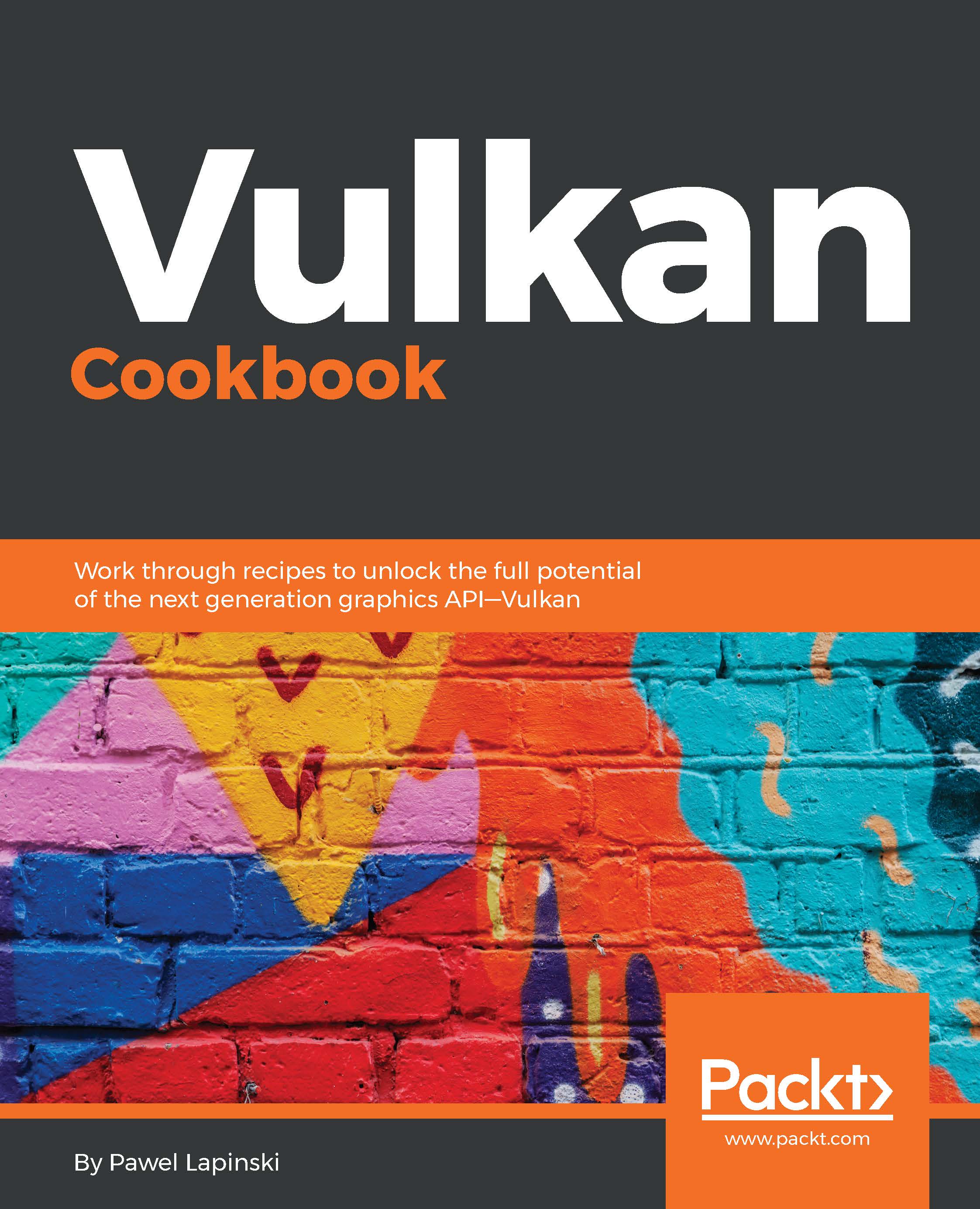
Vulkan Cookbook

Vulkan Cookbook

By : Pawel Lapinski
2.9 (19)
close
close
Vulkan Cookbook

Vulkan Cookbook

2.9 (19)
By: Pawel Lapinski

Overview of this book

Vulkan is the next generation graphics API released by the Khronos group. It is expected to be the successor to OpenGL and OpenGL ES, which it shares some similarities with such as its cross-platform capabilities, programmed pipeline stages, or nomenclature. Vulkan is a low-level API that gives developers much more control over the hardware, but also adds new responsibilities such as explicit memory and resources management. With it, though, Vulkan is expected to be much faster. This book is your guide to understanding Vulkan through a series of recipes. We start off by teaching you how to create instances in Vulkan and choose the device on which operations will be performed. You will then explore more complex topics such as command buffers, resources and memory management, pipelines, GLSL shaders, render passes, and more. Gradually, the book moves on to teach you advanced rendering techniques, how to draw 3D scenes, and how to improve the performance of your applications. By the end of the book, you will be familiar with the latest advanced techniques implemented with the Vulkan API, which can be used on a wide range of platforms.
Table of Contents (13 chapters)
close
close

Instance and Devices

In this chapter, we will cover the following recipes:

  • Downloading Vulkan SDK
  • Enabling validation layers
  • Connecting with a Vulkan Loader library
  • Preparing for loading Vulkan API functions
  • Loading function exported from a Vulkan Loader library
  • Loading global-level functions
  • Checking available Instance extensions
  • Creating a Vulkan Instance
  • Loading instance-level functions
  • Enumerating available physical devices
  • Checking available device extensions
  • Getting features and properties of a physical device
  • Checking available queue families and their properties
  • Selecting the index of a queue family with the desired capabilities
  • Creating a logical device
  • Loading device-level functions
  • Getting a device queue
  • Creating a logical device with geometry shaders and graphics and compute queues
  • Destroying a logical device
  • Destroying a Vulkan Instance
  • Releasing a Vulkan Loader library
Visually different images
CONTINUE READING
83
Tech Concepts
36
Programming languages
73
Tech Tools
Icon Unlimited access to the largest independent learning library in tech of over 8,000 expert-authored tech books and videos.
Icon Innovative learning tools, including AI book assistants, code context explainers, and text-to-speech.
Icon 50+ new titles added per month and exclusive early access to books as they are being written.
Vulkan Cookbook
notes
bookmark Notes and Bookmarks search Search in title playlist Add to playlist download Download options font-size Font size

Change the font size

margin-width Margin width

Change margin width

day-mode Day/Sepia/Night Modes

Change background colour

Close icon Search
Country selected

Close icon Your notes and bookmarks

Confirmation

Modal Close icon
claim successful

Buy this book with your credits?

Modal Close icon
Are you sure you want to buy this book with one of your credits?
Close
YES, BUY

Submit Your Feedback

Modal Close icon
Modal Close icon
Modal Close icon