
Sign In Start Free Trial
Account

Add to playlist

Create a Playlist

Modal Close icon
You need to login to use this feature.
  • Book Overview & Buying Hands-On GPU Programming with Python and CUDA
  • Table Of Contents Toc
Hands-On GPU Programming with Python and CUDA

Hands-On GPU Programming with Python and CUDA

By : Dr. Brian Tuomanen
5 (7)
close
close
Hands-On GPU Programming with Python and CUDA

Hands-On GPU Programming with Python and CUDA

5 (7)
By: Dr. Brian Tuomanen

Overview of this book

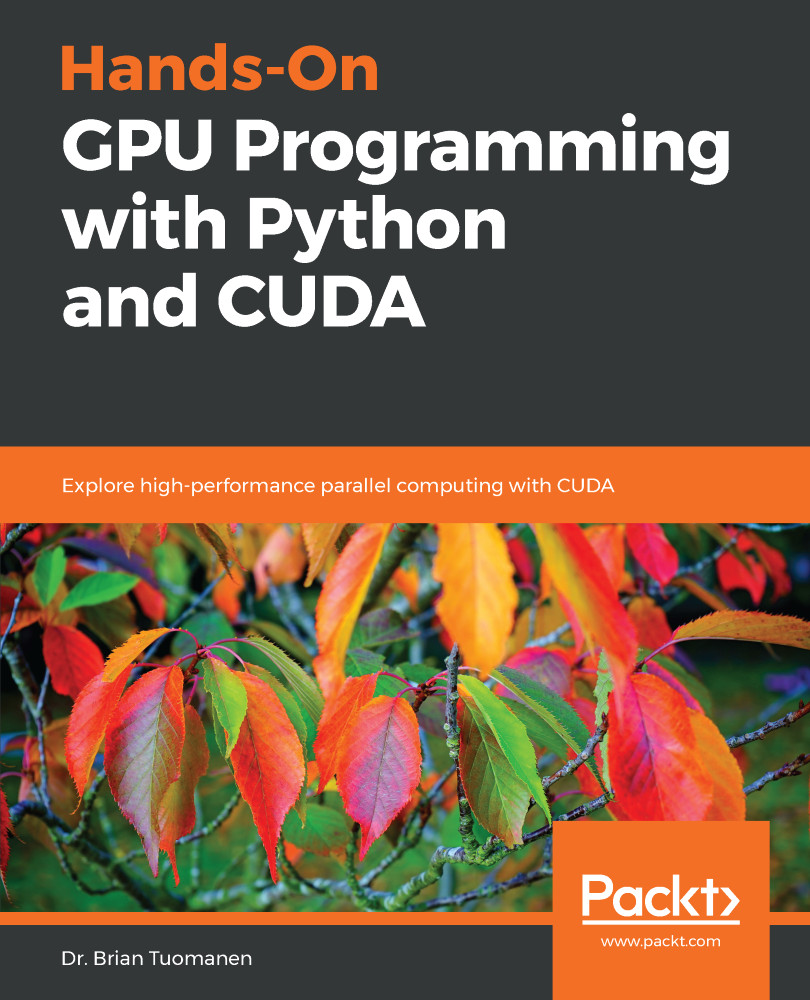
Hands-On GPU Programming with Python and CUDA hits the ground running: you’ll start by learning how to apply Amdahl’s Law, use a code profiler to identify bottlenecks in your Python code, and set up an appropriate GPU programming environment. You’ll then see how to “query” the GPU’s features and copy arrays of data to and from the GPU’s own memory. As you make your way through the book, you’ll launch code directly onto the GPU and write full blown GPU kernels and device functions in CUDA C. You’ll get to grips with profiling GPU code effectively and fully test and debug your code using Nsight IDE. Next, you’ll explore some of the more well-known NVIDIA libraries, such as cuFFT and cuBLAS. With a solid background in place, you will now apply your new-found knowledge to develop your very own GPU-based deep neural network from scratch. You’ll then explore advanced topics, such as warp shuffling, dynamic parallelism, and PTX assembly. In the final chapter, you’ll see some topics and applications related to GPU programming that you may wish to pursue, including AI, graphics, and blockchain. By the end of this book, you will be able to apply GPU programming to problems related to data science and high-performance computing.
Table of Contents (15 chapters)
close
close

Summary

The main advantage of using a GPU over a CPU is its increased throughput, which means that we can execute more parallel code simultaneously on GPU than on a CPU; a GPU cannot make recursive algorithms or nonparallelizable algorithms somewhat faster. We see that some tasks, such as the example of building a house, are only partially parallelizable—in this example, we couldn't speed up the process of designing the house (which is intrinsically serial in this case), but we could speed up the process of the construction, by hiring more laborers (which is parallelizable in this case).

We used this analogy to derive Amdahl's Law, which is a formula that can give us a rough estimate of potential speedup for a program if we know the percentage of execution time for code that is parallelizable, and how many processors we will have to run this code. We then applied Amdahl's Law to analyze a small program that generates the Mandelbrot set and dumps it to an image file, and we determined that this would be a good candidate for parallelization onto a GPU. Finally, we ended with a brief overview of profiling code with the cPython module; this allows us to see where the bottlenecks in a program are, without explicitly timing function calls.

Now that we have a few of the fundamental concepts in place, and have a motivator to learn GPU programming, we will spend the next chapter setting up a Linux- or Windows 10-based GPU programming environment. We will then immediately dive into the world of GPU programming in the following chapter, where we will actually write a GPU-based version of the Mandelbrot program that we saw in this chapter.

CONTINUE READING
83
Tech Concepts
36
Programming languages
73
Tech Tools
Icon Unlimited access to the largest independent learning library in tech of over 8,000 expert-authored tech books and videos.
Icon Innovative learning tools, including AI book assistants, code context explainers, and text-to-speech.
Icon 50+ new titles added per month and exclusive early access to books as they are being written.
Hands-On GPU Programming with Python and CUDA
notes
bookmark Notes and Bookmarks search Search in title playlist Add to playlist download Download options font-size Font size

Change the font size

margin-width Margin width

Change margin width

day-mode Day/Sepia/Night Modes

Change background colour

Close icon Search
Country selected

Close icon Your notes and bookmarks

Confirmation

Modal Close icon
claim successful

Buy this book with your credits?

Modal Close icon
Are you sure you want to buy this book with one of your credits?
Close
YES, BUY

Submit Your Feedback

Modal Close icon
Modal Close icon
Modal Close icon