


- The first two for loops iterate over every pixel, whose outputs are invariant to each other; we can thus parallelize over these two for loops. The third for loop calculates the final value of a particular pixel, which is intrinsically recursive.
- Amdahl's Law doesn't account for the time it takes to transfer memory between the GPU and the host.
- 512 x 512 amounts to 262,144 pixels. This means that the first GPU can only calculate the outputs of half of the pixels at once, while the second GPU can calculate all of the pixels at once; this means the second GPU will be about twice as fast as the first here. The third GPU has more than sufficient cores to calculate all pixels at once, but as we saw in problem 1, the extra cores will be of no use to us here. So the second and third GPUs will be equally fast for this problem.
- One issue with generically...
-
Book Overview & Buying
-
Table Of Contents

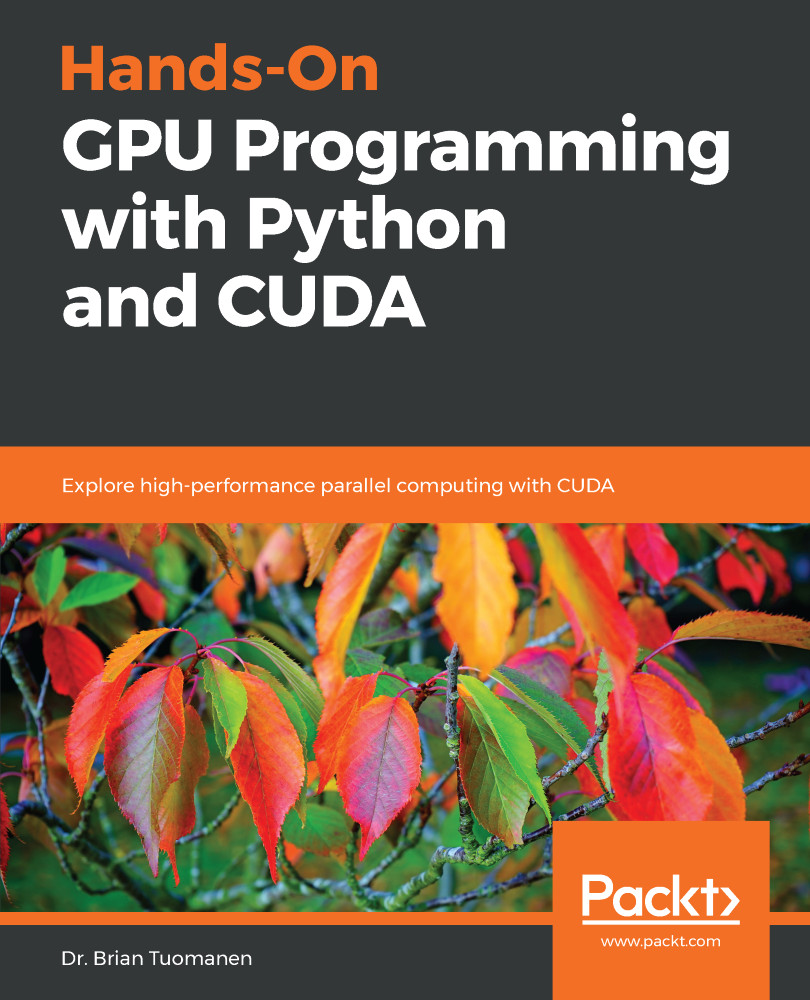
Hands-On GPU Programming with Python and CUDA
By :


Hands-On GPU Programming with Python and CUDA
By:
Overview of this book
Hands-On GPU Programming with Python and CUDA hits the ground running: you’ll start by learning how to apply Amdahl’s Law, use a code profiler to identify bottlenecks in your Python code, and set up an appropriate GPU programming environment. You’ll then see how to “query” the GPU’s features and copy arrays of data to and from the GPU’s own memory.
As you make your way through the book, you’ll launch code directly onto the GPU and write full blown GPU kernels and device functions in CUDA C. You’ll get to grips with profiling GPU code effectively and fully test and debug your code using Nsight IDE. Next, you’ll explore some of the more well-known NVIDIA libraries, such as cuFFT and cuBLAS.
With a solid background in place, you will now apply your new-found knowledge to develop your very own GPU-based deep neural network from scratch. You’ll then explore advanced topics, such as warp shuffling, dynamic parallelism, and PTX assembly. In the final chapter, you’ll see some topics and applications related to GPU programming that you may wish to pursue, including AI, graphics, and blockchain.
By the end of this book, you will be able to apply GPU programming to problems related to data science and high-performance computing.
Table of Contents (15 chapters)
Preface

 Free Chapter
Why GPU Programming?
Setting Up Your GPU Programming Environment
Getting Started with PyCUDA
Kernels, Threads, Blocks, and Grids
Streams, Events, Contexts, and Concurrency
Debugging and Profiling Your CUDA Code
Using the CUDA Libraries with Scikit-CUDA
The CUDA Device Function Libraries and Thrust
Implementation of a Deep Neural Network
Working with Compiled GPU Code
Performance Optimization in CUDA
Where to Go from Here
Assessment

Other Books You May Enjoy


